
Figurative Language Quiz
How the Scales are Structured
Who Usually Takes This Test?
See How You Compare
Below is a preview of how scores are typically distributed across each scale.
Example Questions From the Test
- Euphemism
- Symbolism
- Hyperbole
- Metonymy
- Alliteration
- Onomatopoeia
- Understatement
- Personification
- To change a cold or unfriendly meeting location
- To interrupt the meeting before it formally begins
- To introduce a difficult subject without preparation
- To make people feel more relaxed and willing to talk
Figurative Language Quiz - Description and methodology of the test
Students, teachers, and independent learners can use this figurative language quiz to check whether they distinguish literary devices in meaningful sentences rather than memorize labels alone. Each prompt offers four answer choices, and this figurative-language quiz presents answers to select while its displayed result reports one overall level. It is suited to class revision, close reading, vocabulary building, and focused self-checking.
What This Assessment Explores
The assessment focuses on recognizing how figurative language changes meaning in context. It suits readers who need to distinguish devices that may look similar in definitions but behave differently in a sentence. This assessment is a figurative language review quiz supporting revision, close reading, and terminology in context.
The thematic groups include:
- Comparison shows how metaphor and simile express likeness directly or indirectly.
- Representation shows how symbolism, idiom, allusion, metonymy, and synecdoche substitute one idea or associated detail for another.
- Sound and sensation show how imagery, alliteration, and onomatopoeia shape what a reader hears, sees, or feels.
- Contrast and expression show how paradox, oxymoron, understatement, hyperbole, irony, personification, and apostrophe create emphasis or layered meaning.
Figurative Language Knowledge runs 0-16: Foundation 0-6 reflects basic recognition; Developing 7-12 reflects many distinctions; Strong command 13-16 reflects consistent contextual interpretation.
Methodology and Scientific Basis
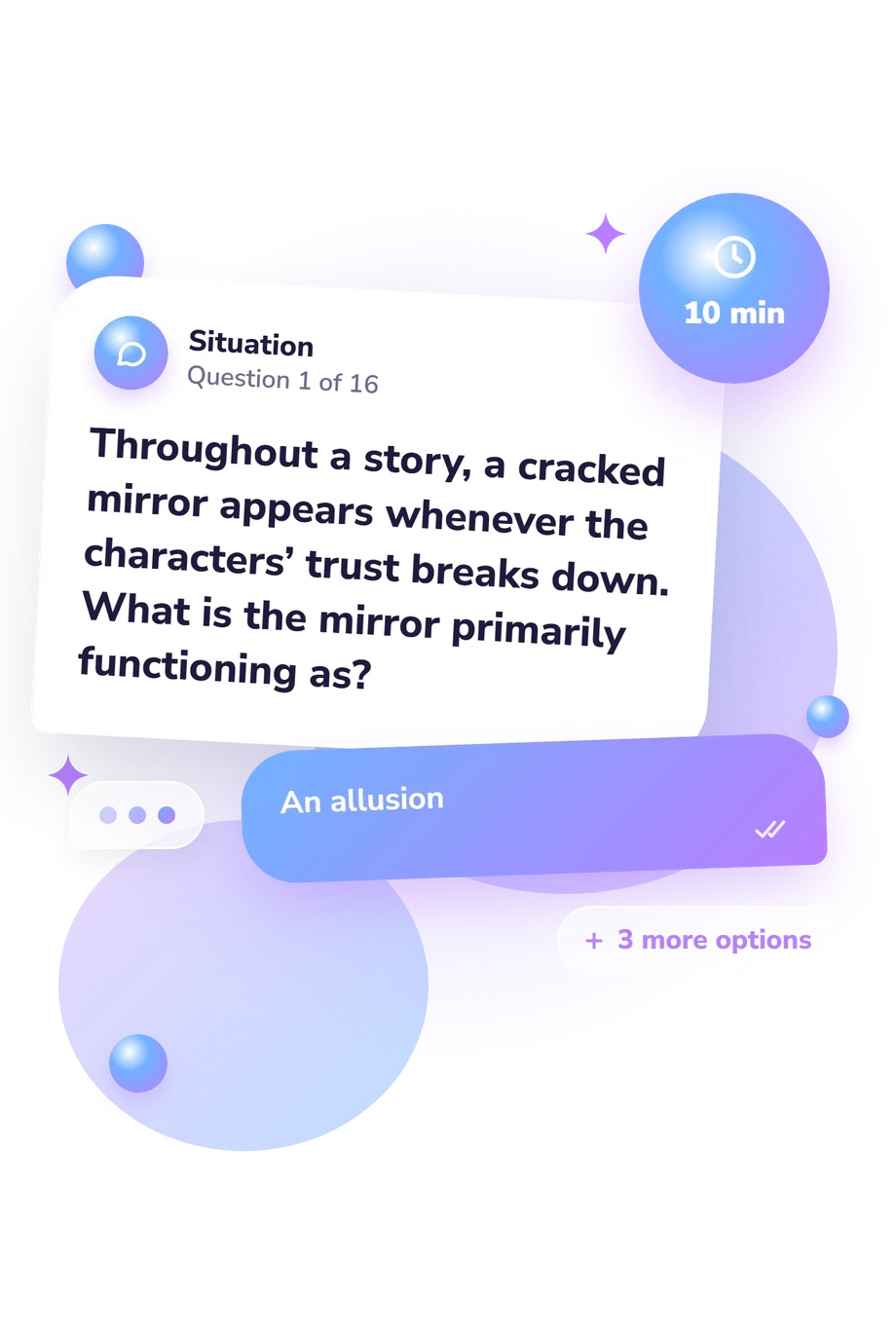
Each item presents a short sentence or situation with four answer choices. Prompts ask you to name a device, identify a relationship between words, or explain a phrase in context. The result reflects recognition of definitions, functions, and distinctions across the examples. Examples range from sound effects and sensory imagery to comparison, substitution, contradiction, and irony.
The questionnaire is conceptually consistent with Smith and Palmer's interpretation test, a conceptual reference point for this comprehension task; it is not a direct adaptation, validation, or restandardization of that instrument. Pollio and Pollio's work on metaphor comprehension, Lanham's rhetorical terminology, and McQuarrie and Mick's analysis of figures supply terminology or conceptual background, not validation evidence for this questionnaire.
This figurative language practice quiz offers a broad result that can indicate whether general review is worthwhile; review device distinctions with fresh examples and compare similar terms in full sentences rather than isolated definitions. The displayed bands describe broad levels of present knowledge rather than item-by-item feedback. Vocabulary familiarity, attention, and learning context can influence performance, so read the result as a snapshot of present knowledge.
- Smith, Edwin H., and Barbara C. Palmer. Smith/Palmer Figurative Language Interpretation Test. 1979. ERIC Document ED236668, 23 pp.
- Pollio, Marilyn R., and Howard R. Pollio. “A Test of Metaphoric Comprehension and Some Preliminary Developmental Data.” Journal of Child Language 6, no. 1 (1979): 111-120. 10.1017/S0305000900007650.
- Lanham, Richard A. A Handlist of Rhetorical Terms: A Guide for Students of English Literature. 2nd ed. Berkeley: University of California Press, 1991.
- McQuarrie, Edward F., and David Glen Mick. “Figures of Rhetoric in Advertising Language.” Journal of Consumer Research 22, no. 4 (1996): 424-438. 10.1086/209459
Updated: