
Does My Child Have PDA Quiz
How the Scales are Structured
Who Usually Takes This Test?
See How You Compare
Below is a preview of how scores are typically distributed across each scale.
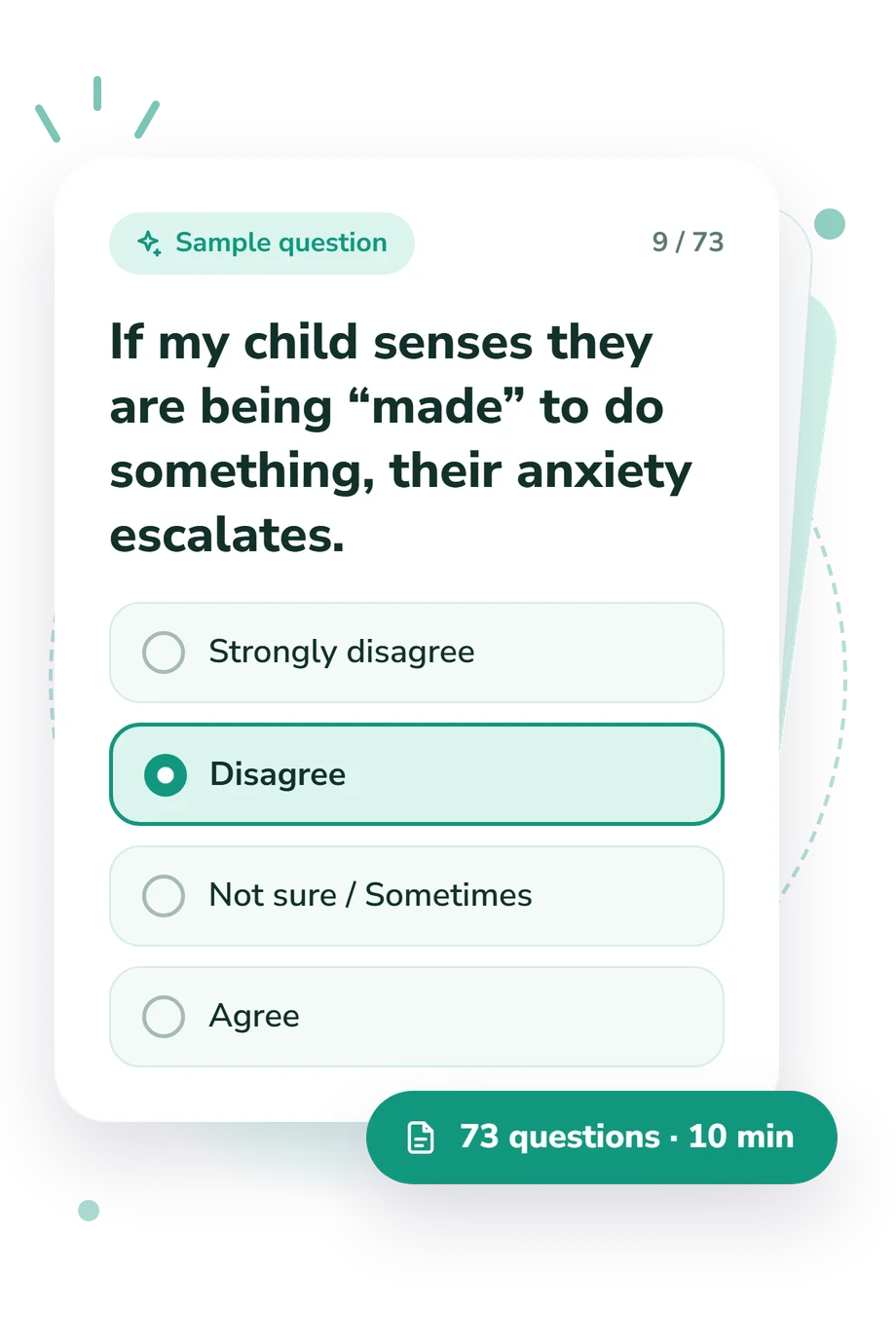
Example Questions From the Test
- Strongly disagree
- Disagree
- Not sure / Sometimes
- Agree
- Strongly disagree
- Disagree
- Not sure / Sometimes
- Agree
- Strongly disagree
- Disagree
- Not sure / Sometimes
- Agree
Does My Child Have PDA Quiz - Description and methodology of the test
For parents trying to understand demand-related distress, the Does My Child Have PDA Quiz offers a structured way to organize observations rather than rely on one difficult moment. It is designed for caregivers who notice avoidance, shutdowns, emotional escalation, or strong reactions to perceived control. This demand avoidance profile can help frame those patterns for calmer reflection and more focused conversations about support.
What This Assessment Explores
The questionnaire examines how a child responds when requests, transitions, limits, or expectations feel controlling, unpredictable, or overwhelming. It suits parents and caregivers who want to organize observations across everyday settings rather than judge one difficult episode.
Its three dimensions describe related patterns:
- Anxiety & Emotional Reactivity (0-30) captures demand-linked anxiety and emotional escalation; bands: Lower 0-10, Moderate 11-20, Higher 21-30.
- Demand Avoidance Intensity (0-40) captures resistance frequency and strength; bands: Low 0-13, Moderate 14-26, High 27-40.
- Need for Control & Autonomy (0-30) captures the drive to direct situations; bands: Lower 0-10, Moderate 11-20, Higher 21-30.
Together, higher scores show stronger expression of the relevant pattern, while the profile indicates the level of each dimension independently; the displayed ranges do not establish a ranking among scales. The profile can help caregivers describe situations associated with demand avoidance in children, including anxiety, emotional reactivity, and a need for control.
Methodology and Evidence Base
Items ask respondents to rate whether situations are true, common, or characteristic, using four-choice formats that move from disagreement to agreement or from “not at all true” to “almost always true.” The questions address demands, transitions, negotiation, shutdown, emotional flooding, and attempts to control people or circumstances. Responses are grouped by dimension, and each displayed total is interpreted through its labelled band, producing a profile rather than a pass/fail outcome.
The questionnaire is conceptually consistent with the Extreme Demand Avoidance Questionnaire (O’Nions et al., 2014), but it is a separate online questionnaire, not a standardized administration of that instrument. O’Nions et al. (2018) examined related dimensions in children reported to have autism and demand-avoidant features, while Kildahl et al. (2021) synthesized the wider evidence and its limitations. This PDA profile quiz uses displayed bands to organize interpretation, not to establish population norms or diagnostic cutoffs.
Scores can reflect current stress, the adult’s perspective, and the setting described. A result is most useful alongside repeated observations and broader assessment of communication, sensory experiences, development, and daily functioning.
- O’Nions, E., Christie, P., Gould, J., Viding, E., & Happé, F. (2014). Development of the ‘Extreme Demand Avoidance Questionnaire’ (EDA-Q): preliminary observations on a trait measure for Pathological Demand Avoidance. Journal of Child Psychology and Psychiatry, 55(7), 758-768. 10.1111/jcpp.12149
- O’Nions, E., Viding, E., Floyd, C., Quinlan, E., Pidgeon, C., Gould, J., & Happé, F. (2018). Dimensions of difficulty in children reported to have an autism spectrum diagnosis and features of extreme/‘pathological’ demand avoidance. Child and Adolescent Mental Health, 23(3), 220-227. 10.1111/camh.12242
- Kildahl, A. N., Helverschou, S. B., Rysstad, A. L., Wigaard, E., Hellerud, J. M. A., Ludvigsen, L. B., & Howlin, P. (2021). Pathological demand avoidance in children and adolescents: A systematic review. Autism, 25(8), 2162-2176. 10.1177/13623613211034382
Updated: