
DNA and RNA Quiz
How the Scales are Structured
Who Usually Takes This Test?
See How You Compare
Below is a preview of how scores are typically distributed across each scale.
Example Questions From the Test
- DNA ligase
- DNA polymerase
- RNA polymerase
- Aminoacyl-tRNA synthetase
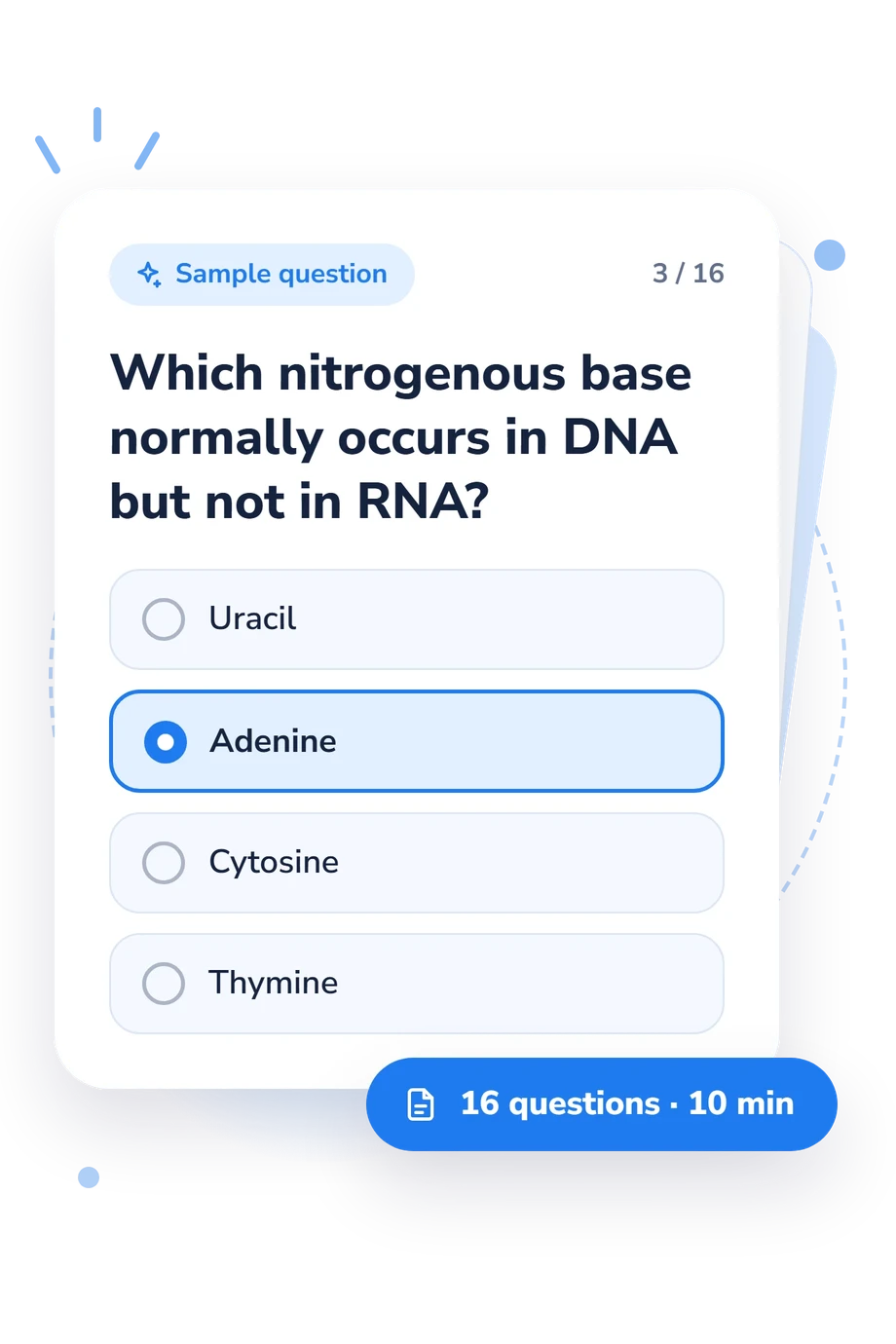
- Uracil
- Adenine
- Cytosine
- Thymine
- 5′-UAC-3′
- 5′-AUG-3′
- 3′-ATG-5′
- 5′-TAC-3′
DNA and RNA Quiz - Description and methodology of the test
Students, educators, and curious learners who want to check their grasp of molecular biology can use the DNA and RNA Quiz to connect foundational facts with mechanism-based reasoning. Presented as a quiz on DNA and RNA, it asks learners to apply enzyme roles, complementary sequences, and information flow between nucleic acids. The questions therefore sample reasoning from molecular clues rather than recognition of familiar terms.
What This Assessment Explores
The questionnaire examines DNA and RNA structure, pairing, replication, transcription, translation, and laboratory applications. It suits learners reviewing molecular biology or preparing for study. As a DNA and RNA practice quiz, it turns terms into problem-solving tasks.
The DNA and RNA Knowledge scale (0-16) reports DNA and RNA knowledge. Building Foundations (0-6) signals that central ideas need strengthening. Developing Knowledge (7-12) shows command with room to consolidate sequence, replication, and gene-expression reasoning. Strong Command (13-16) reflects a well-developed grasp of DNA, RNA, replication, transcription, translation, and related applications.
These groups show the result's dimensions:
- Nucleotide structure and pairing clarify DNA-RNA distinctions and strand direction.
- Replication shows whether enzyme roles, proofreading, leading strands, and Okazaki fragments are understood.
- Gene expression shows understanding of transcription, codons, anticodons, and translation.
- Molecular applications show whether principles transfer to PCR and sequence reasoning.
Methodology and Evidence Base
The questionnaire combines direct concept questions with biological situations and sequence problems, offering four answer choices for each item. Selected items use complementary pairing, antiparallel orientation, and 5′→3′ synthesis to test reasoning about an enzyme, molecule, sequence, or process. Checking reasoning behind selected responses can distinguish understanding from elimination or guessing.
A single visible score summarizes performance, and its displayed interpretation indicates the knowledge level represented by it. This multiple-choice assessment samples connected principles rather than isolated definitions. It also shows whether a learner can transfer a rule to a new sequence or mechanism, not only recall a definition.
The closest conceptual match is the Molecular Genetics Concept Test. This questionnaire is conceptually consistent with that work but is not identified as an adaptation of it. The Central Dogma Concept Inventory and Genetics Concept Assessment offer additional reference points.
Within the RNA quiz, questions cover transcription, pre-mRNA, codons, and translation, alongside DNA structure and replication. Prior instruction, concentration, notation, and distractor interpretation can affect performance, so read the result as a learning snapshot, not proof of comprehensive mastery.
- Sari, Indah Juwita, Pongprapan Pongsophon, Wanwipa Vongsangnak, Pattamaporn Pimthong, and Sasithep Pitiporntapin. “The development of molecular genetics concept test for senior high school students using Rasch analysis.” International Journal of Evaluation and Research in Education 11(4) (2022): 1687-1695. 10.11591/ijere.v11i4.21846
- Newman, Dina L., Christopher W. Snyder, J. Nick Fisk, and L. Kate Wright. “Development of the Central Dogma Concept Inventory (CDCI) Assessment Tool.” CBE-Life Sciences Education 15(2) (2016): ar9. 10.1187/cbe.15-06-0124
- Smith, Michelle K., William B. Wood, and Jennifer K. Knight. “The Genetics Concept Assessment: A New Concept Inventory for Gauging Student Understanding of Genetics.” CBE-Life Sciences Education 7(4) (2008): 422-430. 10.1187/cbe.08-08-0045
Updated: