
Dialect Quiz
How the Scales are Structured
Who Usually Takes This Test?
See How You Compare
Below is a preview of how scores are typically distributed across each scale.
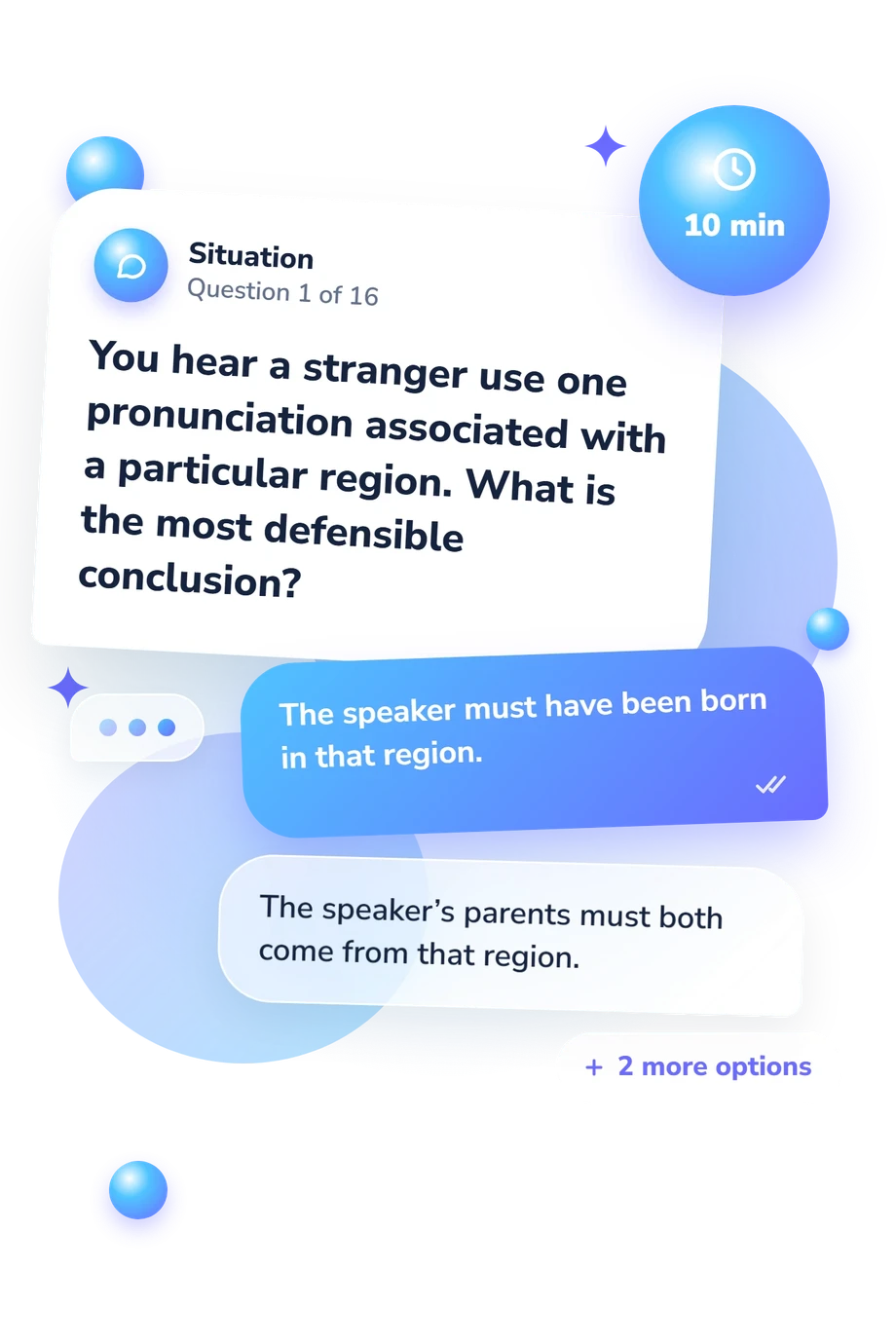
Example Questions From the Test
- The historical route followed by every speaker of a dialect
- A ranking of dialects by their number of speakers
- A phonetic spelling system used to record accents
- A boundary marking where a particular language feature changes
- The pin-pen merger
- The Mary-marry-merry merger
- Canadian raising
- The cot-caught merger
- She began working this Tuesday.
- She is working at this exact moment.
- She might work on one unspecified Tuesday.
- She regularly or characteristically works on Tuesdays.
Dialect Quiz - Description and methodology of the test
For readers who want to understand how speech varies across communities, this dialect quiz offers a compact knowledge check rather than a label for personal identity. An accent quiz perspective appears in the pronunciation items, while the wider assessment asks how grammar, vocabulary, social meaning, and language change work in real speech. The result indicates the strength of your conceptual understanding and points toward useful areas for further study.
What This Assessment Explores
Readers can use the assessment to examine how dialect features operate in speech, whether their interest is academic, educational, or personal. It is a quiz about US dialects, not a way to infer where anyone was born. A regional fit does not prove personal origin, and prestige does not make one variety inherently superior.
The items group their learning targets into four areas:
- Pronunciation and sound patterns show how mergers and rhoticity vary among speakers.
- Grammar and meaning explain habitual be and negative concord without treating difference as error.
- Vocabulary and interaction reveal lexical variation, register, style-shifting, and accommodation.
- Geography and social context connect isoglosses, dialect continua, change, and prestige with communities.
Together, these themes test whether you can interpret examples and distinguish terms. A regional quiz about dialects reports conceptual knowledge, not identity or home region.
Methodology and Evidence Base
Each item presents a prompt with four answer choices. Selecting the most defensible interpretation tests recognition and application of linguistic concepts rather than free-form description. One point is awarded for each correct answer, producing the displayed total.
The single displayed scale is Dialect Knowledge (0-16). Foundations (0-6) marks recognition of core ideas; Developing (7-12) indicates understanding of many patterns; Strong (13-16) indicates well-developed knowledge of variation and social context. This score measures knowledge, not the respondent’s own dialect or region.
Methodologically, the content is conceptually consistent with American English (Wolfram and Schilling, 2016), which treats pronunciation, grammar, vocabulary, regional variation, and social meaning together. Chambers and Trudgill support the treatment of isoglosses, continua, and change; Green provides context for African American English patterns; and Labov links variation with social stratification. An American quiz on dialects uses these concepts without being a direct adaptation or standardized administration of those works. Its descriptive bands and knowledge-check format mean performance may reflect familiarity with terminology and cannot capture every aspect of real-world language use.
- Walt Wolfram and Natalie Schilling. American English: Dialects and Variation. 3rd ed. Wiley-Blackwell, 2016.
- J. K. Chambers and Peter Trudgill. Dialectology. 2nd ed. Cambridge University Press, 1998. 10.1017/CBO9780511805103.
- Lisa J. Green. African American English: A Linguistic Introduction. Cambridge University Press, 2002. 10.1017/CBO9780511800306.
- William Labov. The Social Stratification of English in New York City. 2nd ed. Cambridge University Press, 2006. 10.1017/CBO9780511618208.
Updated: