
Could You Survive in Poverty Quiz
How the Scales are Structured
Who Usually Takes This Test?
See How You Compare
Below is a preview of how scores are typically distributed across each scale.
Example Questions From the Test
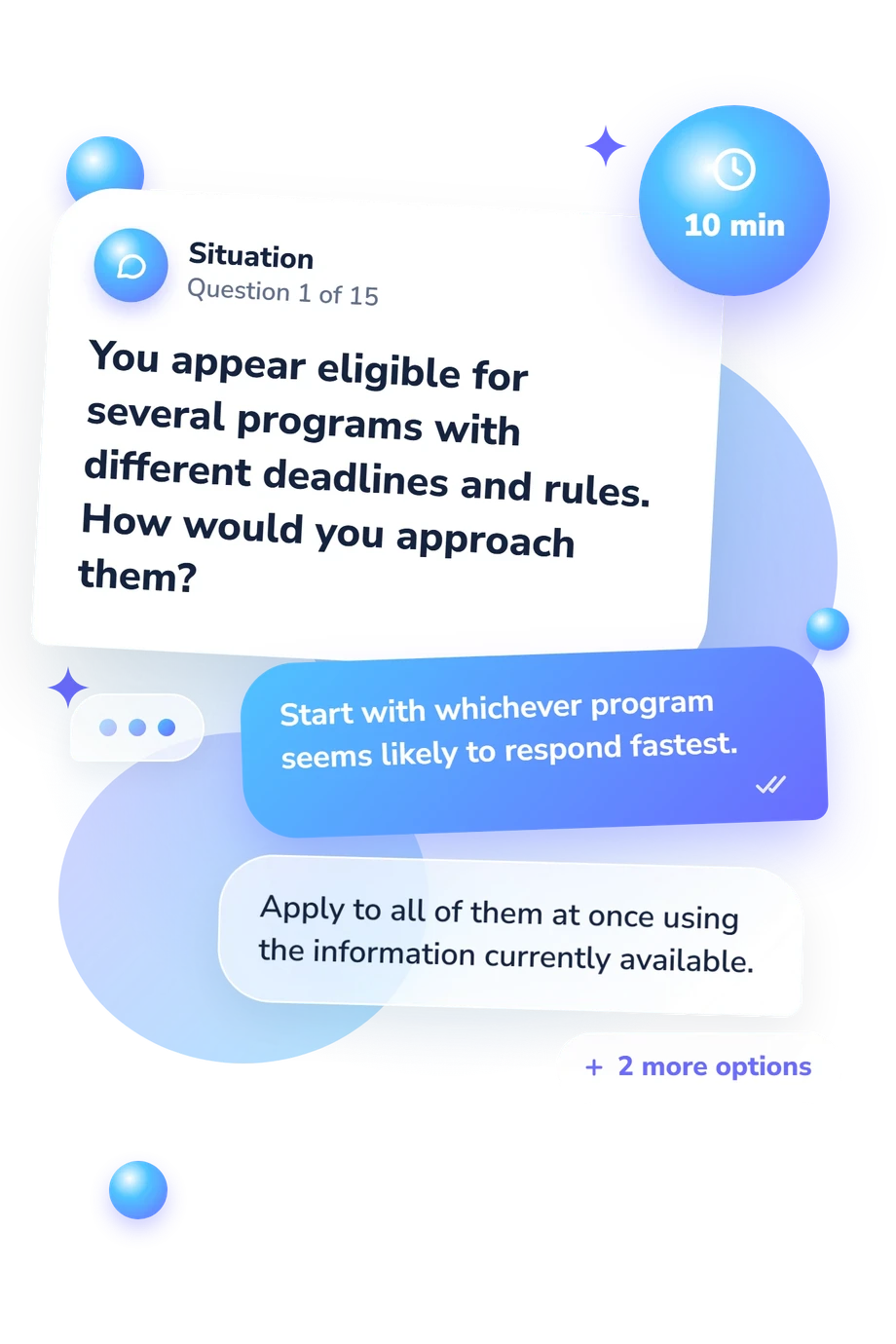
- Start with whichever program seems likely to respond fastest.
- Apply to all of them at once using the information currently available.
- Ask one agency which related programs it recommends pursuing.
- Map eligibility, deadlines, documents, and possible interactions before prioritizing applications.
- Use each good week to cover whichever priorities feel most pressing then.
- Build the monthly budget around your average earnings.
- Set aside essentials from every payment, then treat the remainder flexibly.
- Base commitments on a conservative income level and reserve part of stronger weeks for shortfalls.
- Borrow enough to maintain the current spending pattern until hours return.
- Reduce flexible spending and wait to see how large the income gap becomes.
- Look immediately for extra shifts, temporary work, or small paid tasks.
- Recalculate the cash runway and coordinate expense cuts, assistance options, and replacement income.
Could You Survive in Poverty Quiz - Description and methodology of the test
People considering how they might respond to unstable income, urgent bills, housing changes, or unfamiliar support systems can use this questionnaire to examine decision patterns. The Could You Survive in Poverty Quiz focuses on practical choices when several constraints compete. As a poverty coping quiz, it can highlight habits worth reflecting on without treating them as proof of resilience, income security, or likely outcomes.
What This Assessment Explores
Rather than measuring income or worth, the questionnaire uses scenarios about fluctuating pay, transport, food, utilities, debt, housing, benefits, and caseworker communication. Four options differ in immediacy, preparation, comparison, and follow-through.
Its scenarios give the Ruby Payne hidden rules quiz a practical focus on decisions under pressure, while the result describes response patterns rather than income, eligibility, service access, or housing security.
The profile covers three dimensions:
- Disruption Adaptability (0-15) shows how you respond to sudden changes; Familiar Responses (0-5), Flexible Reaction (6-10), or Structured Adaptation (11-15).
- Scarce-Resource Prioritization (0-15) shows how choices protect essentials and preserve flexibility; Immediate Trade-Offs (0-5), Emerging Priorities (6-10), or Deliberate Triage (11-15).
- Support-System Navigation (0-15) reflects how you locate, document, and follow through with assistance; Familiar Channels (0-5), Active Navigation (6-10), or Systematic Navigation (11-15).
Methodology and Evidence Base
Each scenario offers four response options that differ in immediacy, planning, comparison, and follow-through. Responses are grouped by dimension and placed in the displayed band. Because no per-answer points, population norms, or clinical cutoffs are stated, a scoring formula should not be inferred; this is a structured self-report measure rather than a normed test.
Its conceptual reference is the Could You Survive in Poverty? quiz (Payne, 2005). The questionnaire is conceptually consistent with that work, not a direct adaptation or validated edition. Payne's framework offers language for discussing resources, expectations, and choices, but this online version should not be treated as a standardized implementation of the book.
Bomer, Dworin, May, and Semingson (2008) challenge broad claims associated with Payne's framework, so the scenarios are practical prompts, not evidence that poverty follows one behavioral pattern. For someone taking a Ruby Payne quiz, the useful focus is how choices reveal priorities, alternatives, documentation, and follow-up.
Current stress, prior experience, self-awareness, and response bias can shape results, while local eligibility and available services remain outside the score.
- Payne, Ruby K. (2005). A Framework for Understanding Poverty (4th revised ed.). Highlands, TX: aha! Process, Inc. ISBN 9781929229482.
- Bomer, Randy, Joel E. Dworin, Laura May, and Peggy Semingson. (2008). Miseducating Teachers about the Poor: A Critical Analysis of Ruby Payne's Claims about Poverty. Teachers College Record, 110(12), 2497-2531. 10.1177/016146810811001201.
Updated: