
Cognitive Aptitude Test
How the Scales are Structured
Who Usually Takes This Test?
See How You Compare
Below is a preview of how scores are typically distributed across each scale.
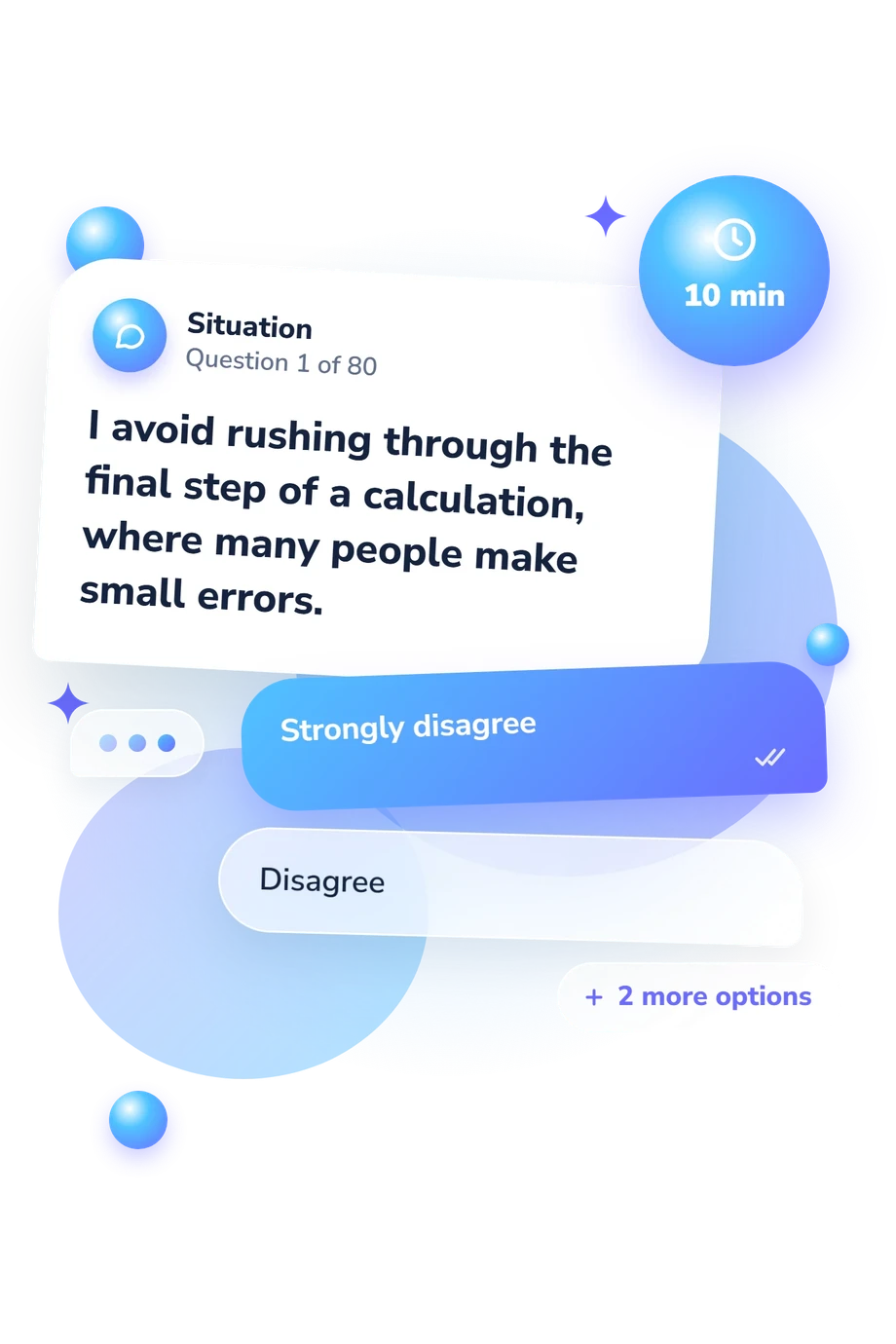
Example Questions From the Test
- Strongly disagree
- Disagree
- Not sure
- Agree
- Strongly disagree
- Disagree
- Agree
- Strongly agree
- Strongly disagree
- Disagree
- Not sure
- Agree
Cognitive Aptitude Test - Description and methodology of the test
People preparing for timed reasoning tasks, workplace assessments, or structured practice can use this cognitive aptitude test to examine how confidently they handle several common problem-solving demands. As preparation for a cognitive ability test for employment, this questionnaire helps respondents identify skills that deserve focused practice. That information can guide a choice about which item types to practise next.
What This Assessment Explores
The statements ask respondents to report perceived accuracy in quantitative work and careful inspection, along with logic, pattern recognition, and verbal reasoning. Its statements cover word problems, rules, contradictions, evidence, constraints, and calculation errors.
The cognitive ability test examples in this questionnaire ask respondents to judge their own accuracy with evidence, logic, and detail, while the result describes perceived consistency and practice priorities.
The profile reports three dimensions:
- Overall Aptitude Score (0-100) combines all question types; higher scores indicate stronger overall aptitude. Bands are Low 0-33, Moderate 34-66, and High 67-100.
- Quant & Detail Accuracy (0-40) measures quantitative thinking and attention-to-detail accuracy; higher scores indicate stronger numerical problem-solving and fewer inspection errors. Bands are Developing 0-15, Proficient 16-28, and Strong 29-40.
- Reasoning Accuracy (0-40) measures logic, pattern recognition, and verbal reasoning; higher scores indicate more consistent correct reasoning. Bands are Developing 0-19, Solid 20-31, and Strong 32-40.
Methodology and Evidence Base
Items are statements about accuracy, reasoning habits, and performance under pressure. Respondents choose Strongly disagree, Disagree, Not sure, Agree, or Strongly agree; some items omit Not sure. The result reports one composite scale and two grouped accuracy scales; displayed ranges do not establish per-answer weighting.
The mix of reasoning, quantitative, verbal, and attention-to-detail items makes this mental aptitude test conceptually consistent with Carroll's (1993) broad ability structure. Hunter (1986) distinguishes general cognitive ability from narrower aptitudes and job knowledge, while Bertua, Anderson, and Salgado (2005) add employment-related meta-analytic context. The questionnaire is conceptually consistent with the cited ability frameworks and employment research, but is not identified as an adaptation of those instruments and has no stated shared norms.
During preparation for a cognitive test for employment, the result supports practice priorities rather than hiring decisions. The questionnaire displays test-level bands; its ranges should not be read as population percentiles or evidence of norms. Self-reported answers can vary with confidence, concentration, familiarity with test formats, and honest self-description, so the bands are test-level categories rather than population percentiles.
- Hunter, John E. (1986). Cognitive ability, cognitive aptitudes, job knowledge, and job performance. Journal of Vocational Behavior, 29(3), 340-362. 10.1016/0001-8791(86)90013-8
- Bertua, Cristina, Neil Anderson, and Jesús F. Salgado. (2005). The predictive validity of cognitive ability tests: A UK meta-analysis. Journal of Occupational and Organizational Psychology, 78(3), 387-409. 10.1348/096317905X26994
- Carroll, John Bissell. (1993). Human cognitive abilities: A survey of factor-analytic studies. Cambridge University Press. 10.1017/CBO9780511571312
Updated: