
Cloud Quiz
How the Scales are Structured
Who Usually Takes This Test?
See How You Compare
Below is a preview of how scores are typically distributed across each scale.
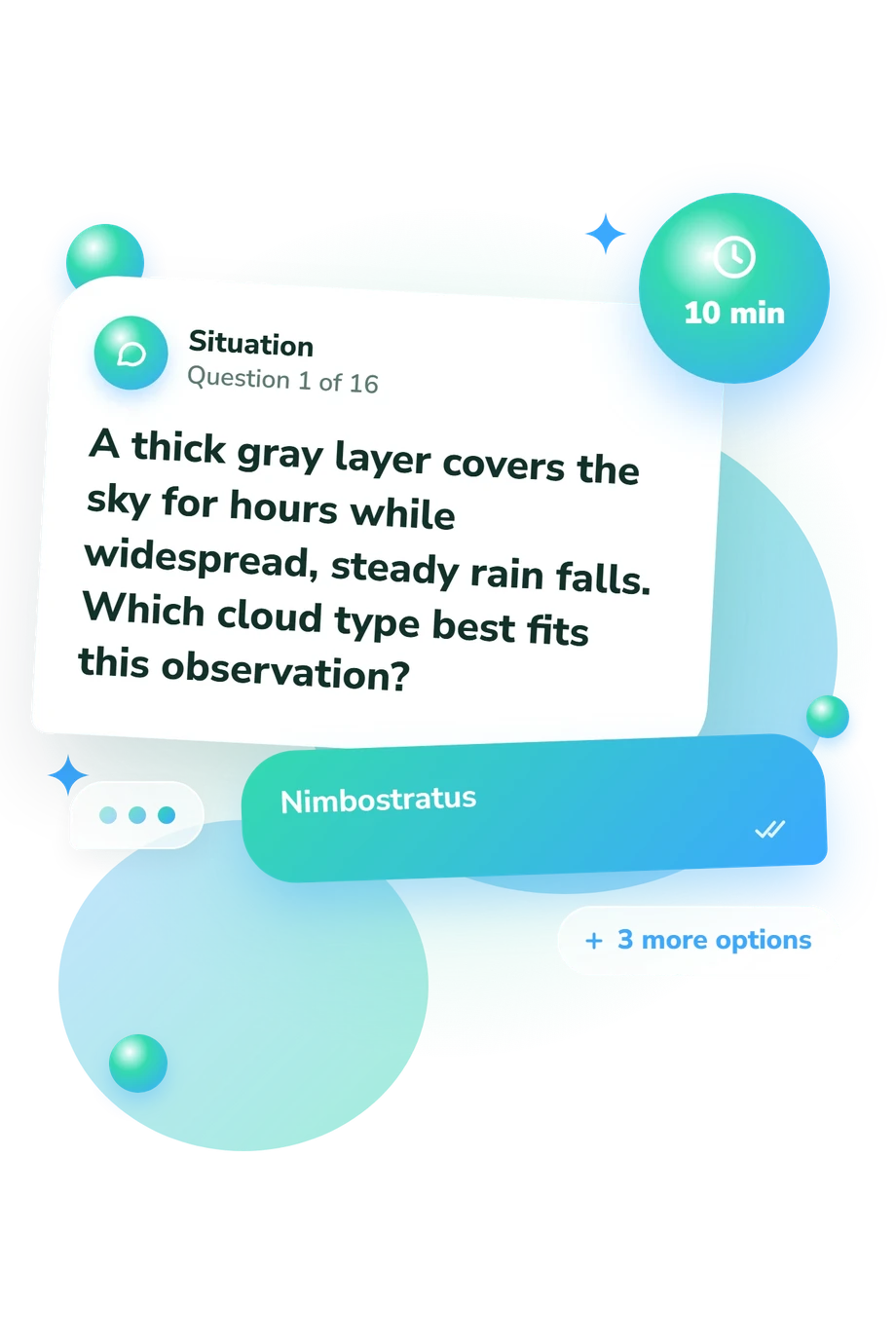
Example Questions From the Test
- Nimbostratus
- Altocumulus
- Cirrus
- Cumulus humilis
- Cumulonimbus
- Cirrostratus
- Altocumulus
- Stratus
- Stratocumulus
- Cirrocumulus
- Altocumulus
- Cirrus
Cloud Quiz - Description and methodology of the test
Readers who want to connect visible sky patterns with basic atmospheric processes can use this cloud quiz as a focused learning check. It is suited to students, weather enthusiasts, and curious observers who want clearer distinctions between cloud families, formation processes, and precipitation clues. Its cloud type quiz format helps learners identify what they know securely and what deserves review.
What This Assessment Explores
Across the items, the assessment examines cloud forms and the processes that shape them. It links altitude, appearance, moisture, temperature, fronts, mountains, and precipitation with likely conditions. The questions support a cloud identification quiz for students, hobbyist observers, and anyone building a vocabulary for reading the sky.
The result is a knowledge profile, not a personality description. It shows how well you distinguish layers, connect structure with formation, and interpret clues such as halos, virga, contrails, steady rain, and thunderstorm anvils.
The catalogue reports one scale: Cloud Knowledge, scored 0-16. Its result bands are:
- Foundations to build (0-6) indicates that core concepts need review.
- Developing knowledge (7-12) shows that common forms are understood, with finer distinctions to strengthen.
- Strong knowledge (13-16) indicates accurate identification across most scenarios.
Methodology and Scientific Basis
Each item presents an observation, mechanism, or weather situation with four answer choices. This is structured multiple-choice knowledge testing: the respondent selects the best identification or explanation rather than rating personal feelings. The displayed score is based on the number of correct answers and is read through the result bands; no extra weighting is implied.
The content is conceptually consistent with International Cloud Atlas (WMO, 2017), which provides descriptive language for cloud genera, altitude groups, visual features, and meteors. Luke Howard’s 1803 classification essay supplies historical logic for familiar forms such as cirrus, cumulus, stratus, and nimbus. These sources provide terminology and subject-matter context, while the questionnaire produces an educational score from its own correct-answer set rather than administering either source instrument.
The result from this types of clouds quiz is a snapshot across educational scenarios. A strong band suggests recognition within this set, while a lower band points to topics for review; it does not establish forecasting skill or professional certification. Performance may vary with prior study, attention, and interpretation of written descriptions, so sky observation and formal instruction remain useful next steps.
- World Meteorological Organization; International Cloud Atlas Task Team, Stephen Cohn, Michael Bruhn, George Anderson, Ernest Lovell, Eliane Thürig-Jenzer, Marinés Campos, Jim Trice, Tam Kwong Hung, and Colleen Rae. (2017). International Cloud Atlas: Manual on the Observation of Clouds and Other Meteors (WMO-No. 407). Geneva: World Meteorological Organization.
- Howard, Luke. (1803). XVIII. On the modifications of clouds, and on the principles of their production, suspension, and destruction; being the substance of an essay read before the Askesian Society in the session 1802-3. The Philosophical Magazine and Journal, 16(62), 97-107. 10.1080/14786440308676310
Updated: