
Chinese Quiz
How the Scales are Structured
Who Usually Takes This Test?
See How You Compare
Below is a preview of how scores are typically distributed across each scale.
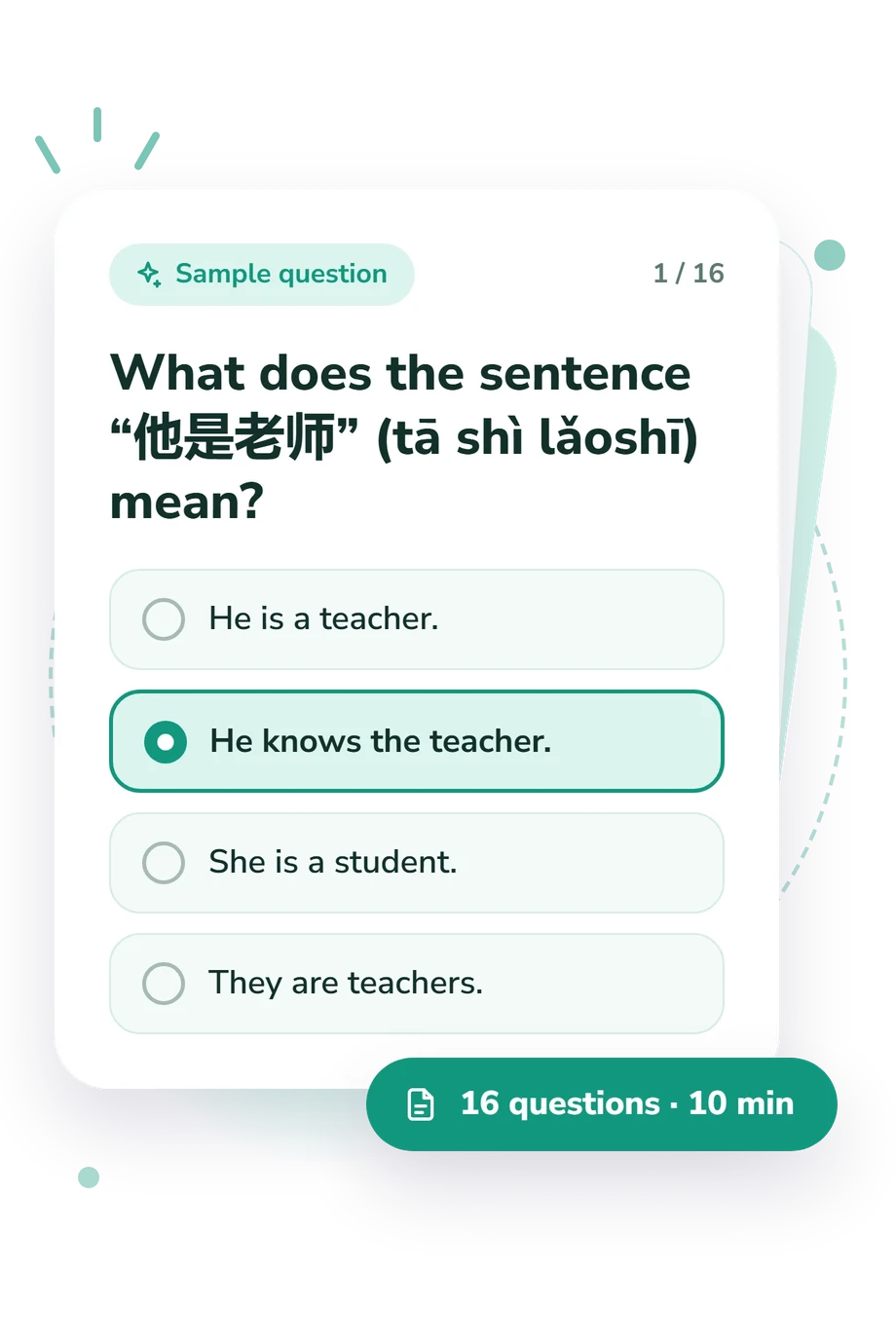
Example Questions From the Test
- He is a teacher.
- He knows the teacher.
- She is a student.
- They are teachers.
- I bought tea.
- I want coffee.
- I like tea.
- He likes tea.
- 你叫什么名字?(Nǐ jiào shénme míngzi?)
- 现在几点?(Xiànzài jǐ diǎn?)
- 多少钱?(Duōshao qián?)
- 厕所在哪里?(Cèsuǒ zài nǎli?)
Chinese Quiz - Description and methodology of the test
For learners beginning Mandarin, the Chinese Quiz offers a focused way to check whether familiar words and short expressions are understood in context. It suits learners who want to use this Chinese vocabulary test to check practical beginner vocabulary and plan their next review, with examples drawn from everyday communication and written character recognition. The result gives a concise picture of current vocabulary knowledge and highlights areas worth revisiting.
What This Assessment Measures
Items use practical recognition rather than extended grammar analysis. They ask learners to translate short sentences, choose words for everyday situations, and identify meanings from Chinese characters and pinyin. The Mandarin quiz therefore suits beginners building a functional base in greetings, family language, shopping, time, numbers, and simple descriptions.
The question themes are:
- Translation items connect a short Mandarin sentence with its English meaning.
- Situational items show vocabulary in requests, replies, and daily exchanges.
- Core-word items cover common nouns, verbs, adjectives, and family terms.
- Time and number items check relative day and time expressions, clock references, and basic numbers.
Results use the Mandarin Vocabulary Knowledge scale, 0-16: Starting foundation (0-6) reflects partial recognition; Developing knowledge (7-12) reflects broader beginner understanding; Strong foundation (13-16) reflects secure knowledge of the sampled items. The result describes written vocabulary performance, not overall fluency.
Methodology and Evidence Base
Each item presents a prompt with four answer choices and one best answer, making the task controlled recognition rather than open-ended production. Prompts ask for translation, meaning, or a word that fits a situation. The single result summarizes performance across these fixed-choice items; it is not divided into separate scores for speaking, listening, grammar, or vocabulary breadth.
The Chinese Vocabulary Proficiency Test, the HSK Level 1 syllabus, and the Mandarin Vocabulary Size Test are relevant comparison points for beginner vocabulary and meaning-focused recognition. They place the content in areas such as linking written forms with meanings, translations, and simple everyday contexts, but they do not define this test's scoring or establish proficiency equivalence.
As a Mandarin vocabulary test, it supports personal study decisions: a lower band signals a need to review the sampled beginner vocabulary, while a higher band indicates stronger command of the sampled set. Recent study, guessing, character familiarity, and pinyin comfort can affect the displayed score, which covers only these written items. Written recognition cannot establish pronunciation, listening, spontaneous speaking, grammar, or broad communicative fluency.
- Zhang, Haiwei, Peng Sun, Yaowaluk Bianglae, and Winda Widiawati. (2024). The development of a Chinese vocabulary proficiency test (CVPT) for learners of Chinese as a second/foreign language. Language Testing, 41(2), 412-442. 10.1177/02655322231219998
- People's Education Press. (2015). HSK Test Syllabus, Level 1. Beijing: People's Education Press. ISBN 978-7-107-30418-7
- Zhao, Ping, and Xiaoli Ji. (2018). Validation of the Mandarin Version of the Vocabulary Size Test. RELC Journal, 49(3), 308-321. 10.1177/0033688216639761
Updated: