
Chinese 5 Elements Personality Quiz
How the Scales are Structured
Who Usually Takes This Test?
See How You Compare
Below is a preview of how scores are typically distributed across each scale.
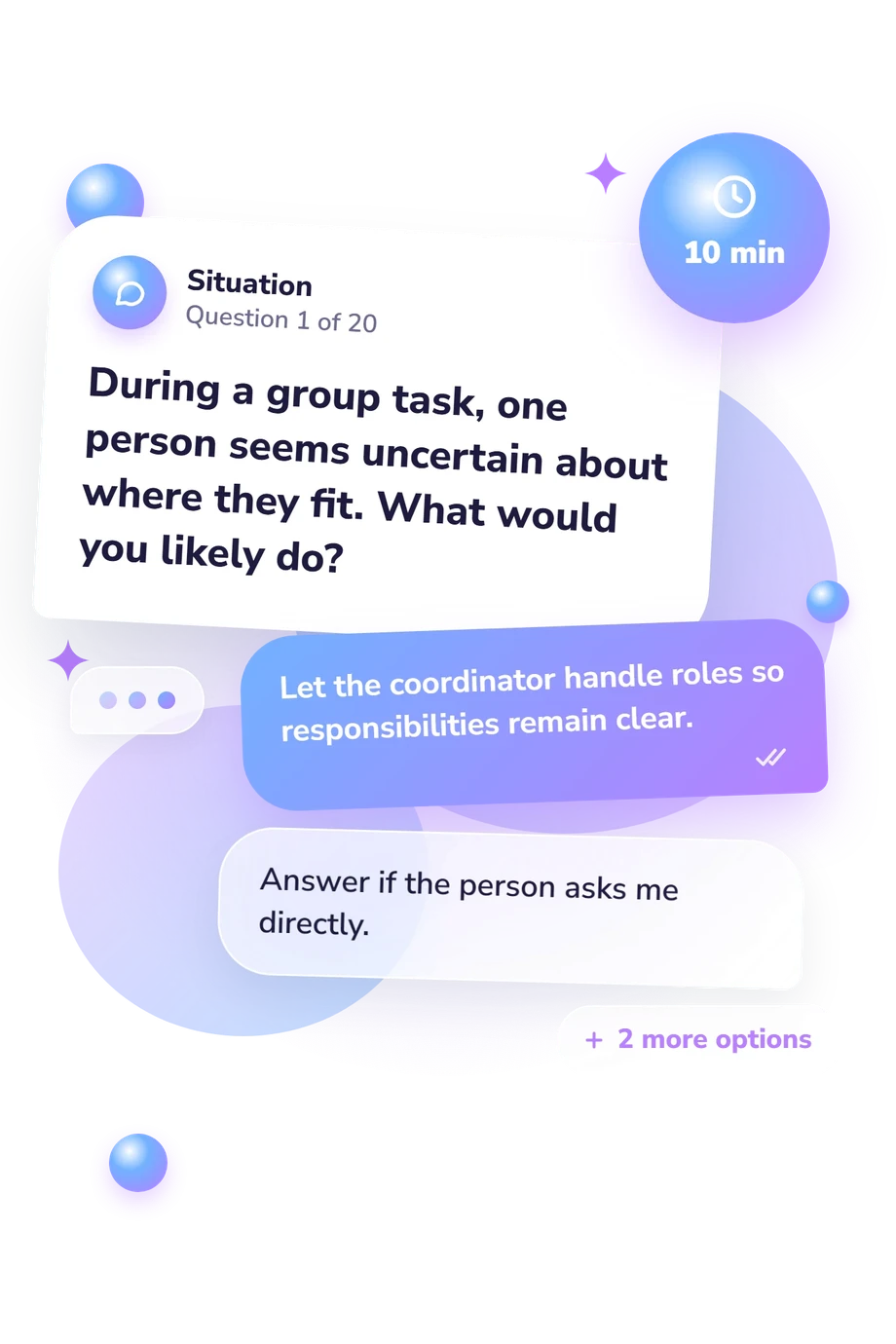
Example Questions From the Test
- Let the coordinator handle roles so responsibilities remain clear.
- Answer if the person asks me directly.
- Check whether they understand the plan and point them toward a useful role.
- Draw them into the group and help them find a role where they feel supported.
- Settle in quietly and let conversations form around me.
- Connect with one or two people who seem approachable.
- Join the livelier exchanges once I understand the mood.
- Bring visible warmth and help create an energetic atmosphere.
- It stays mostly internal until I have considered it carefully.
- I mention it calmly to someone whose opinion I value.
- My voice and manner become noticeably more animated.
- I express it immediately and invite others into the excitement.
Chinese 5 Elements Personality Quiz - Description and methodology of the test
People who want a structured pause before making sense of recurring choices or deciding how to approach a situation may find the Chinese 5 Elements Personality Quiz useful. It is intended for curious respondents seeking language for self-reflection, not a fixed identity. This 5 elements quiz can help them consider which patterns deserve closer attention.
What This Assessment Explores
Five affinities cover uncertainty, structure, expression, care, reflection, boundaries, growth. Scores within one point blend.
The dimensions are:
- Earth Affinity (0-12) measures care and steadiness: Independent Ground (0-4), Supportive Ground (5-8), or Anchoring Earth (9-12).
- Fire Affinity (0-12) measures warmth and excitement: Quiet Ember (0-4), Steady Flame (5-8), or Radiant Fire (9-12).
- Metal Affinity (0-12) measures standards and boundaries: Flexible Form (0-4), Shaped Metal (5-8), or Refined Metal (9-12).
- Water Affinity (0-12) measures observation and adaptation: Direct Current (0-4), Responsive Water (5-8), or Deep Water (9-12).
- Wood Affinity (0-12) measures development: Rooted Elsewhere (0-4), Growing Wood (5-8), or Flourishing Wood (9-12).
For readers, this chinese medicine elements quiz compares relationship, communication, and change patterns without assigning a single type.
Methodology and Scientific Basis
Each item presents an everyday situation with four response options. The choices represent approaches such as direct action, structure, expressiveness, practical support, adaptation, and inward processing. Choosing the response that feels most characteristic keeps the method self-report based; no answer is inherently correct.
In this five elements quiz, the five affinities are reported independently. Compare them, especially near-ties, rather than combine them into one total; the labels describe relative tendencies, not severity.
The published Revised Five Element Personality Questionnaire (R-5EPQ) was evaluated by Aplin-Houtz and colleagues (2023) within the Traditional Chinese Medicine five-element framework. This questionnaire is conceptually consistent with that instrument but is not a direct adaptation of it. Li Jia Jia and colleagues (2023) add qualitative context for describing five-element traits, while Dahlin (2016) presents a contemporary relationship-oriented account of the framework.
In this tcm element quiz, self-reported results can shift with current circumstances, interpretation of a scenario, and willingness to answer candidly. No population norms or diagnostic thresholds are stated, so the bands are descriptive categories for broader personal reflection.
- Aplin-Houtz, Matthew, Emily Lane, Sean Leahy, Sarah Willey, and April Rowsey. "The Other Big Five: an Evaluation and Validation of a Measure for the Five Elements of Personality from Traditional Chinese Medicine." Proceedings of the Twelfth International Conference on Engaged Management Scholarship, 2023. 10.2139/ssrn.4322693
- Li Jia Jia, Yang Xin Yu, Zhang Hong Jun, Yin Dong Qing, Zhang Jin Tao, Cui Jing Wen, Han Jing Dong, Ma Yan, and Jia Hong Xiao. "The Psychosomatic Traits of ‘People with the Five Elements in Traditional Chinese Medicine’: A Qualitative Study." Biomedical and Environmental Sciences, 36(11), 1068-1078, 2023. 10.3967/bes2023.136
- Dahlin, Dondi. "The Five Elements: Understand Yourself and Enhance Your Relationships with the Wisdom of the World’s Oldest Personality Type System." TarcherPerigee, 2016. ISBN 9780399176296
Updated: