
Butch or Femme Quiz
How the Scales are Structured
Who Usually Takes This Test?
See How You Compare
Below is a preview of how scores are typically distributed across each scale.
Example Questions From the Test
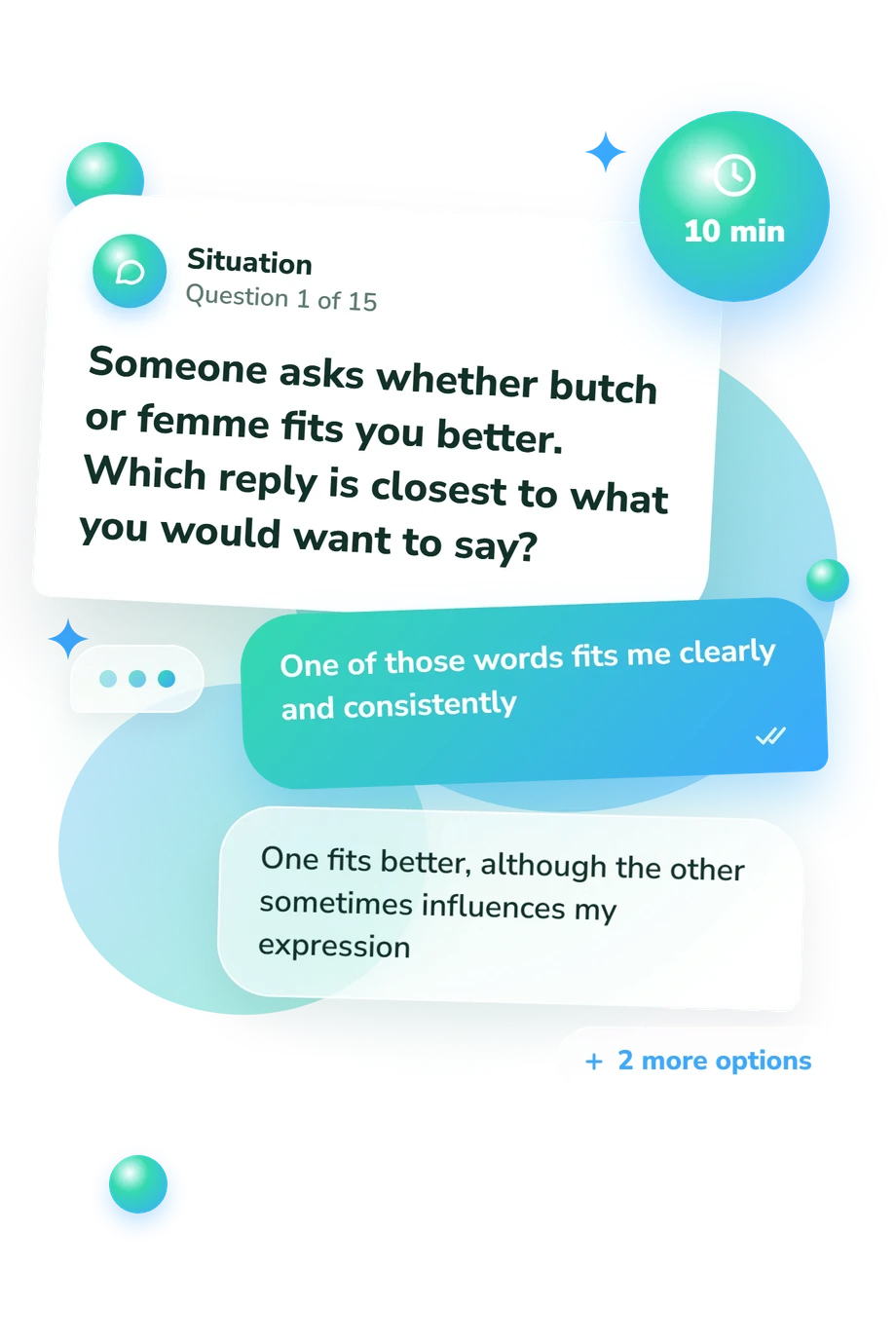
- One of those words fits me clearly and consistently
- One fits better, although the other sometimes influences my expression
- The balance varies enough that I would not choose a permanent side
- A blended description usually fits, even if the balance is fairly stable
- I would enjoy using it as part of an intentionally mixed look
- I would probably leave it because masculine styling feels more natural
- I would value it mainly for adding a subtle hint of femininity
- I would be excited by how clearly it expresses a femme side of me
- One direction has remained a clear anchor throughout
- One direction remains primary, with a few meaningful variations
- The balance has shifted substantially, and that movement feels authentic
- Both have stayed relevant through a fairly consistent mixture
Butch or Femme Quiz - Description and methodology of the test
For people exploring how masculine, feminine, or mixed presentation feels in their own lives, the butch or femme quiz offers a structured moment of self-reflection. It is intended for anyone curious about language, style, recognition, and change across contexts. As a butch or femme test, it can help organize personal impressions without turning a flexible experience into a fixed identity.
What This Assessment Explores
The assessment explores relationships with butch-coded, femme-coded, and blended or shifting expression. Its situations cover clothing, grooming, styling, self-description, recognition, and changes across settings. It suits anyone seeking language for a current pattern rather than a permanent label.
The three displayed dimensions are:
- Blended / Fluid Affinity (0-15) shows whether movement beyond a fixed pole is central; bands are Consistent direction (0-5), Flexible expression (6-10), and Strong blended/fluid resonance (11-15).
- Butch Affinity (0-15) shows how strongly butch language, presentation, or recognition aligns; bands are Limited pull (0-5), Meaningful resonance (6-10), and Strong resonance (11-15).
- Femme Affinity (0-15) shows how strongly femme expression or recognition aligns; bands are Limited pull (0-5), Meaningful resonance (6-10), and Strong resonance (11-15).
The highest score marks the strongest affinity; scores within one point form a blended result. This makes the futch scale quiz relevant when no single pole fits.
Methodology and Scientific Basis
Each item presents a situation involving clothing, grooming, labels, recognition, or movement between masculine and feminine cues. Four choices let the respondent select the closest description, from a steady direction to a mixed, alternating, or context-sensitive pattern. This captures personal meaning, not only observable behavior.
Scoring is questionnaire-specific: responses produce three comparable affinity results that are read together. The highest indicates the strongest current pull, while closely matched results support a blended interpretation. As a femme butch scale quiz, it is most useful when the pattern matters more than choosing one label.
The conceptual reference point is Gunn, Hoskin, and Blair (2021), whose work on gender style closely matches these themes; this questionnaire is conceptually consistent with it, not an adaptation. Related support comes from Lehavot, King, and Simoni (2011) on gender expression, Levitt and Hiestand (2005) on butch and femme perspectives, and van Anders (2015) on Sexual Configurations Theory.
The online format has no stated standardization, population norms, or validated clinical cutoffs. Self-report may shift with current context, self-awareness, safety, and personal meanings attached to gendered language, so the result is a reflective snapshot.
- Gunn, A., Hoskin, R. A., & Blair, K. L. (2021). The new lesbian aesthetic? Exploring gender style among femme, butch and androgynous sexual minority women. Women's Studies International Forum, 88, 102504. 10.1016/j.wsif.2021.102504
- Lehavot, K., King, K. M., & Simoni, J. M. (2011). Development and validation of a gender expression measure among sexual minority women. Psychology of Women Quarterly, 35(3), 381-400. 10.1177/0361684311413554
- van Anders, S. M. (2015). Beyond sexual orientation: Integrating gender/sex and diverse sexualities via Sexual Configurations Theory. Archives of Sexual Behavior, 44(5), 1177-1213. 10.1007/s10508-015-0490-8
- Levitt, H. M., & Hiestand, K. R. (2005). Gender within lesbian sexuality: Butch and femme perspectives. Journal of Constructivist Psychology, 18(1), 39-51. 10.1080/10720530590523062
Updated: