
Body Count Quiz
How the Scales are Structured
Who Usually Takes This Test?
See How You Compare
Below is a preview of how scores are typically distributed across each scale.
Example Questions From the Test
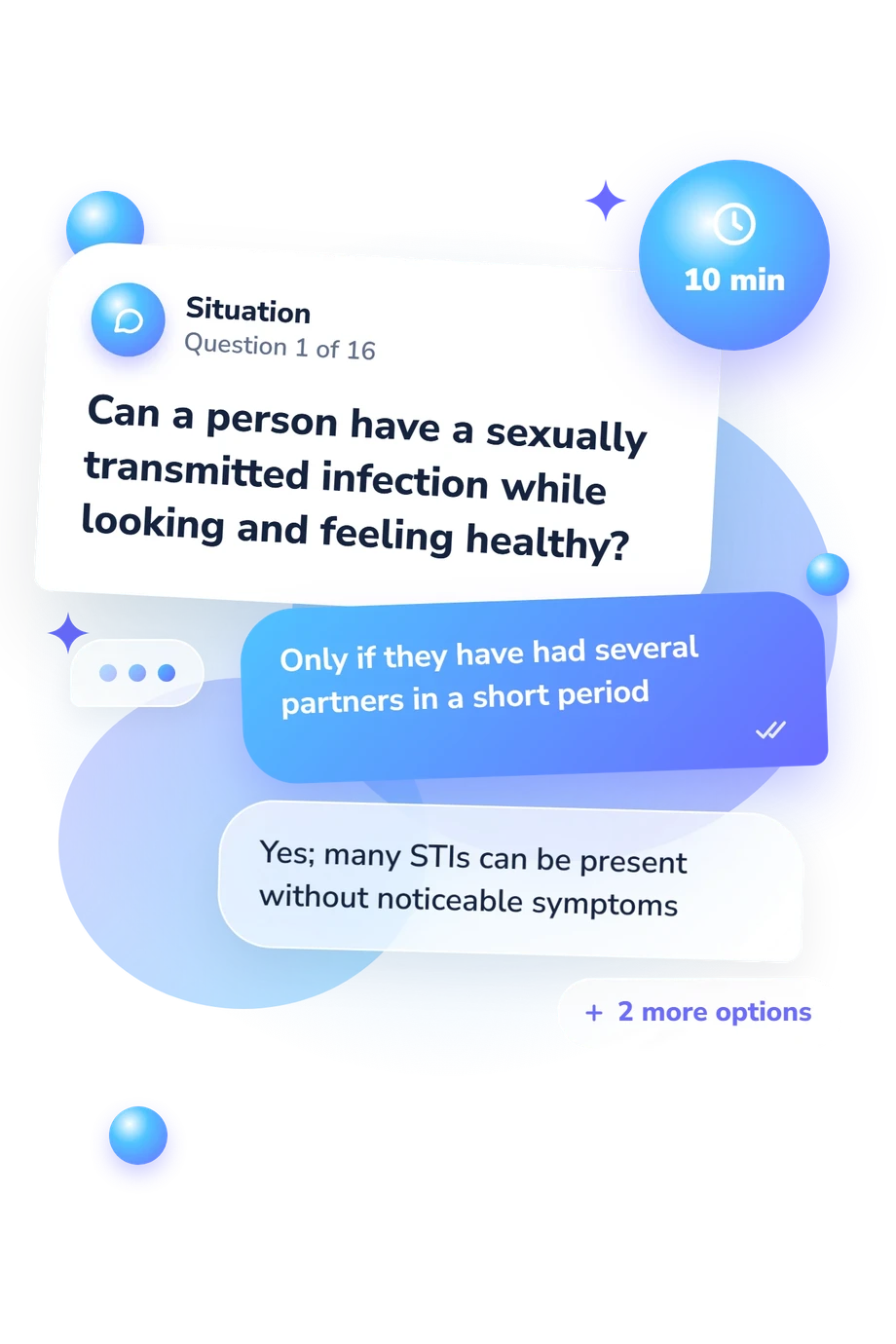
- Only if they have had several partners in a short period
- Yes; many STIs can be present without noticeable symptoms
- Only during the first day after transmission
- No; an STI always causes visible or painful symptoms
- Proceed only with activities they previously discussed while sober
- Do not proceed with sexual activity because clear, voluntary consent is not present
- Ask their friend to confirm what they would probably want
- Treat a lack of resistance as temporary consent
- The number of people a person is currently dating
- The number of sexual partners a person reports having had
- The number of long-term relationships a person has had
- The total number of times a person has had sex
Body Count Quiz - Description and methodology of the test
Readers asking how partner totals relate to sexual health can use this sexual health quiz to examine the knowledge behind those conversations. It focuses on practical sexual-health principles rather than personal judgment. The Body Count Quiz covers consent, testing, contraception, prevention, and exposure context. Its result helps readers identify topics to review before making decisions or discussing sexual health with a partner.
What This Assessment Explores
Rather than treating a partner total as a medical measure, the questionnaire explains why the body count meaning is an imprecise social term. It links the phrase with consent, exposure, protection, testing, and contraception, so the result concerns understanding, not personal risk.
The displayed scale is Body Count Knowledge (0-16). It measures recognition of core sexual-health principles and limits of partner totals. Bands are Foundations to build (0-6), Developing knowledge (7-12), and Strong knowledge (13-16).
Five areas are covered:
- Consent requires clear, voluntary agreement and allows withdrawal.
- STI knowledge includes asymptomatic infection, oral transmission, and prevention limits.
- Testing depends on exposure and timing.
- Contraception and prevention protect against different outcomes.
- Partner totals cannot establish status without test information.
A higher band indicates stronger knowledge here, not a diagnosis or proof of STI or pregnancy status.
Methodology and Evidence Base
Each item presents a sexual-health situation with four choices. Respondents select the most accurate response, testing recognition of principles rather than personal history across consent, STI knowledge, prevention, contraception, testing, and partner-total limits.
The displayed scoring information gives the total range and result bands but does not specify how individual answers contribute or provide population norms, so the result should not be interpreted as a standardized estimate.
Its content is conceptually consistent with Sexual Health Questionnaire (Acharya et al., 2016), which organizes sexual-health knowledge into domains. It also aligns with Sanz-Martos et al. (2019) on sexual and contraceptive knowledge and Jaworski and Carey (2007) on STI knowledge. Pinkerton et al. (2010) supports caution about aggregate partner totals because detailed exposure information can matter more for HIV/STI risk assessment than a single number. These sources support the construct, not validation of the exact questionnaire.
As a body count test, it works as a topic-review tool. Performance can vary with attention, prior knowledge, interpretation of the wording, and guessing, so the result is best used to identify topics for further learning or discussion.
- Acharya, Dev Raj, Malcolm Thomas, and Rosemary Cann. "Validation of a questionnaire to measure sexual health knowledge and understanding (Sexual Health Questionnaire) in Nepalese secondary school: A psychometric process." Journal of Education and Health Promotion 5 (2016): 18. 10.4103/2277-9531.184560
- Sanz-Martos, Sebastian, Isabel M. Lopez-Medina, Cristina Alvarez-Garcia, and Carmen Alvarez-Nieto. "Sexuality and contraceptive knowledge in university students: instrument development and psychometric analysis using item response theory." Reproductive Health 16, no. 1 (2019): 127. 10.1186/s12978-019-0791-9
- Jaworski, Beth C., and Michael P. Carey. "Development and psychometric evaluation of a self-administered questionnaire to measure knowledge of sexually transmitted diseases." AIDS and Behavior 11, no. 4 (2007): 557-574. 10.1007/s10461-006-9168-5
- Pinkerton, Steven D., Carol L. Galletly, Timothy L. McAuliffe, Wayne DiFranceisco, H. Fisher Raymond, and Harrell W. Chesson. "Aggregate versus individual-level sexual behavior assessment: how much detail is needed to accurately estimate HIV/STI risk?" Evaluation Review 34, no. 1 (2010): 19-34. 10.1177/0193841X09353534
Updated: