
Birthstone Quiz
How the Scales are Structured
Who Usually Takes This Test?
See How You Compare
Below is a preview of how scores are typically distributed across each scale.
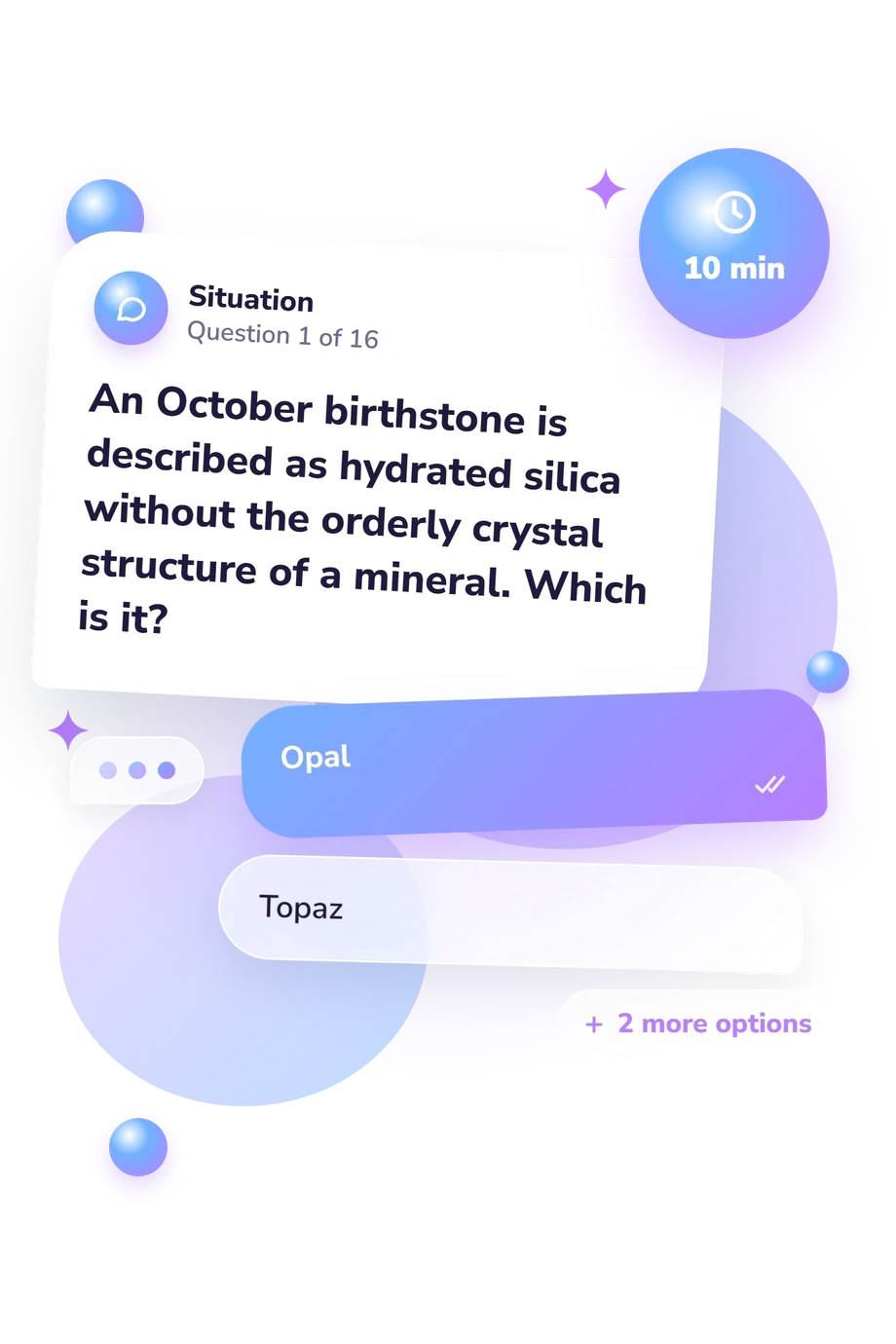
Example Questions From the Test
- Opal
- Topaz
- Zircon
- Tourmaline
- Tanzanite
- Sapphire
- Amethyst
- Spinel
- Peridot
- Green tourmaline
- Bloodstone
- Emerald
Birthstone Quiz - Description and methodology of the test
Readers who want a clear way to review month-to-gem associations can use the birthstone quiz as a focused knowledge check rather than a personality exercise. It suits curious learners, jewelry shoppers, and anyone brushing up on gem terminology. A birthstone knowledge test like this can show which familiar pairings come easily and which mineral details deserve another look.
What This Assessment Explores
Questions link each month with a traditional gem while testing mineral identity and distinguishing properties. Some clues ask you to recognize quartz varieties, separate natural zircon from cubic zirconia, or use color change, hardness, and crystal structure. This checks practical factual knowledge, not belief in crystal effects or personal traits.
It suits self-directed learning. The focus on monthly birthstone associations can show which pairings are secure, where similar colors cause confusion, and which gemology topics deserve review. The bands describe performance on tested material; they do not indicate intelligence or professional competence.
The score uses one scale:
- Birthstone Knowledge: 0-16 records correct answers.
- Foundation (0-6) reflects partial recognition and gaps.
- Developing (7-12) shows solid knowledge with some missed details.
- Sparkling (13-16) indicates strong command of associations and gem features.
Methodology and Scientific Basis
Each item uses multiple choice with four alternatives. Prompts combine month questions with clues about composition, mineral family, color change, organic origin, hardness, or crystal structure. This asks you to apply a fact to a description rather than recognize a memorized pairing. A gem identification quiz therefore resembles guided recall more than a personality inventory.
Content follows the Jewelers of America birthstone list and commonly recognized modern U.S. usage. Gemological Institute of America references support the month associations; Webster's revised gemological text supplies mineral and gem descriptions. Liddicoat's historical note adds context to that reference tradition. These sources support factual content; the online questionnaire is conceptually consistent with them, not an adaptation of a published psychometric scale.
Scoring follows the number of answers matching the keyed responses, and the displayed bands organize that total rather than population norms. The questionnaire is a knowledge measure, not a standardized clinical or personality instrument. Results may reflect prior exposure, interpretation of wording, and momentary attention, so they are best read as a snapshot of birthstone knowledge.
- Jewelers of America. Birthstone Jewelry. Jewelers of America, accessed September 18, 2026.
- Gemological Institute of America. Birthstones. Gemological Institute of America, accessed September 18, 2026.
- Webster, Robert, revised by Basil William Anderson. Gems: Their Sources, Descriptions and Identification. 4th ed. Butterworths, London, 1983. ISBN 0-408-01148-3.
- Liddicoat, Richard T. Basil W. Anderson, 1901-1984. Gems & Gemology, vol. 20, no. 1, 1984, p. 1. DOI 10.5741/gems.20.1.1.
Updated: