
Beef Cuts Quiz
How the Scales are Structured
Who Usually Takes This Test?
See How You Compare
Below is a preview of how scores are typically distributed across each scale.
Example Questions From the Test
- Strip steak
- Filet mignon
- Chuck roast
- Top sirloin steak
- Chuck eye
- Bottom round
- Skirt steak
- Tenderloin
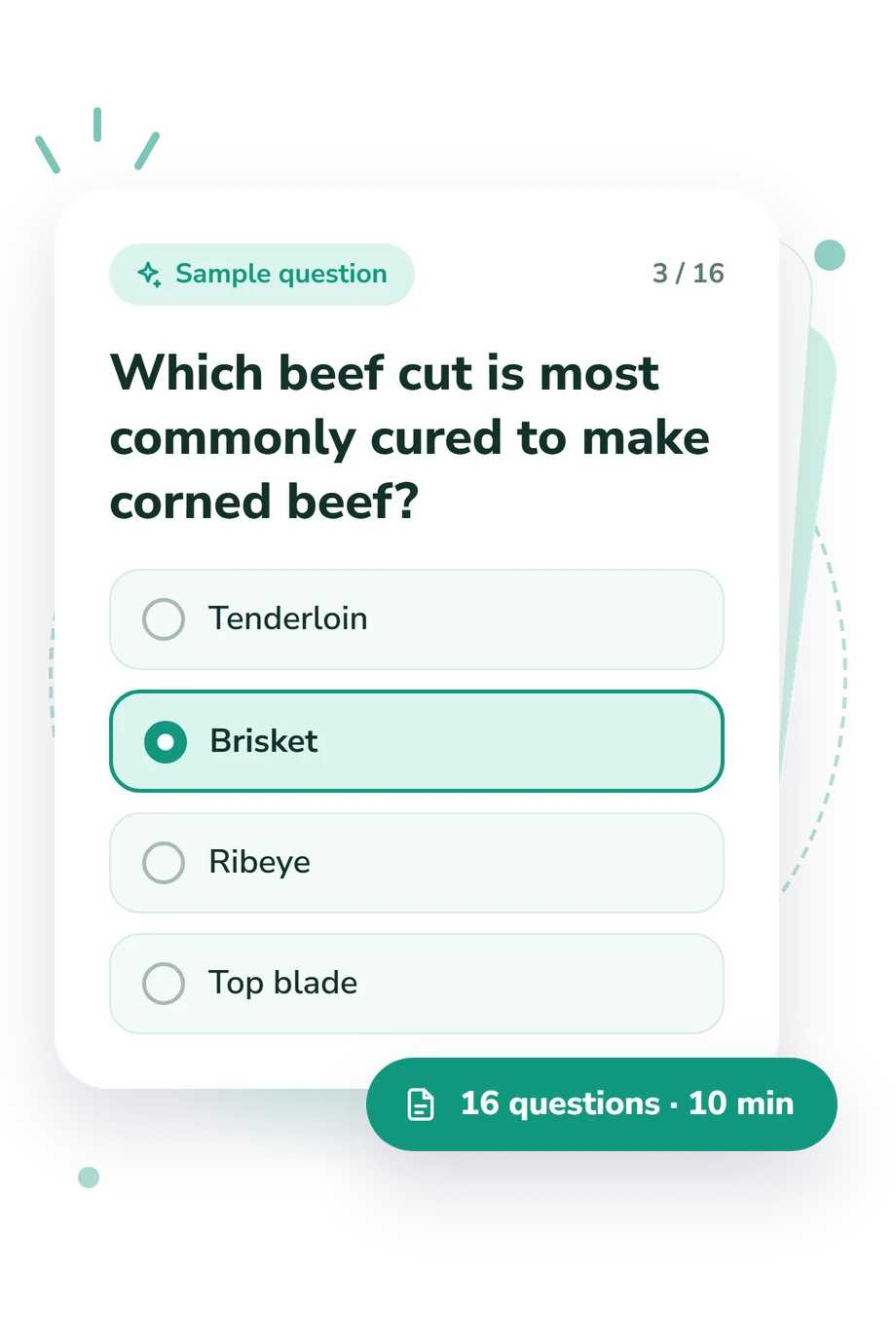
- Tenderloin
- Brisket
- Ribeye
- Top blade
Beef Cuts Quiz - Description and methodology of the test
For home cooks, culinary students, and curious shoppers, this assessment offers a practical way to decide which beef topics deserve attention before the next trip to the butcher counter. The beef cuts quiz helps you decide which topics deserve attention before your next trip to the butcher counter. Questions in this beef primal cuts quiz show whether your understanding is foundational, developing, or strong.
What This Assessment Explores
This assessment focuses on practical beef knowledge. The questions connect market cuts with anatomy, physical characteristics, and preparation choices. Beef Cuts Knowledge reflects correct-answer performance and knowledge of cuts, primal locations, defining features, and suitable cooking approaches. Common U.S. terminology is used, although names and fabrication can vary by region.
The question themes fall into three practical areas:
- Primal location shows whether you can trace a steak or roast to the section of the animal that supplied it.
- Cut characteristics show whether you can connect tenderness, marbling, connective tissue, bone, or grain with a cut’s behavior.
- Cooking suitability shows whether you can match heat, time, and slicing technique to the structure of the meat.
The displayed result bands are Foundation (0-6), Developing (7-12), and Strong (13-16). A beef cut identification quiz can clarify which knowledge areas deserve further practice.
Methodology and Reference Sources
Each item presents a practical scenario or identification prompt with four answer choices. The documented score range is 0-16 correct answers. The four-choice items cover primal locations, named steaks and roasts, connective tissue, marbling, grain direction, and cooking methods, combining recognition with applied reasoning.
Beef Retail Identification Cuts is a content source for identifying cuts and their source regions, while USDA Series 100 is a reference source for beef nomenclature and fabrication. They support content and terminology, and this questionnaire is conceptually consistent with them, not a reproduction, validated adaptation, or standardized version of either source.
As a beef cuts knowledge test, it offers a snapshot of current familiarity. No population norms, reliability estimates, or diagnostic cutoffs are established for this online questionnaire. Results can also reflect prior cooking experience, regional terminology, attention, or guessing, so they are most useful for choosing topics to review rather than defining complete butchery expertise.
- Estevez, Brian, Chad Carr, and Larry F. Eubanks. "Beef Retail Identification Cuts." UF/IFAS Extension, publication 4HASP01, 2017. 10.32473/edis-4h380-2017.
- U.S. Department of Agriculture, Agricultural Marketing Service. "Institutional Meat Purchase Specifications: Fresh Beef - Series 100." USDA, 2014.
Updated: