
Atmosphere Quiz
How the Scales are Structured
Who Usually Takes This Test?
See How You Compare
Below is a preview of how scores are typically distributed across each scale.
Example Questions From the Test
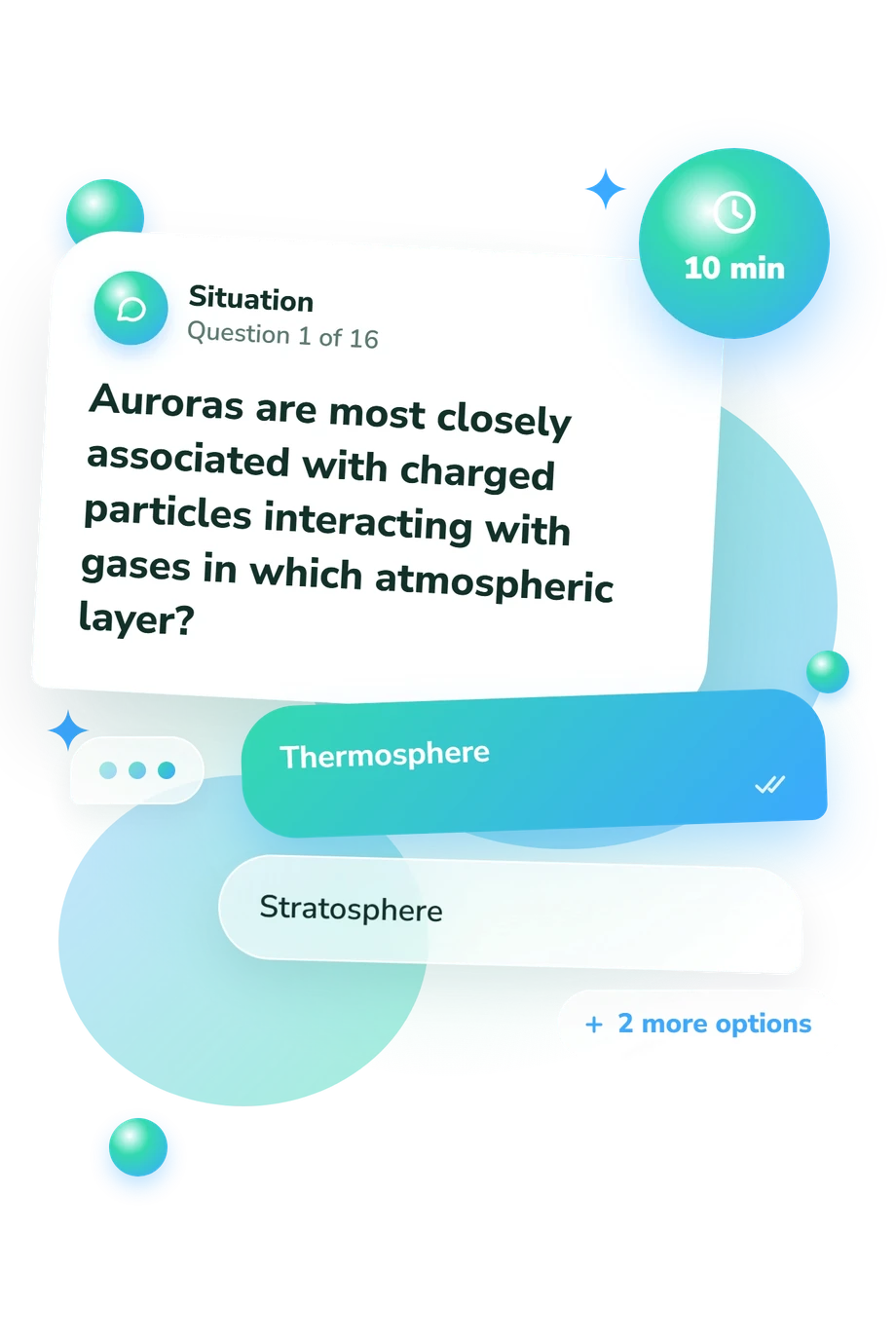
- Thermosphere
- Stratosphere
- Mesosphere
- Troposphere
- Stratosphere
- Exosphere
- Thermosphere
- Mesosphere
- Nitrogen
- Oxygen
- Argon
- Carbon dioxide
Atmosphere Quiz - Description and methodology of the test
For curious learners, students, and anyone revisiting basic Earth science, this atmosphere quiz checks overall understanding of atmospheric concepts. This atmosphere knowledge quiz connects factual recognition with brief applications while keeping the result broad rather than topic-specific. It suits learning-oriented self-checking, where the result can show whether wider review may be useful.
What This Assessment Explores
This questionnaire examines introductory atmospheric science through composition, structure, pressure, motion, weather, and radiative energy. It functions as a quiz about layers of the atmosphere, asking learners to distinguish five layers while applying principles to familiar scenarios.
The four thematic areas below all contribute to the single reported result:
- Atmospheric structure shows whether you connect layers with characteristic processes and locations.
- Pressure and gas behavior indicate how you reason about expansion, density, and altitude.
- Weather dynamics reveal how you apply convection, inversions, and the Coriolis effect.
- Radiation and composition reflect understanding of ozone, greenhouse gases, sunlight, and infrared energy.
The result is reported on the Atmosphere Knowledge scale: 0-16. Foundational covers 0-6, Developing covers 7-12, and Strong covers 13-16. These bands describe the integration of concepts demonstrated by the responses; the educational result is not a professional certification.
Methodology and Scientific Basis
Each item presents four answer choices and asks for the best explanation, prediction, or identification. The quiz questions about the atmosphere move from recognizing layers and gases to applying pressure, density, heat transfer, circulation, and radiation. Item-level scoring and weighting are not specified for this questionnaire, so the result should be read through its performance bands rather than as a measure of any single topic.
The closest named reference is the Standardized Introductory Meteorology Assessment Exam described by Davenport et al. (2015). This questionnaire is conceptually consistent with that introductory focus, but it is neither a standardized version nor an adaptation of the published exam. Wallace and Hobbs (2006) provide the physical framework for atmospheric structure and processes, while the IPCC (2021) supports its treatment of greenhouse warming and radiative effects.
The bands are interpretive labels for performance on this questionnaire. Careful reading and prior instruction affect recall and interpretation of item wording, so the result is a snapshot across selected topics, not a complete measure of meteorology or climate science. The questions test recognition and application of foundational atmospheric principles. Reviewing uncertain concepts can guide focused learning.
- Davenport, Casey E., Christian S. Wohlwend, and Thomas L. Koehler. “Motivation for and Development of a Standardized Introductory Meteorology Assessment Exam.” Bulletin of the American Meteorological Society, 96(2), 2015, 305-312. DOI 10.1175/BAMS-D-13-00157.1
- Wallace, John M., and Peter V. Hobbs. Atmospheric Science: An Introductory Survey. 2nd ed. Elsevier Academic Press, 2006.
- Intergovernmental Panel on Climate Change. Climate Change 2021: The Physical Science Basis: Working Group I Contribution to the Sixth Assessment Report of the Intergovernmental Panel on Climate Change. Cambridge University Press, 2023. DOI 10.1017/9781009157896
Updated: