
Amino Acid Quiz
How the Scales are Structured
Who Usually Takes This Test?
See How You Compare
Below is a preview of how scores are typically distributed across each scale.
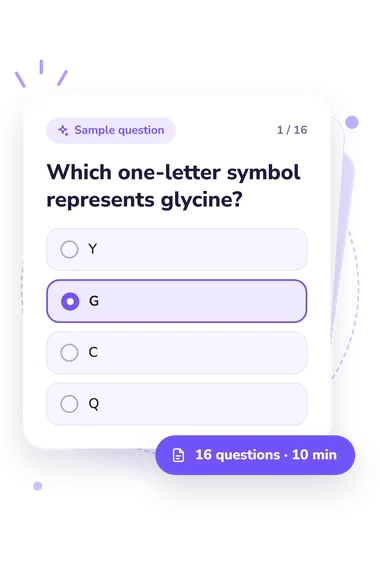
Example Questions From the Test
- Y
- G
- C
- Q
- Lysine
- Glutamine
- Serine
- Leucine
- S
- A
- L
- G
Amino Acid Quiz - Description and methodology of the test
Designed for learners who want to check whether biochemical notation feels familiar, the amino acid quiz focuses on practical recognition rather than memorizing isolated facts. It suits students, educators, and curious readers who want a quick profile of their grasp of standard amino-acid names, one-letter codes, and chemical properties. An amino acid online quiz result shows which areas are secure and which merit review.
What This Assessment Explores
The questions move between symbol recall and biochemical reasoning. They ask you to translate one-letter codes into names, recognize side-chain features, and apply facts to short protein-sequence situations. As an amino acid structure quiz, it connects notation with charge, polarity, hydrophobicity, chirality, aromaticity, hydroxyl groups, and disulfide-forming cysteine.
The main skill areas are:
- Code recognition shows how reliably you retrieve standard amino-acid symbols and names.
- Property matching shows whether side-chain chemistry guides choices about charge, polarity, hydrophobicity, and reactivity.
- Sequence reasoning shows how accurately you map symbols to residues and apply facts to phosphorylation, proton transfer, and disulfide bonding.
The result is reported as Amino Acid Knowledge: 0-16. Foundations to Build covers 0-6, Developing Knowledge covers 7-12, and Strong Knowledge covers 13-16. This profile combines notation and biochemical properties rather than testing recall alone.
Methodology and Scientific Basis
Methodologically, this is a direct knowledge assessment using selected-response questions rather than self-report. Most items present four answer choices; some use symbol strings or ordered pairs, so you must recognize notation as well as biochemical meaning. The coverage makes this a 20 amino acids quiz, spanning names, codes, sequence reading, and side-chain properties.
Its notation framework is consistent with the IUPAC-IUB Commission’s 1972 rules for one-letter amino-acid sequences. Saffran (1998) explains why names and abbreviations create a persistent memory challenge, while Pennington, Sears, and Clegg (2014) support the educational value of active practice with structures and abbreviations. These sources provide conceptual context; this online questionnaire is not presented as an adaptation or standardized reproduction of any of them.
The scoring display organizes performance into the bands, but no separate weighting or population norm is claimed. Recent study, familiarity with biochemical notation, attention, and self-paced responding can affect the outcome, so the band is a snapshot rather than a permanent ability label. Missed concepts can guide review when you want to improve at recognizing amino acids in unfamiliar sequences.
- Pennington, Britney O., Duane Sears, and Dennis O. Clegg. (2014). Interactive Hangman teaches amino acid structures and abbreviations. Biochemistry and Molecular Biology Education, 42(6), 495-500. 10.1002/bmb.20826
- Saffran, M. (1998). Amino acid names and parlor games: From trivial names to a one-letter code, amino acid names have strained students' memories. Is a more rational nomenclature possible? Biochemical Education, 26(2), 116-118. 10.1016/S0307-4412(97)00167-2
- IUPAC-IUB Commission on Biochemical Nomenclature. (1972). A one-letter notation for amino acid sequences (definitive rules). Pure and Applied Chemistry, 31(4), 639-646. 10.1351/pac197231040639
Updated: