
Am I White Trash Quiz
How the Scales are Structured
Who Usually Takes This Test?
See How You Compare
Below is a preview of how scores are typically distributed across each scale.
Example Questions From the Test
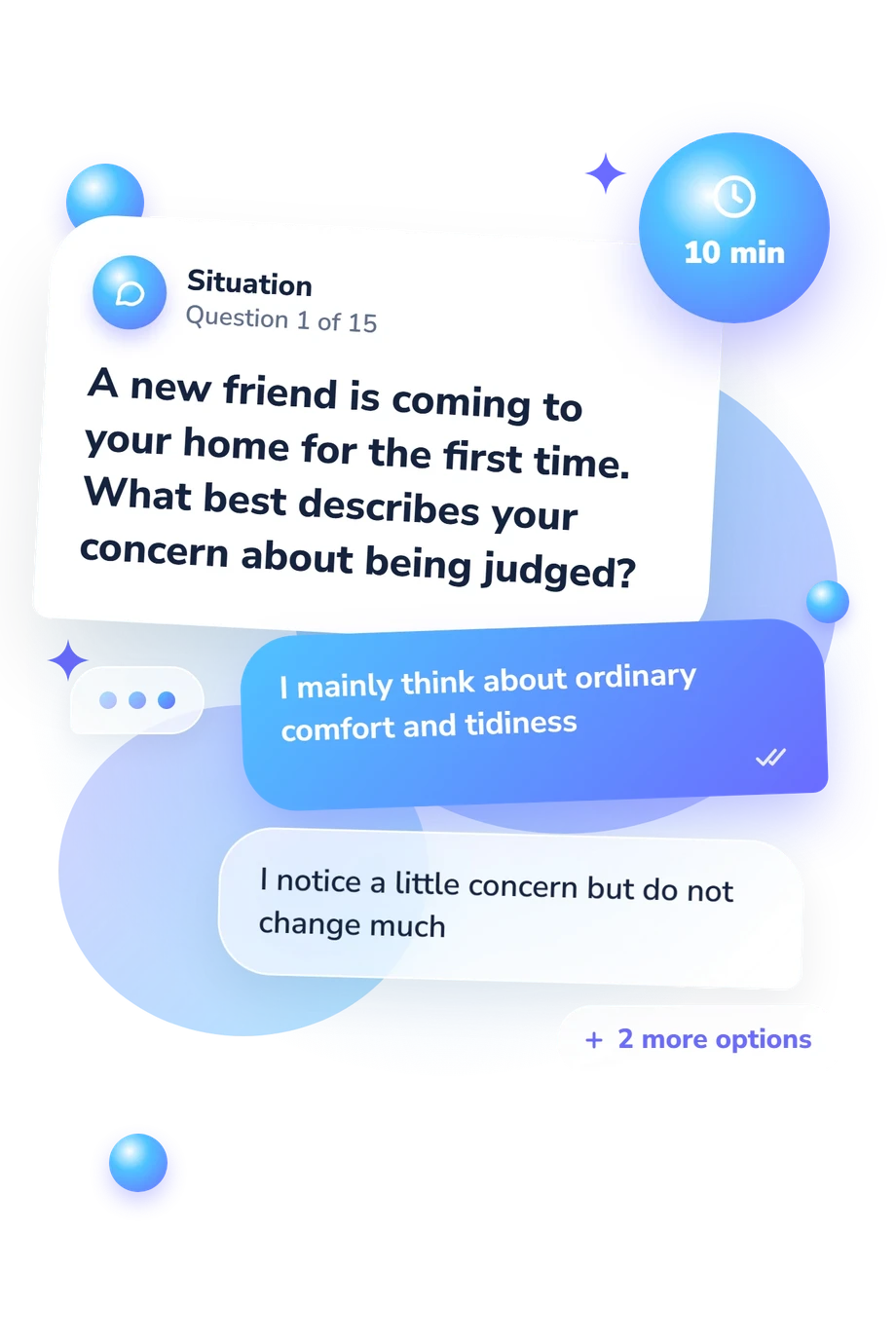
- I mainly think about ordinary comfort and tidiness
- I notice a little concern but do not change much
- I hide or adjust a few things that might seem class-coded
- I feel substantial pressure to disguise how I normally live
- Hardly at all; I speak and act much as usual
- I make a few automatic adjustments
- I stay noticeably alert to how I come across
- I closely manage myself to avoid exposing my background
- Generally comfortable when the topic arises naturally
- Mostly comfortable, though I choose some details carefully
- Often guarded because I anticipate class-based conclusions
- Highly uncomfortable and inclined to conceal or rewrite details
Am I White Trash Quiz - Description and methodology of the test
People considering the meaning of a class-based label may use the am i white trash quiz to examine how social judgment, background, and personal identification intersect. It also works as a white trash identity quiz, helping readers reflect on whether they monitor their presentation, encounter stereotypes, or reclaim the phrase. The result offers a profile of these experiences rather than a verdict about personal worth.
What This Assessment Explores
Three themes organize the questions: class-coded self-presentation, exposure to stereotyping, and personal distance from or reclamation of a loaded phrase. Items refer to homes, accents, education, work, taste, clothing, money, and other people's reactions. This white trash quiz examines social meaning and lived interaction, not manners, achievement, or human worth.
Your result is divided into three dimensions:
- Class-Based Self-Consciousness (0-15) shows pressure to conceal or manage background; Low self-monitoring 0-5, Situational self-monitoring 6-10, Strong self-monitoring 11-15.
- Relationship to the Label (0-15) shows distance, ambivalence, or reclamation; Rejected or distant 0-5, Contextual or ambivalent 6-10, Reclaimed or identified 11-15.
- Social Stereotype Exposure (0-15) shows reported contact with class-based assumptions; Limited exposure 0-5, Recurring exposure 6-10, Frequent exposure 11-15.
Read the profiles together: they separate what you monitor, what others direct at you, and what language you claim for yourself.
Methodology and Scientific Basis
Each item offers four ordered responses, moving from little concern or exposure toward stronger monitoring, repeated stereotyping, or identification. Responses produce three separate scale profiles rather than one verdict. The format asks how the label functions in your experience, not whether it is objectively true.
Loughnan et al. (2014) offer the closest conceptual comparison through research on stereotypes attached to the label white trash. Hartigan (1997) and Wilson (2002) explain the phrase's links with hierarchy, stigma, and contested identity. Kallschmidt and Eaton (2019) add context on concealing or disclosing class origins. These sources support the themes; they do not make this questionnaire an adaptation of a cited instrument.
To read an Am I White Trash Test result, compare profiles rather than ranking yourself by one number. Self-consciousness can reflect anticipated judgment; exposure can describe others' behavior; label-related identification can show distance or reclamation. The pattern may clarify whose standards you carry and how freely you describe your background.
Scores are descriptive, not normed diagnostic findings. Mood, memory, interpretation of class-coded situations, and willingness to disclose can shape self-report, so treat the profile as a snapshot rather than a fixed identity.
- Steve Loughnan, Nick Haslam, Robbie M. Sutton, and Bettina Spencer. (2014). Dehumanization and social class: Animality in the stereotypes of “white trash,” “chavs,” and “bogans.” Social Psychology, 45(1), 54-61. 10.1027/1864-9335/a000159
- John Hartigan Jr. (1997). Unpopular culture: The case of ‘white trash.’ Cultural Studies, 11(2), 316-343. 10.1080/09502389700490171
- Jacqueline Zara Wilson. (2002). Invisible racism: The language and ontology of ‘White Trash.’ Critique of Anthropology, 22(4), 387-401. 10.1177/0308275X020220040101
- Anna M. Kallschmidt and Asia A. Eaton. (2019). Are lower social class origins stigmatized at work? A qualitative study of social class concealment and disclosure among White men employees who experienced upward mobility. Journal of Vocational Behavior, 113, 115-128. 10.1016/j.jvb.2018.08.010
Updated: