
Am I Ready to Buy a House Quiz
How the Scales are Structured
Who Usually Takes This Test?
See How You Compare
Below is a preview of how scores are typically distributed across each scale.
Example Questions From the Test
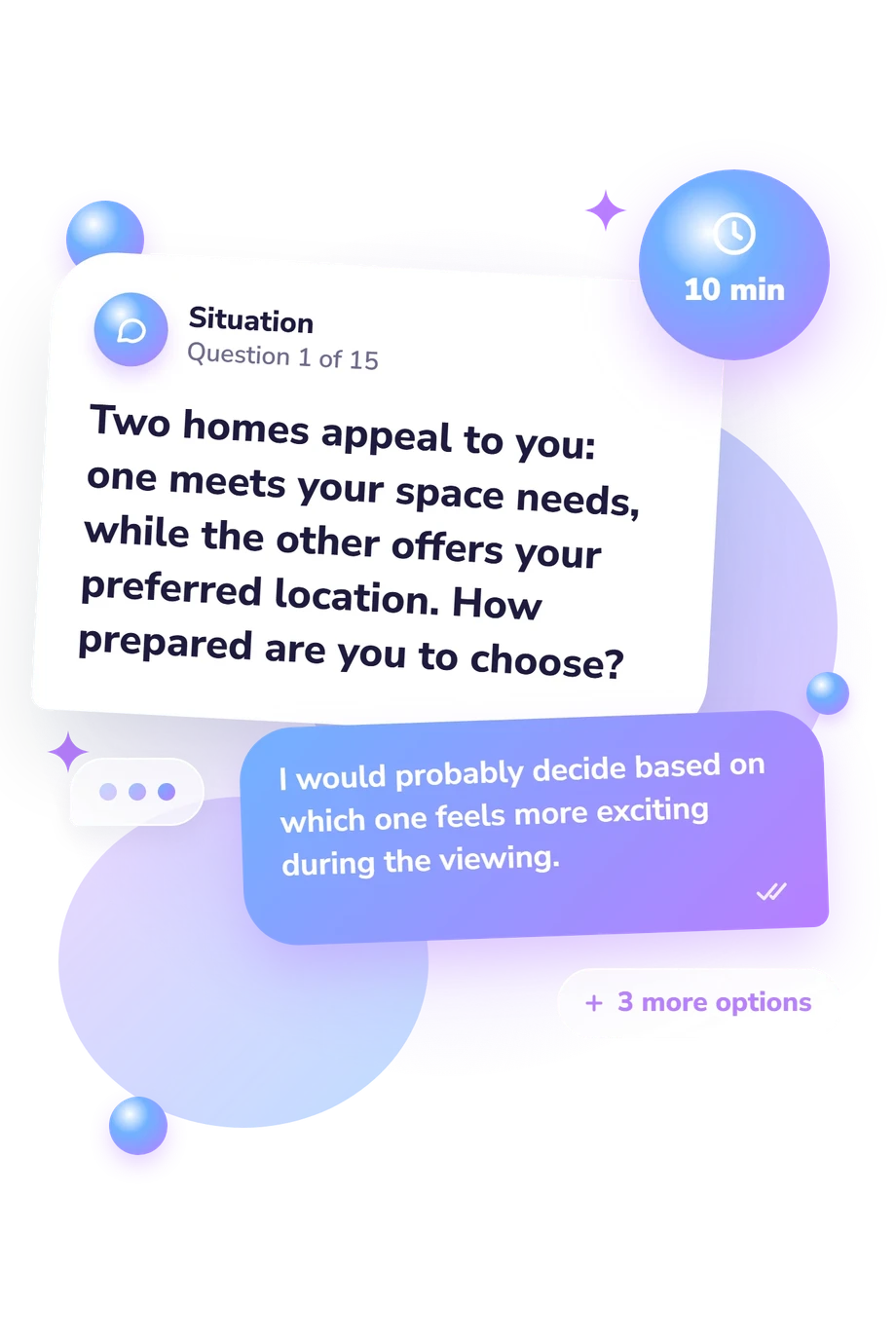
- I would probably decide based on which one feels more exciting during the viewing.
- I know which feature I prefer, though I have not discussed the trade-offs in detail.
- I have ranked must-haves, flexible preferences, and deal-breakers against my budget and plans.
- I have a short priority list but would need to weigh commute, upkeep, or future needs.
- I could use a repair plan and designated funds without displacing essential expenses.
- I would need to compare repair, financing, or payment options before deciding.
- I would probably rely on a credit card or postpone another planned expense.
- I have not yet considered how I would arrange or pay for an urgent repair.
- It could significantly disrupt my essential spending or near-term plans, and I do not yet have alternatives.
- I have financial and practical buffers, plus clear limits for when I would reassess the situation.
- I could adapt for a while, though the trade-offs with savings, leisure, or other goals are not fully mapped.
- I would likely cut optional spending and work out the rest as costs arose.
Am I Ready to Buy a House Quiz - Description and methodology of the test
People considering a first purchase can use the Am I Ready to Buy a House Quiz to organize a decision involving money, daily responsibilities, timing, and uncertainty. It suits someone who wants a clearer starting point before speaking with lenders or comparing properties. Framed as a quiz about whether you are ready to buy a house, this assessment turns a broad concern into practical areas to examine.
What This Assessment Explores
The questionnaire treats readiness as a planning profile rather than a yes-or-no verdict. Its prompts cover cash flow, reserves, credit, unexpected costs, maintenance, shared decisions, flexibility, and comparing homes or financing. When priorities compete, this quiz about whether I should buy a house gives the decision more structure.
The result separates three dimensions, showing where preparation is concrete and where more information or buffer may be needed:
- Financial Foundation (0-15) measures how clearly you understand and can support purchase demands: Foundation to Build (0-5), Taking Shape (6-10), or Well Defined (11-15).
- Ownership Fit and Resilience (0-15) measures how ownership fits foreseeable life and practical demands: Fit to Explore (0-5), Conditional Fit (6-10), or Strong Practical Fit (11-15).
- Purchase Process Preparation (0-15) measures your ability to navigate finding a home, financing, evaluation, and closing: Early Orientation (0-5), Active Preparation (6-10), or Process Ready (11-15).
Methodology and Scientific Basis
Each item describes a concrete home-buying situation and offers four self-report choices, so you select the description closest to your current preparation. As a ready-to-buy-a-house quiz, it is a structured reflection exercise, not a lender’s underwriting model.
Responses combine across the displayed dimensions to create a profile. Since no point-by-option key is published, do not convert choices manually; use the result labels and planning actions. A stronger area indicates clearer preparation there, not guaranteed affordability, approval, favorable prices, or trouble-free ownership.
Moulton et al. (2019) and DeMarco et al. (2017) examine counseling for prospective buyers, which is conceptually consistent with this questionnaire’s themes. Gathergood and Weber (2017) connect mortgage financial literacy with ownership barriers; Smith et al. (2017) provide randomized evidence on pre-purchase counseling. These studies support the themes but do not establish standardized norms here.
Honest self-report is limited by current stress, incomplete knowledge, optimism, and changing finances. A quiz about buying a home can guide budgeting and conversations, but property, loan terms, reserves, and future changes require separate evaluation.
- Shawn R. Moulton, Laura R. Peck, Nichole Fiore, Debbie Gruenstein Bocian, and Donna DeMarco. "An Examination of Participation in Homebuyer Education and Counseling Services." Journal of Consumer Affairs, 2019, 53(3), 825-847. 10.1111/joca.12236
- Donna DeMarco, Nichole Fiore, Shawn Moulton, Debbie Gruenstein Bocian, Laura Peck, Sarah Ballinger, Karen Cuenca, Louise Rothschild, and Stephen Whitlow. "The First-Time Homebuyer Education and Counseling Demonstration: Baseline Report: Study Design and Implementation." U.S. Department of Housing and Urban Development, Office of Policy Development and Research, 2017.
- John Gathergood and Jörg Weber. "Financial literacy: A barrier to home ownership for the young?" Journal of Urban Economics, 2017, 99, 62-78. 10.1016/j.jue.2017.02.001
- Marvin M. Smith, Daniel Hochberg, and William H. Greene. "The effectiveness of pre-purchase homeownership counseling: Evidence from a randomized study." The Quarterly Review of Economics and Finance, 2017, 65, 36-49. 10.1016/j.qref.2016.05.002
Updated: