
Am I Healed from My Breakup Quiz
How the Scales are Structured
Who Usually Takes This Test?
See How You Compare
Below is a preview of how scores are typically distributed across each scale.
Example Questions From the Test
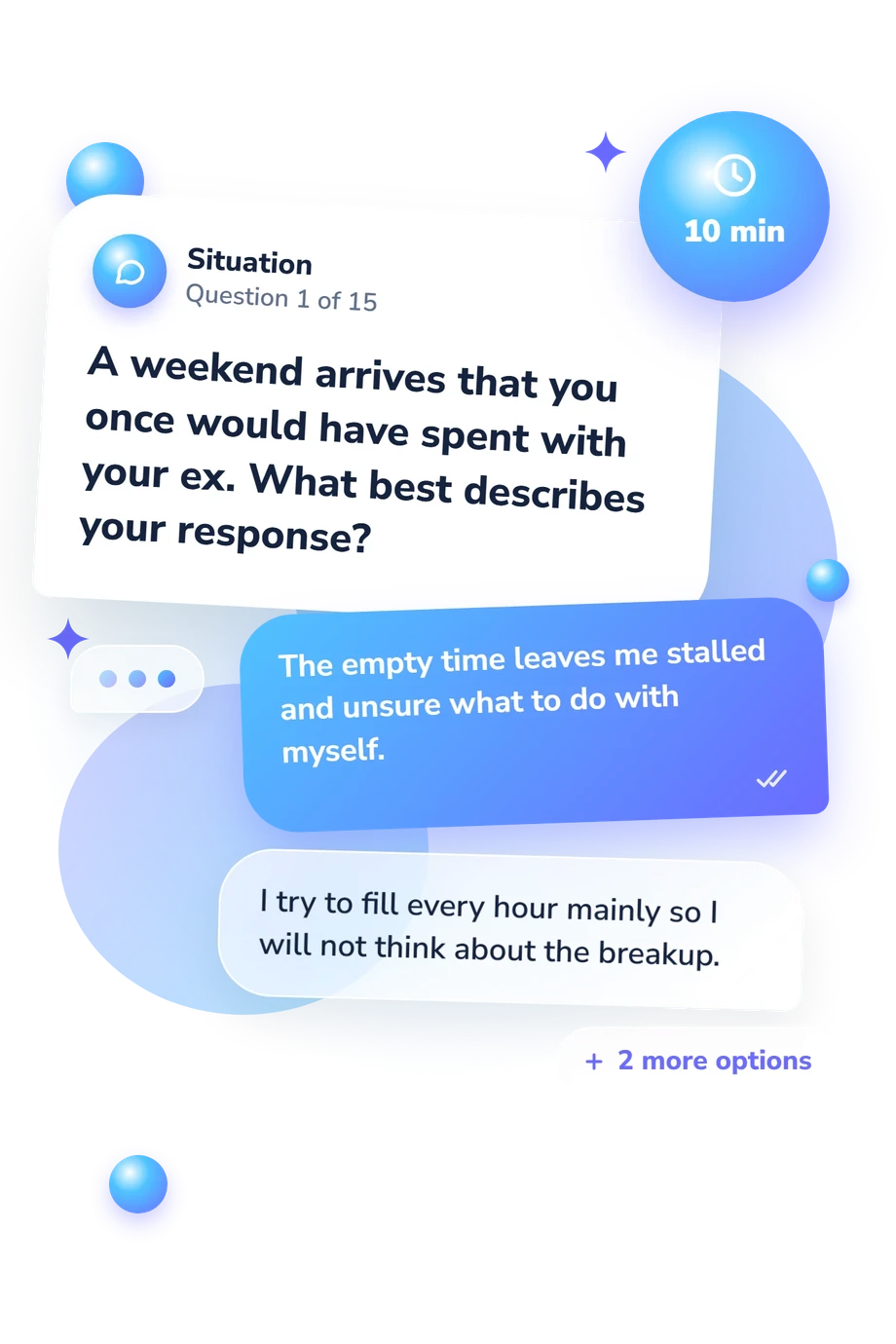
- The empty time leaves me stalled and unsure what to do with myself.
- I try to fill every hour mainly so I will not think about the breakup.
- I choose something for myself, although enjoying it may feel uneven.
- I look forward to using the time for plans that genuinely fit my current life.
- I would probably avoid an event I otherwise wanted to attend.
- I would go, but spend considerable time rehearsing the encounter beforehand.
- I would expect some nerves while trusting that I could manage them.
- I could attend for my own reasons without making the possible encounter the focus.
- I stop or leave because hearing it feels too overwhelming.
- I listen, but the memories unsettle me for much of the day.
- I feel a pang, then return to what I was doing after a while.
- I notice the memory without it significantly changing my mood or plans.
Am I Healed from My Breakup Quiz - Description and methodology of the test
For readers trying to understand whether a past relationship still shapes daily life, the Am I Healed From My Breakup Quiz offers a structured pause rather than a yes-or-no verdict. It focuses on emotional disruption, re-engagement with your own life, and the pull of the former bond. The result can help you consider different dimensions of breakup recovery while keeping recovery personal rather than tied to a timetable.
What This Assessment Explores
Designed for people reflecting on a past romantic relationship, the questionnaire covers reminders, contact, reunion hopes, comparisons, concentration, pleasure, identity, and choices made without an ex’s reaction as the main reference. It treats healing after a breakup as multidimensional rather than a single emotional state.
The three displayed scales show:
- Emotional Settling (0-15) reflects disruption from reminders: Still emotionally activated (0-5), Gradually settling (6-10), or More emotionally settled (11-15).
- Independent Life Re-Engagement (0-15) reflects reconnection with your own life: Loss-centered (0-5), Rebuilding momentum (6-10), or Actively re-engaged (11-15).
- Relational Release and Boundaries (0-15) reflects whether checking, contact, comparisons, keepsakes, or reunion hopes sustain the bond: Bond maintained (0-5), Loosening the bond (6-10), or Greater release (11-15).
Together, the profile shows where the breakup still has leverage and where present-focused functioning is returning; one area can progress ahead of another.
Methodology and Evidence Base
Each item presents a familiar situation with four response options, moving from stronger disruption or attachment toward greater flexibility and self-direction. The questionnaire reports three scores, each ranging from 0-15, with the displayed interpretive bands; the point contribution of each response and the mapping of items to scales are not specified. The options focus on how emotions, attention, choices, and bond-maintaining habits respond in everyday situations.
The questionnaire is conceptually consistent with the Breakup Distress Scale (Field et al., 2009) and is not an adaptation of it. The themes are also conceptually consistent with Lewandowski and Bizzoco (2007) on identity, interests, and growth after a low-quality relationship ends, and Marshall (2012) on former-partner monitoring, recovery, and personal growth.
For someone considering emotional recovery after a breakup, the result is a current self-report snapshot. Mood, memory, ongoing contact, and self-presentation can affect answers, while practical ties may require some contact. Read the pattern across scales to identify pressure points and next steps rather than to rank the speed of recovery.
- Field, Tiffany, Miguel Diego, Martha Pelaez, Osvelia Deeds, and Jeannette Delgado. (2009). Breakup distress in university students. Adolescence, 44(176), 705-727.
- Lewandowski, Gary W., Jr., and Nicole M. Bizzoco. (2007). Addition through subtraction: Growth following the dissolution of a low quality relationship. The Journal of Positive Psychology, 2(1), 40-54. 10.1080/17439760601069234
- Marshall, Tara C. (2012). Facebook Surveillance of Former Romantic Partners: Associations with PostBreakup Recovery and Personal Growth. Cyberpsychology, Behavior, and Social Networking, 15(10), 521-526. 10.1089/cyber.2012.0125
Updated: