
Am I Graysexual Quiz
How the Scales are Structured
Who Usually Takes This Test?
See How You Compare
Below is a preview of how scores are typically distributed across each scale.
Example Questions From the Test
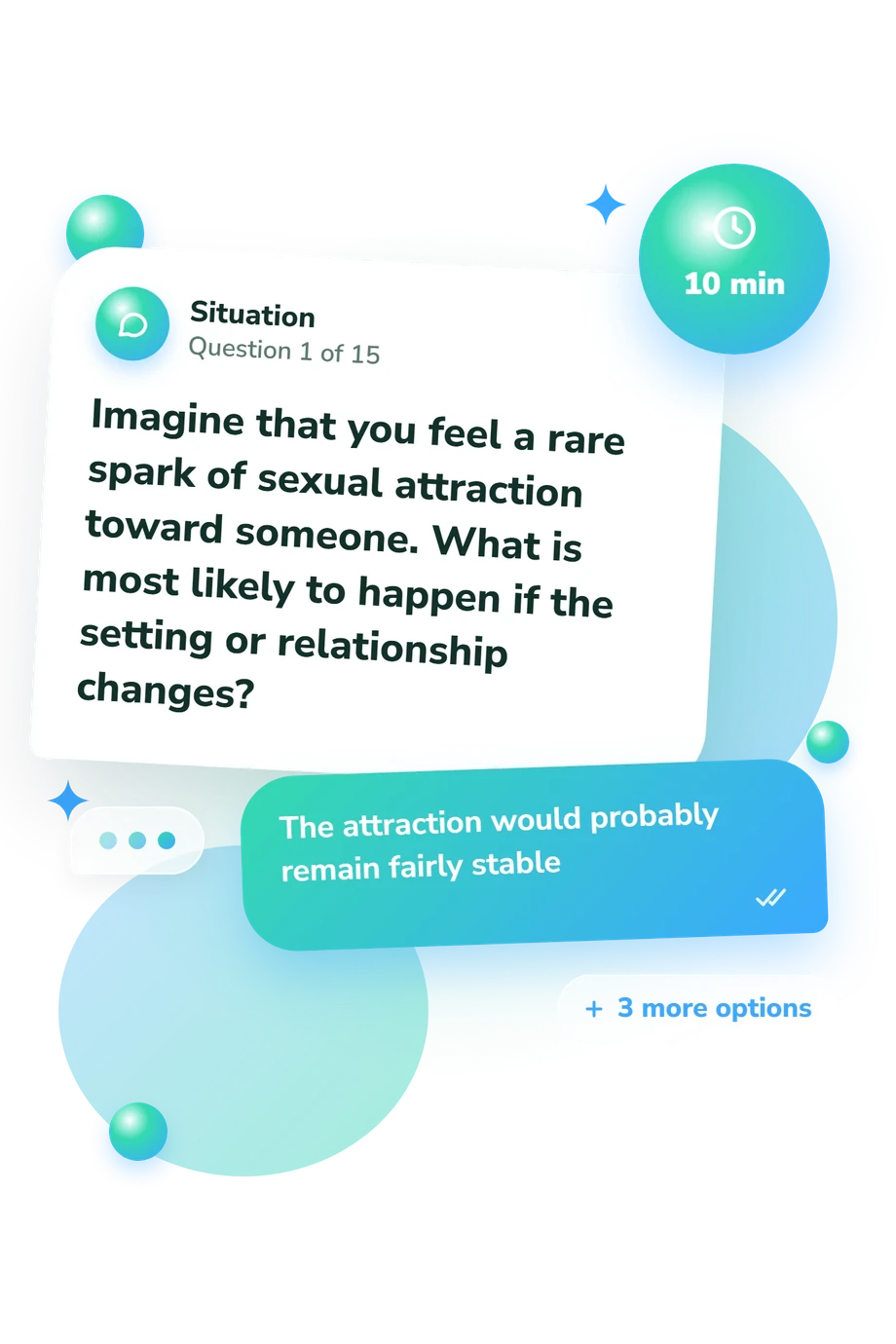
- The attraction would probably remain fairly stable
- It might weaken, as attraction often responds to circumstances
- It could disappear quickly because it depended on a very specific moment or dynamic
- I cannot picture this because I do not recognize having felt such a spark
- Fairly often or as a recurring part of my life
- Occasionally, with noticeable gaps between experiences
- Rarely, but I can identify a small number of instances
- I cannot identify an instance of sexual attraction
- Usually; it commonly has a specific person as its focus
- Sometimes, though it can also be general or unfocused
- Rarely; libido and person-directed attraction feel mostly separate
- I experience little libido, or neither experience is familiar enough to compare
Am I Graysexual Quiz - Description and methodology of the test
People who experience sexual attraction as rare, faint, difficult to identify, or strongly shaped by circumstances may use the Am I Graysexual Quiz to organize a confusing pattern. It is intended for personal reflection by anyone considering whether graysexual language fits their experience. The graysexual quiz produces a profile of attraction patterns and identity resonance rather than a fixed conclusion.
What This Assessment Explores
Questions separate sexual attraction from libido, romantic interest, emotional closeness, and behavior. They examine frequency, clarity, range of situations, and the role of specific circumstances or bonds. This graysexuality test suits people exploring rare, faint, intermittent, or conditional attraction, including those unsure about labels.
The three displayed dimensions are:
- Attraction Frequency and Salience (0-15) reflects how infrequent, faint, or hard to identify attraction feels; its bands are Frequent or clear (0-5), Mixed pattern (6-10), and Strong graysexual resonance (11-15).
- Conditionality of Attraction (0-15) reflects whether attraction appears only in narrow conditions; its bands are Broadly available (0-5), Context-sensitive (6-10), and Highly conditional (11-15).
- Graysexual Identity Resonance (0-15) reflects how useful graysexual language feels for your experience; its bands are Limited resonance (0-5), Partial resonance (6-10), and Strong resonance (11-15).
Methodology and Scientific Basis
Each item presents four descriptions of different attraction patterns; across the questionnaire, these include recurring, intermittent, faint, highly conditional, and unrecognized attraction. Several questions distinguish libido, romantic interest, and emotional closeness from person-directed sexual attraction.
Results are presented across three displayed profiles.
The sexual attraction quiz asks respondents to describe their experiences through a structured self-report format; answers can reflect current context, memory, self-awareness, response bias, and changing perspective over time.
The questionnaire is conceptually consistent with Copulsky and Hammack (2023), who distinguish graysexuality, asexuality, and demisexuality through desire, behavior, and identity. It is not an adaptation of their study.
The Asexuality Identification Scale offers a related measure of no sexual attraction, while Brotto and Yule (2017) explain why asexuality should not be collapsed into dysfunction. These sources support distinctions, not automatic classification.
The displayed bands are reflective rather than diagnostic cutoffs.
- Copulsky, Daniel, and Phillip L. Hammack. (2023). Asexuality, Graysexuality, and Demisexuality: Distinctions in Desire, Behavior, and Identity. The Journal of Sex Research, 60(2), 221-230. 10.1080/00224499.2021.2012113
- Yule, Morag A., Lori A. Brotto, and Boris B. Gorzalka. (2015). A validated measure of no sexual attraction: The Asexuality Identification Scale. Psychological Assessment, 27(1), 148-160. 10.1037/a0038196
- Brotto, Lori A., and Morag Yule. (2017). Asexuality: Sexual Orientation, Paraphilia, Sexual Dysfunction, or None of the Above? Archives of Sexual Behavior, 46(3), 619-627. 10.1007/s10508-016-0802-7
Updated: