
Am I Boyfriend Material Quiz
How the Scales are Structured
Who Usually Takes This Test?
See How You Compare
Below is a preview of how scores are typically distributed across each scale.
Example Questions From the Test
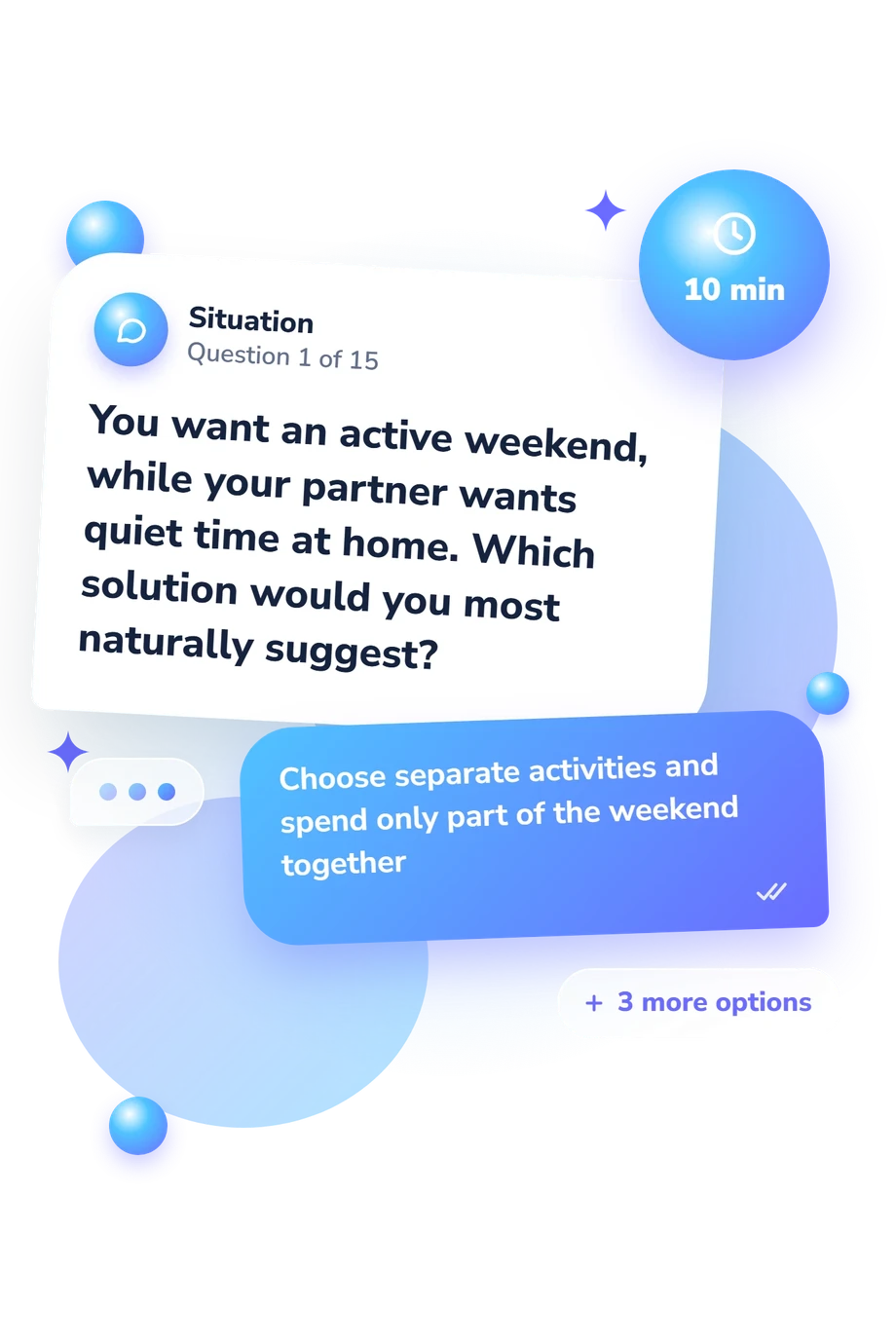
- Choose separate activities and spend only part of the weekend together
- Combine parts of both preferences and check whether the split feels fair
- Alternate whose preferred kind of weekend takes priority
- Choose based on who has the stronger need that particular weekend
- I help with shared details when my partner asks
- We divide recurring tasks explicitly so each person knows their part
- I manage my own tasks while my partner coordinates most shared details
- I track my share and revisit the division when either person's workload changes
- Explain what I meant so they know I was not trying to hurt them
- Acknowledge the impact, listen to what landed badly, and ask what would help repair it
- Ask for a little time to think before discussing it
- Acknowledge that it hurt and then share the intention behind it
Am I Boyfriend Material Quiz - Description and methodology of the test
Readers considering a committed partnership can use this assessment to reflect on how their likely responses fit the partner they want to be. The Am I Boyfriend Material Quiz turns everyday choices into a profile for reflection. It explores whether your relationship approach fits the qualities you want in partnership, functioning as an am i relationship material quiz without reducing the answer to a label.
What This Assessment Explores
Beyond attractiveness or romantic style, this questionnaire examines behaviors relevant to dependable and respectful partnership. It looks at commitments, emotional impact, repair after tension, boundaries, shared choices, and competing priorities. People examining their own relationship approach can use this boyfriend material test to consider dating or committed relationships; the result describes tendencies, not a verdict about character.
The three displayed scales describe these result areas:
- Dependable Follow-Through (0-15) shows commitment management: Flexible approach (0-5), Situational consistency (6-10), or Reliable presence (11-15).
- Emotional Connection and Repair (0-15) reflects emotional communication and reconnection after tension: Private processing (0-5), Selective openness (6-10), or Engaged connection (11-15).
- Respectful Partnership (0-15) reflects autonomy, boundaries, collaboration, and shared priorities: Independence-led (0-5), Cooperative balance (6-10), and Mutual partnership (11-15).
These bands describe tendencies, not universal compatibility.
Methodology and Scientific Basis
Each item presents an everyday relationship scenario with four response options. The respondent chooses the option closest to their typical approach, eliciting a self-reported tendency or likely response in context rather than documenting observed conduct. The test reports three scale scores within the displayed reflective bands; the displayed ranges do not establish item-by-item weights or clinical cutoffs.
The Relationship Quality Interview (Lawrence et al., 2011) is a related published instrument addressing relationship functioning and quality. Buhrmester et al. (1988), Salvatore et al. (2011), and Frei and Shaver (2002) address interpersonal competence, recovery after romantic conflict, and respect or boundaries. The questionnaire is conceptually consistent with relevant constructs in these works, but their published scoring and norms should not be attributed to this test.
The result concerns the respondent’s own answers, so this boyfriend material quiz should be read as a profile of their relationship approach rather than a rating of another person. Mood, relationship context, self-awareness, and social desirability can shape answers, so the bands indicate reflective tendencies rather than clinical norms or a diagnosis.
- Lawrence, Erika, Robin A. Barry, Rebecca L. Brock, Mali Bunde, Amie Langer, Eunyoe Ro, Emily Fazio, Lorin Mulryan, Sara Hunt, Lisa Madsen, and Sandra Dzankovic. (2011). The Relationship Quality Interview: Evidence of Reliability, Convergent and Divergent Validity, and Incremental Utility. Psychological Assessment, 23(1), 44-63. 10.1037/a0021096
- Buhrmester, Duane, Wyndol Furman, Mitchell T. Wittenberg, and Harry T. Reis. (1988). Five Domains of Interpersonal Competence in Peer Relationships. Journal of Personality and Social Psychology, 55(6), 991-1008. 10.1037/0022-3514.55.6.991
- Salvatore, Jessica E., Sally I-Chun Kuo, Ryan D. Steele, Jeffry A. Simpson, and W. Andrew Collins. (2011). Recovering from Conflict in Romantic Relationships: A Developmental Perspective. Psychological Science, 22(3), 376-383. 10.1177/0956797610397055
- Frei, Jennifer R., and Phillip R. Shaver. (2002). Respect in Close Relationships: Prototype Definition, Self-Report Assessment, and Initial Correlates. Personal Relationships, 9(2), 121-139. 10.1111/1475-6811.00008
Updated: