
Am I Asian Quiz
How the Scales are Structured
Who Usually Takes This Test?
See How You Compare
Below is a preview of how scores are typically distributed across each scale.
Example Questions From the Test
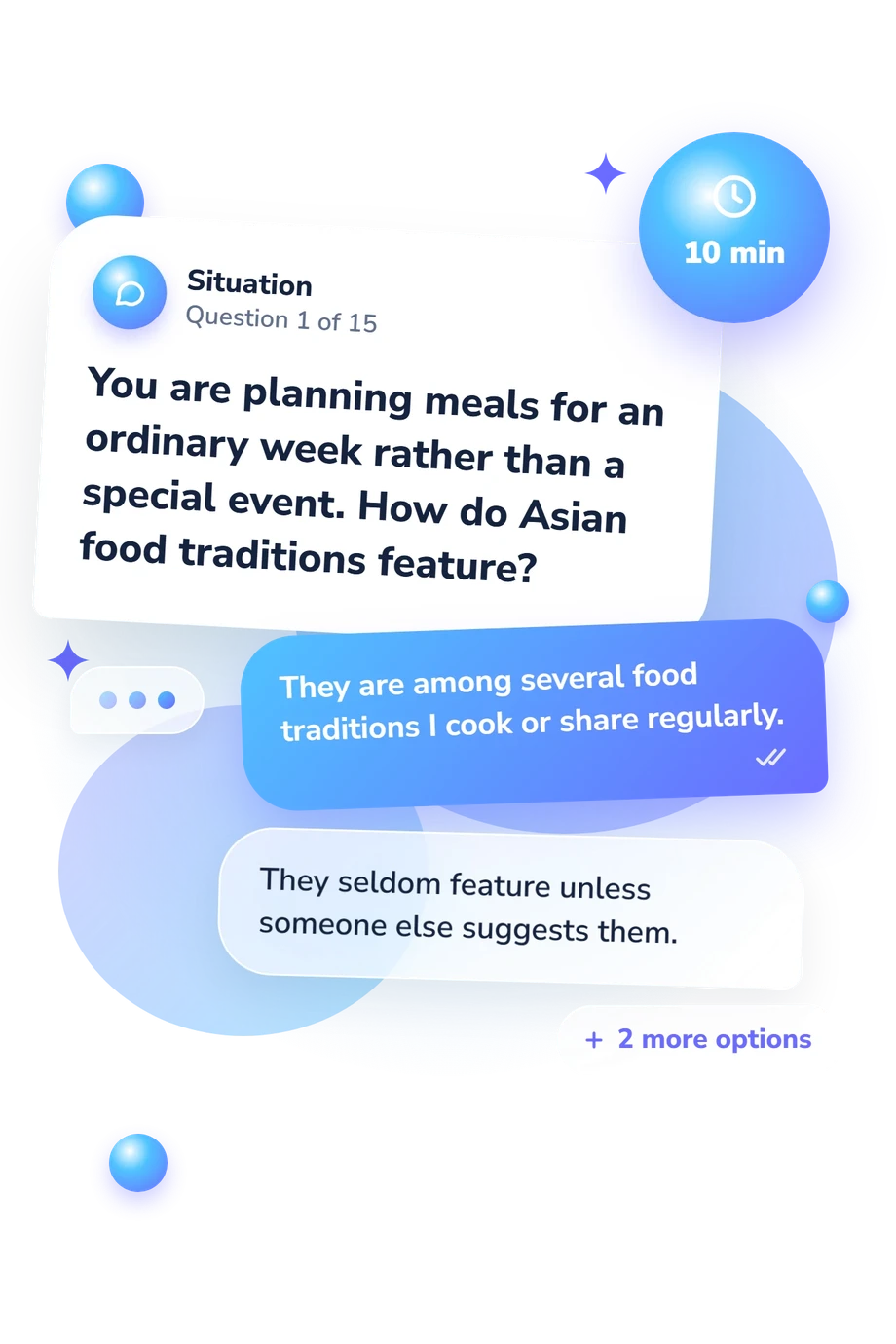
- They are among several food traditions I cook or share regularly.
- They seldom feature unless someone else suggests them.
- A few dishes appear occasionally, often through restaurants or simple recipes.
- They are embedded in my household routines, techniques, or family recipes.
- They are hinted at, but I have few names, places, or details.
- They are central stories told across generations in my family.
- They form one meaningful part of a broader or mixed family story.
- They are not part of the family history known to me.
- No, that is not an identity I use for myself.
- Sometimes; it depends on the country, community, or situation.
- I am considering it, but I am not sure the label fits me.
- Yes, it is an established part of who I am.
Am I Asian Quiz - Description and methodology of the test
For anyone exploring belonging, heritage, or cultural connection, an am i asian quiz can organize a personal question without imposing an outside label. It can also serve as a how asian are you quiz when the goal is to compare several parts of experience rather than reach a yes-or-no verdict. The result is intended for reflection on how identity, cultural life, and family history may connect or diverge.
What This Assessment Explores
The questionnaire examines three related but distinct aspects of cultural identity. A how asian am i quiz can help when self-description, daily participation, and known family history do not line up neatly. Situations involving food, holidays, language, media, community spaces, forms, and conversations make the dimensions concrete. The profile shows where these areas align or diverge rather than issuing a verdict.
These are the three dimensions shown in the result:
- Asian Self-Identification (0-15) reads personal identification: Little identification (0-5), Contextual or layered (6-10), or Strong identification (11-15).
- Cultural Participation (0-15) reads current involvement in traditions, languages, communities, or creative life: Occasional participation (0-5), Active connection (6-10), or Deep participation (11-15).
- Family Heritage Connection (0-15) reads known links to Asian places or diasporas: Limited known linkage (0-5), Some known linkage (6-10), or Strong known linkage (11-15).
Methodology and Scientific Basis
Each item presents a familiar situation with four answer choices covering different forms or degrees of connection. The choices allow mixed backgrounds, uncertainty, context, and partial participation rather than forcing binary responses. Answers produce three separate dimension scores, so the outcome is a pattern rather than a single total or pass/fail judgment.
This multidimensional self-report approach is conceptually consistent with the Ethnocultural Identity Behavioral Index (Yamada et al., 1998), which links ethnocultural identity with cultural behaviors, but this questionnaire is not presented as its adaptation. Oyserman and Sakamoto (1997) add context for Asian American identity, while Phinney’s Multigroup Ethnic Identity Measure (1992) offers a broader reference for ethnic identity across groups. These sources place this asian identity quiz in a wider framework without claiming that it reproduces any published instrument.
Interpret scores as prompts for reflection, not proof of ancestry or a fixed definition of belonging. This online version has no supplied normative sample, clinical cutoff, or standardization claim. Responses may shift with current circumstances, self-awareness, family knowledge, cultural access, and comfort with identity labels.
- Yamada, Ann-Marie, Anthony J. Marsella, and Stan Y. Yamada. “The Development of the Ethnocultural Identity Behavioral Index: Psychometric Properties and Validation with Asian Americans and Pacific Islanders.” Asian American and Pacific Islander Journal of Health, 1998, 6(1), 35-45.
- Oyserman, Daphna, and Izumi Sakamoto. “Being Asian American: Identity, Cultural Constructs, and Stereotype Perception.” The Journal of Applied Behavioral Science, 1997, 33(4), 435-453. 10.1177/0021886397334002
- Phinney, Jean S. “The Multigroup Ethnic Identity Measure: A New Scale for Use with Diverse Groups.” Journal of Adolescent Research, 1992, 7(2), 156-176. 10.1177/074355489272003
Updated: