
Am I Allergic to Coffee Quiz
How the Scales are Structured
Who Usually Takes This Test?
See How You Compare
Below is a preview of how scores are typically distributed across each scale.
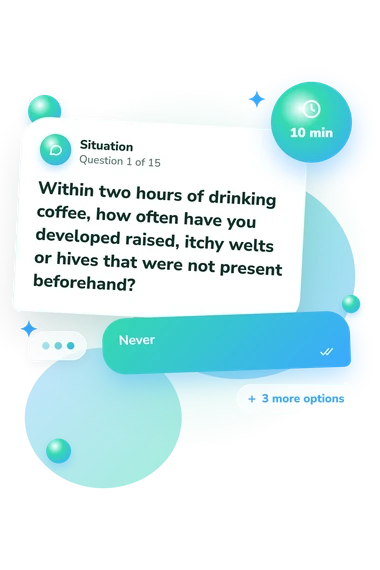
Example Questions From the Test
- Never
- Once, with no repeat episode
- On more than one occasion, but inconsistently
- Nearly every time or during several clearly separate exposures
- I have not experienced a suspected reaction
- Symptoms appear much later, with no consistent timing
- Symptoms usually appear within about two to six hours
- Symptoms consistently begin within minutes to about two hours
- I have had it without the suspected symptoms
- Symptoms have occurred only with added ingredients so far
- I have not compared plain coffee carefully enough to tell
- The same symptoms repeatedly occur with plain black coffee
Am I Allergic to Coffee Quiz - Description and methodology of the test
People who notice hives, swelling, digestive upset, nasal or eye symptoms, throat changes, or breathing problems after coffee can use this questionnaire to organize what happened before discussing it with a clinician. The Am I Allergic to Coffee Quiz helps organize timing, symptoms, and possible exposures so the pattern can be described more clearly. Comparing caffeine sources can help distinguish caffeine reaction symptoms from coffee-specific effects.
What This Assessment Explores
People who can describe episodes can use this questionnaire to review timing, repeatability, ingredients, body systems, and urgency. It asks whether coffee remains plausible after milk, syrups, flavorings, medication, or other exposures are considered.
The result presents three summaries:
- Coffee-Specific Reaction Pattern (0-15) measures repeatability and whether coffee remains plausible after other exposures; Pattern not established (0), Early clue (1-2), and Pattern worth reviewing (3-15).
- Immediate Allergy-Like Symptoms (0-15) summarizes skin, mouth, nose, eye, and digestive symptoms after coffee; No items endorsed (0-0), Limited signal (1-2), and Action warranted (3-15).
- Urgent Reaction Warning Signs (0-15) captures serious throat, breathing, circulation, or worsening symptoms; Not reported here (0), Concerning change (1-2), and Urgent action (3-15).
The summaries describe reported coffee reaction symptoms and possible coffee-specific patterns; urgent-warning results flag potential risk without identifying the trigger or confirming an allergy.
Methodology and Evidence Base
Each item offers four options, moving from no symptom or alternative explanation toward repeated or urgent experiences. It covers timing, repeatability, plain or altered coffee, regular or decaffeinated coffee, other caffeine sources, body systems, and help required. This coffee reaction questionnaire is a self-report tool; its displayed bands are unvalidated reflective summaries rather than diagnostic thresholds, and its scoring rule is not documented.
Scores are shown, but answer weights are not stated. Totals are not probability or severity estimates; a red flag overrides the total. For current breathing difficulty, throat tightness, collapse, confusion, blue or gray lips, or rapid worsening, use prescribed epinephrine if available and seek emergency help.
Evidence is conceptually consistent with Moneret-Vautrin’s 1993 report of a severe reaction involving coffee or a co-exposure. Nakagawa’s 2020 study keeps sodium caseinate in view; Tognetti’s 2014 work supports caffeine-related urticaria-angioedema, and Manavski’s 2012 research indicates that coffee proteins can be allergenic. These studies validate neither this questionnaire nor its scoring.
Recall, context, incomplete ingredient records, and coincidence can affect results. Repeated episodes, timing, and recorded ingredients improve medical review.
- D.A. Moneret-Vautrin, Gisèle Kanny, J.P. Faller, D. Levan, C. Kohler. Severe anaphylactic shock with cardiac arrest caused by coffee and gum arabic, potentiated by beta-blocking eye drops. La Revue de Médecine Interne. 1993;14(2):107-111. 10.1016/S0248-8663(05)81260-3
- Yukinobu Nakagawa, Kaori Odomari, Yorihisa Kotobuki, Eiji Kiyohara, Ichiro Katayama, Manabu Fujimoto. Anaphylaxis caused by sodium caseinate contained in canned coffee. Allergology International. 2020;69(1):157-158. 10.1016/j.alit.2019.08.005
- Linda Tognetti, Francesco Murdaca, Michele Fimiani. Caffeine as a cause of urticaria-angioedema. Indian Dermatology Online Journal. 2014;5(Suppl 2):S113-S115. 10.4103/2229-5178.146181
- Nikolay Manavski, Ulrike Peters, Reinhold Brettschneider, Marcus Oldenburg, Xaver Baur, Cordula Bittner. Cof a 1: Identification, expression and immunoreactivity of the first coffee allergen. International Archives of Allergy and Immunology. 2012;159(3):235-242. 10.1159/000337461