
4 Elements Quiz
How the Scales are Structured
Who Usually Takes This Test?
See How You Compare
Below is a preview of how scores are typically distributed across each scale.
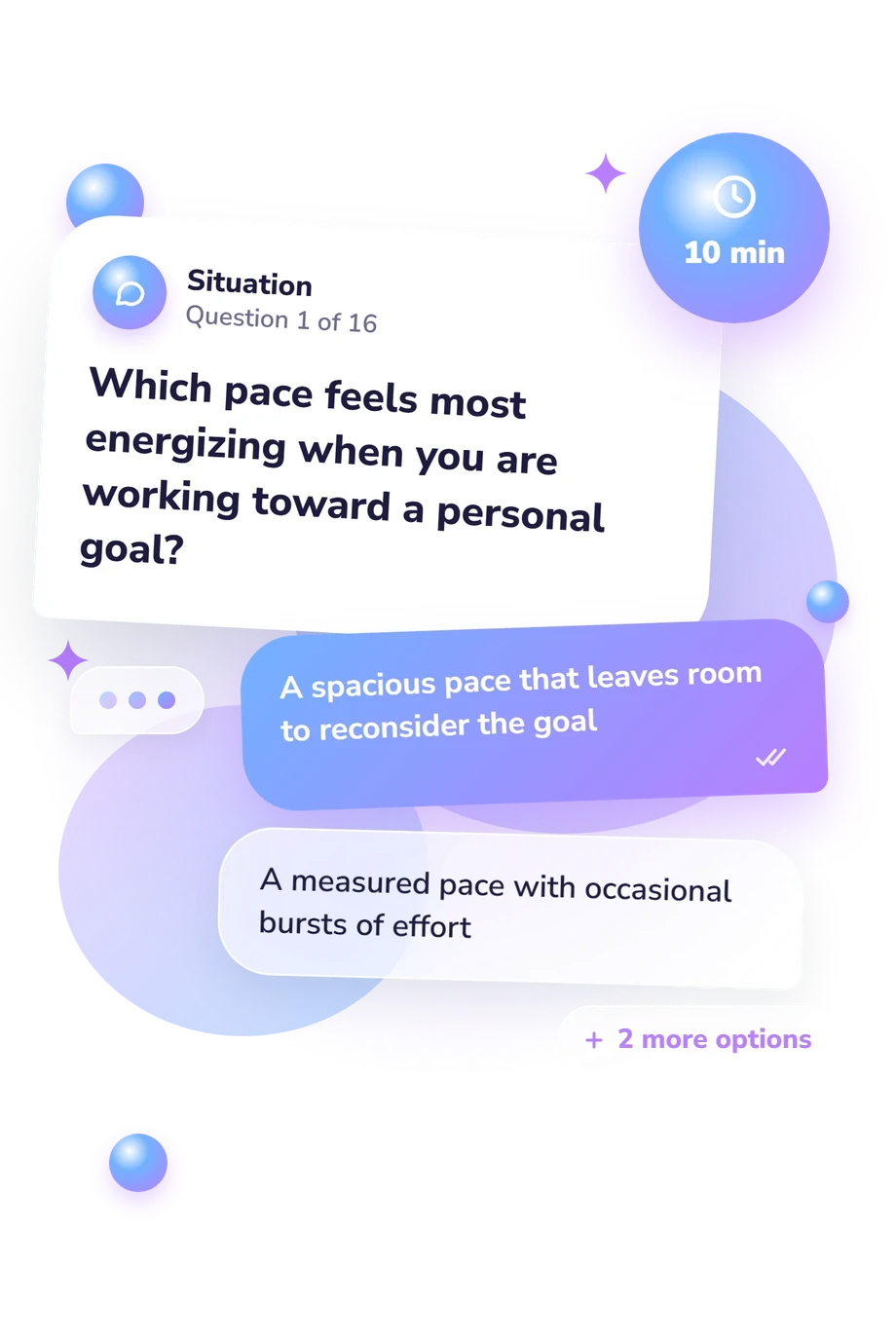
Example Questions From the Test
- A spacious pace that leaves room to reconsider the goal
- A measured pace with occasional bursts of effort
- A brisk pace that produces visible progress quickly
- An intense push that turns motivation into immediate momentum
- Choose one practical subject and stay focused on it
- Visit a few sections connected to an existing interest
- Browse broadly and investigate whatever catches my attention
- Leap between unrelated topics and make connections among them
- Pause until a clear replacement plan can be established
- Accept a practical substitute even if the mood feels different
- Adjust the plan according to what everyone seems to need
- Let the day unfold and follow the emotional flow of the moment
4 Elements Quiz - Description and methodology of the test
For readers who want to reflect on how they approach ideas, stability, action, and feeling, the 4 Elements Quiz offers a four-part view of preferences. It suits anyone comparing reactions across planning, change, social exchange, and emotional situations. The questionnaire works as a four elements personality test, organizing those observations for conversations about work, relationships, and decisions.
What This Assessment Explores
The questions turn everyday choices into four broad preferences, including openness to ideas, practical steadiness, energetic initiative, and emotional responsiveness. They touch situations involving planning, novelty, disagreement, sustained effort, intuition, and noticing another person's feelings. In that sense, this four elements personality quiz describes tendencies in how you engage with experience, not a single permanent type.
The four displayed scales are the result dimensions shown to the reader:
- Air (0-12) shows affinity for ideas and changing perspectives: Grounded Breeze (0-4), Open Current (5-8), or High Wind (9-12).
- Earth (0-12) shows preference for stability and follow-through: Roaming Soil (0-4), Firm Footing (5-8), or Deep Roots (9-12).
- Fire (0-12) reflects initiative and momentum: Quiet Spark (0-4), Steady Flame (5-8), or Bright Blaze (9-12).
- Water (0-12) captures emotional attunement and adaptation: Sheltered Pool (0-4), Moving Stream (5-8), or Deep Current (9-12).
Methodology and Scientific Basis
The response format presents short everyday scenarios with four answer choices, each expressing a different way of approaching the situation. The items cover pace, exploration, planning, challenge, motivation, practical follow-through, intuition, emotional cues, social exchange, personal priorities, and emotional boundaries in relationships. Selecting the response that feels most natural creates a profile across four scores; the scoring shown is comparative, so the highest score marks the strongest affinity, while scores within one point suggest a blend.
Viewed as a four elements personality profile, the output is conceptually consistent with the 4Elements Inventory (Bahbouh et al., 2012). A later analysis by Höschlová and Bahbouh (2019) examined that published inventory, while Merenda (1987) and Stelmack and Stalikas (1991) provide broader four-factor and historical temperament context. These references support the framework's lineage, but they do not prove that this online questionnaire has identical norms, reliability, or validity to the published inventory.
Because it is a current self-reported preference pattern, the result may be influenced by mood, circumstances, and self-awareness, so it describes present tendencies and current preferences rather than a fixed identity.
- Bahbouh, Radvan, Eva Rozehnalová, Dana Fajmonová, and Jiřina Sněhotová (2012). “4Elements Inventory: Elements as an Approach to Understanding the Personality.” In New Perspectives of Psychodiagnostics, pp. 17-32. Prague: QED GROUP.
- Höschlová, Eva, and Radvan Bahbouh (2019). “Replication of psychometric analysis of the 4Elements Inventory (4EI) in the general population.” In J. Procházka, T. Kratochvíl, and M. Vaculík (Eds.), Psychology of Work and Organization 2019, pp. 53-64. Brno: MUNI Press. 10.5817/CZ.MUNI.P210-9488-2019-5.
- Merenda, P. F. (1987). “Toward a four-factor theory of temperament and/or personality.” Journal of Personality Assessment, 51(3), 367-374. 10.1207/s15327752jpa5103_4.
- Stelmack, Robert M., and Anastassios Stalikas (1991). “Galen and the humour theory of temperament.” Personality and Individual Differences, 12(3), 255-263. 10.1016/0191-8869(91)90111-N.
Updated: