
WW1 Quiz
How the Scales are Structured
Who Usually Takes This Test?
See How You Compare
Below is a preview of how scores are typically distributed across each scale.
Example Questions From the Test
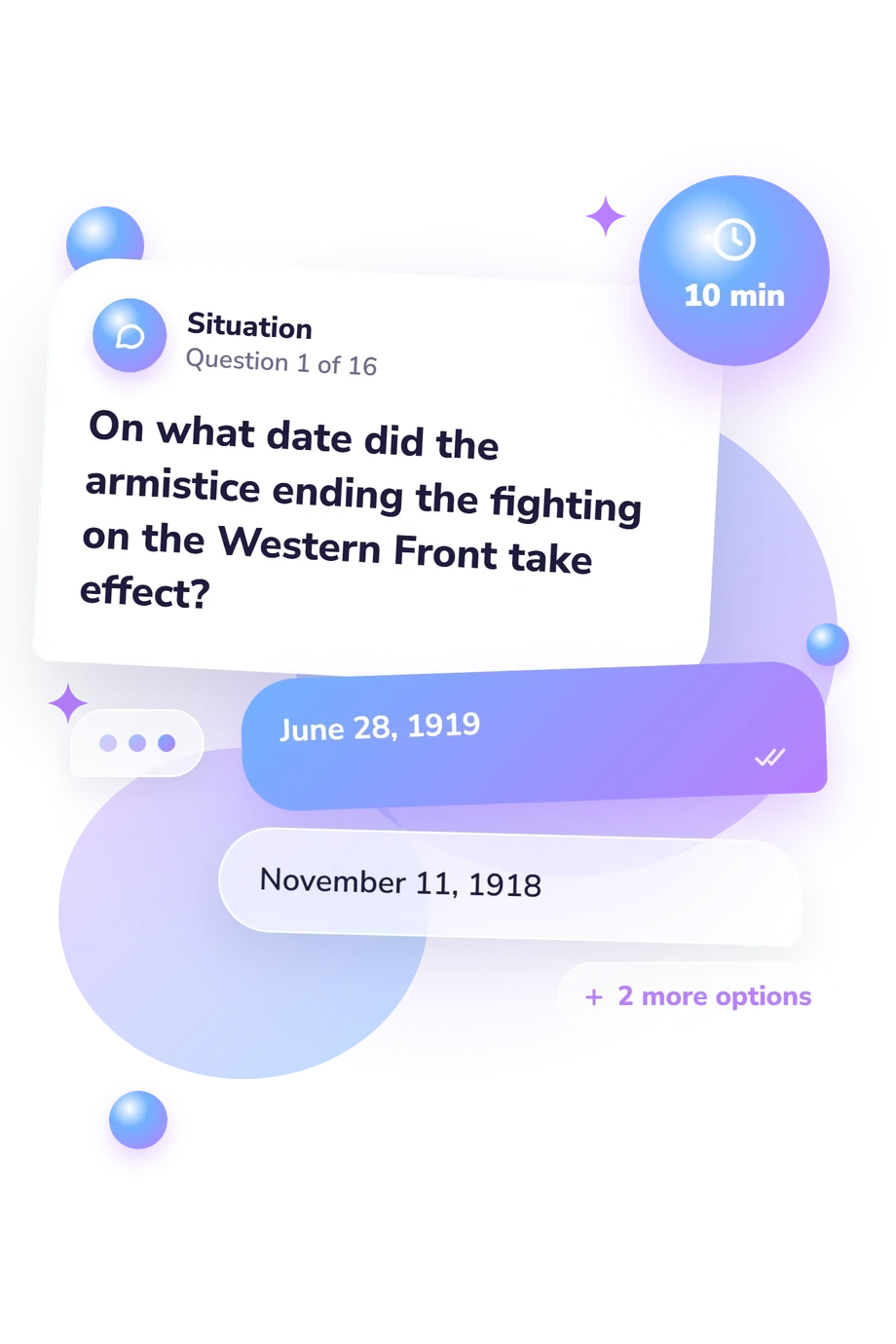
- June 28, 1919
- November 11, 1918
- July 28, 1914
- March 3, 1918
- The Treaty of Sèvres
- The Treaty of Trianon
- The Treaty of Brest-Litovsk
- The Treaty of Saint-Germain
- Chemical agents such as chlorine or mustard gas
- Artillery shell fragments
- Diseases transmitted by lice
- Smoke produced by steam-powered vehicles
WW1 Quiz - Description and methodology of the test
Readers who want to check their grasp of the conflict can use the WW1 Quiz as a focused introduction to its chronology, decisions, and consequences. It is suited to curious learners, students, and history readers who want to connect famous events with the wider course of the war; questions in this World War 1 quiz make those connections explicit.
What This Assessment Explores
The assessment measures knowledge of the First World War, from the 1914 crisis through the armistice and postwar settlement. It also asks how military operations affected civilian life. This WWI quiz gives learners an overall level of knowledge rather than a topic-by-topic profile, while suggesting where further reading may be useful.
Three thematic groups shape what the result can tell you:
- Causes and escalation connect Sarajevo, alliances, nationalism, and decisions that widened the crisis into general war.
- Fronts, campaigns, and technology show differences among the Western Front, Eastern Front, Gallipoli, and the Somme.
- Politics and society link total war to rationing, industry, women’s work, diplomacy, and the League of Nations.
Results appear on the WW1 Knowledge scale (0-16). Bands are Foundations to build (0-6), Developing knowledge (7-12), and Strong knowledge (13-16); they describe performance on this set, not complete expertise.
Methodology and Evidence Base
Each item presents a historical prompt with four answer choices, and one point is awarded for each correct response. The total therefore reflects demonstrated performance across this set rather than an estimate of general historical ability. With four choices per item, this World War I quiz tests recognition and factual recall, while careful reading still matters.
The questionnaire is conceptually consistent with Winter (2014) and with Beckett, Bowman, and Connelly (2017), whose works provide historical and military context; it is not an adaptation of either work.
Multiple-choice results have limits. Reich (2013) notes that answers can reflect recognition, wording, prior instruction, and test familiarity as well as deeper reasoning. No population norms are claimed, so the bands describe this item set rather than general historical ability. The result from this World War One quiz can guide broad further study, while fuller understanding still requires reading across theatres and sources.
- Winter, Jay, ed. The Cambridge History of the First World War: Volume I: Global War. Cambridge University Press, 2014. 10.1017/CHO9780511675669.
- Beckett, Ian, Timothy Bowman, and Mark Connelly. The British Army and the First World War. Cambridge University Press, 2017. 10.1017/9780511794377.
- Reich, Gabriel A. “Imperfect Models, Imperfect Conclusions: An Exploratory Study of Multiple-Choice Tests and Historical Knowledge.” The Journal of Social Studies Research, 37(1), 2013, 3-16. 10.1016/j.jssr.2012.12.004.
Updated: