
Would I Be a Good Mom Quiz
How the Scales are Structured
Who Usually Takes This Test?
See How You Compare
Below is a preview of how scores are typically distributed across each scale.
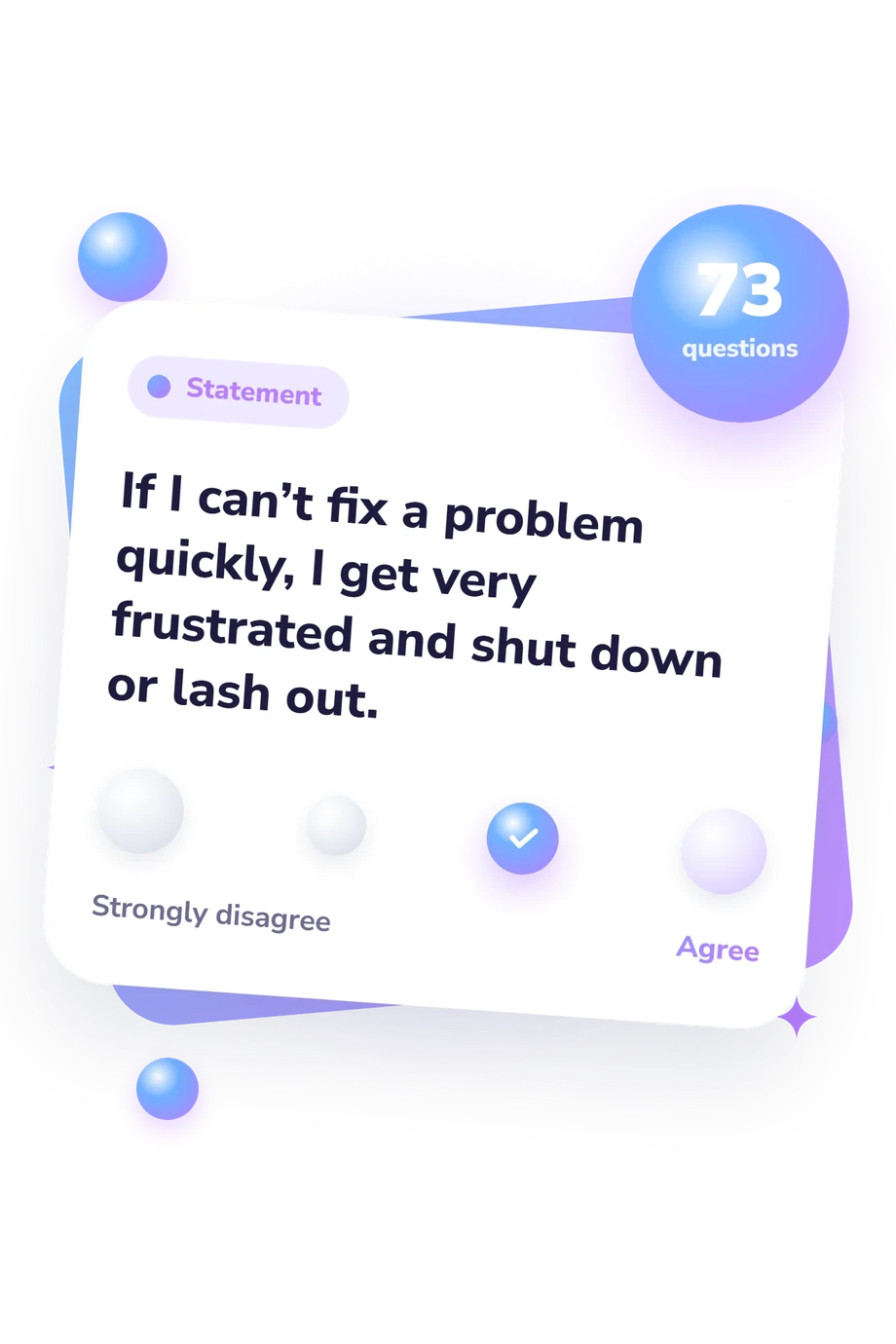
Example Questions From the Test
- Strongly disagree
- Disagree
- Not sure
- Agree
- Strongly disagree
- Disagree
- Not sure
- Agree
- Strongly disagree
- Disagree
- Not sure
- Agree
Would I Be a Good Mom Quiz - Description and methodology of the test
People thinking about parenthood can use the would i be a good mom quiz to examine how they might respond to a child’s feelings, pressure, and everyday demands. It suits adults seeking structured reflection rather than a yes-or-no verdict. People wondering whether they will be a good mom can use this parenting self-assessment to connect personal strengths with practical areas to prepare, discuss, or support.
What This Assessment Explores
Readiness is multidimensional. Items cover emotional responsiveness, frustration and fatigue reactions, and preparation for routines, boundaries, caregiving, and help. Results describe tendencies and pressure points, not predictions.
The displayed scales are:
- Emotional Attunement (0-20) measures noticing, validating, and responding to a child’s emotions and your own; Developing (0-8), Emerging (9-14), and Strong (15-20) are bands.
- Patience & Stress Tolerance (0-20) measures regulation through frustration, sleep loss, conflict, and chaos; Easily Overwhelmed (0-7), Mixed Coping (8-14), and Steady Under Pressure (15-20) are the bands.
- Practical Readiness & Support (0-20) measures planning, resources, help-seeking, and boundaries; Needs Support (0-9), Building Readiness (10-15), and Strong Readiness (16-20) are the bands.
The profile highlights skills to practise and supports to arrange for parenthood readiness. Higher bands indicate stronger functioning on the relevant dimension; lower bands point to skills or supports that may need attention.
Methodology and Evidence Base
This is a dimensional self-report questionnaire. The representative items use four-option responses, including agreement scales, degree scales, and choices about available help. Themes cover emotional cues, reactions to crying or conflict, self-soothing, repair, boundaries, routines, and support.
Responses create a three-part profile, but the questionnaire does not state how many points responses contribute. Read ranges as displayed result bands, not a reverse-engineered scoring formula.
Its closest conceptual anchor is the Healthy Families Parenting Inventory. This questionnaire is conceptually consistent with that instrument’s focus on parenting functioning, but is not an adaptation of it. The Parental Reflective Functioning Questionnaire supports its focus on mental-state interpretation; the Parenting Stress Index-Short Form and Johnston and Mash’s measure add context for stress and parenting efficacy.
As a parenting readiness questionnaire, it offers a reflection profile without stated reliability estimates, clinical norms, or diagnostic cutoffs. Self-report can shift with mood, self-awareness, and impression management, so interpret results alongside lived experience and concrete support planning.
- Krysik, Judy, & LeCroy, Craig W. (2012). Development and initial validation of an outcome measure for home visitation: The Healthy Families Parenting Inventory. Infant Mental Health Journal, 33(5), 496-505. 10.1002/imhj.21343
- Luyten, Patrick, Mayes, Linda C., Nijssens, Liesbet, & Fonagy, Peter. (2017). The parental reflective functioning questionnaire: Development and preliminary validation. PLOS ONE, 12(5), e0176218. 10.1371/journal.pone.0176218
- Haskett, Mary E., Ahern, Lisa S., Ward, Caryn S., & Allaire, Jason C. (2006). Factor structure and validity of the Parenting Stress Index-Short Form. Journal of Clinical Child and Adolescent Psychology, 35(2), 302-312. 10.1207/s15374424jccp3502_14
- Johnston, Charlotte, & Mash, Eric J. (1989). A measure of parenting satisfaction and efficacy. Journal of Clinical Child Psychology, 18(2), 167-175. 10.1207/s15374424jccp1802_8
Updated: