
Will He Ask Me Out Quiz
How the Scales are Structured
Who Usually Takes This Test?
See How You Compare
Below is a preview of how scores are typically distributed across each scale.
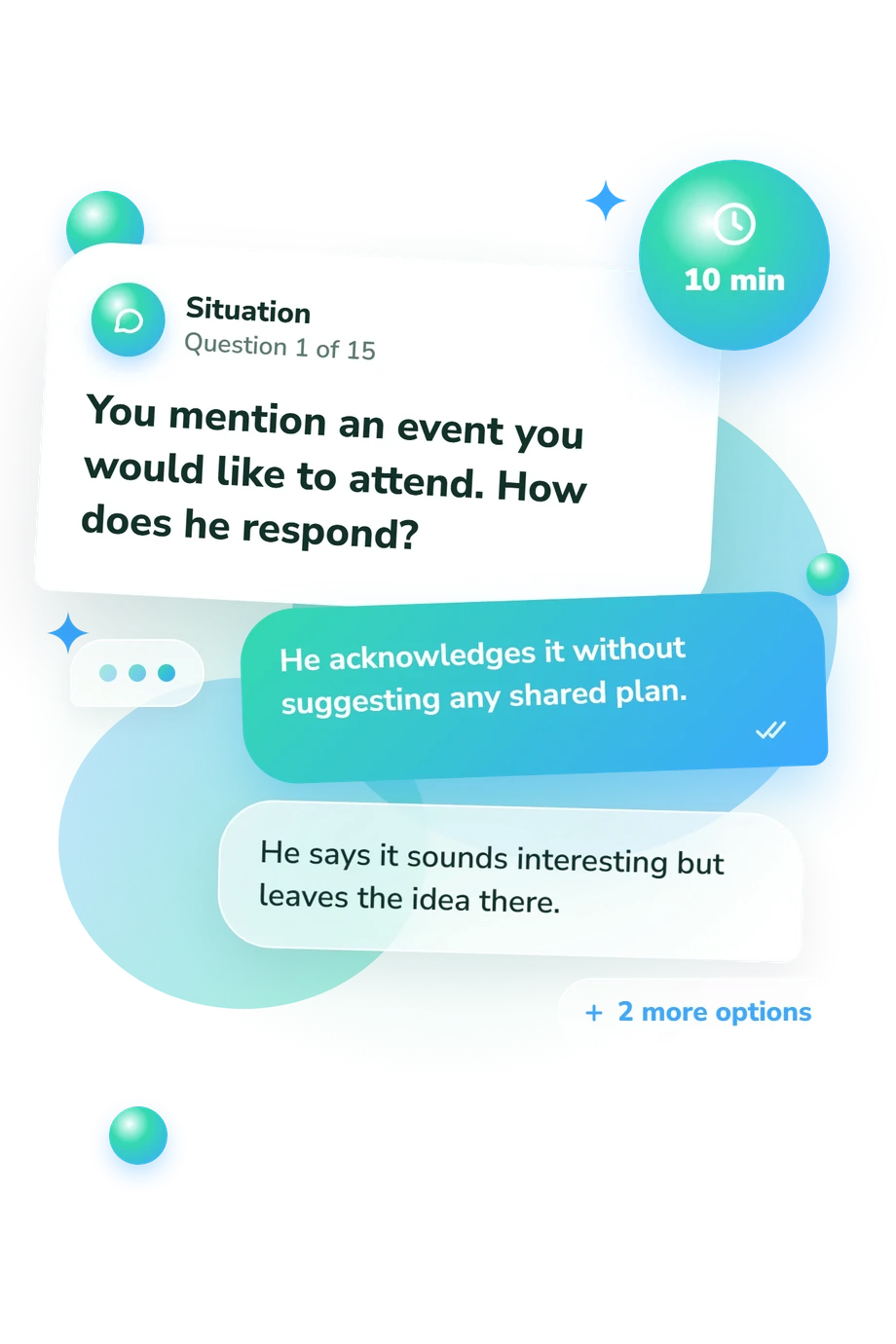
Example Questions From the Test
- He later suggests a specific time or checks when I am free.
- He brings the idea up again but does not settle the details.
- The idea moves forward only if I organize it.
- It generally remains a passing comment.
- His response seems much the same as it is for anyone else.
- He acknowledges me politely, then returns to what he was doing.
- He visibly brightens or makes an effort to talk with me.
- He often notices quickly and finds a natural way to include me.
- I nearly always start them.
- He starts some, though I initiate more often.
- We initiate at roughly similar rates.
- He frequently finds a reason to start a conversation with me.
Will He Ask Me Out Quiz - Description and methodology of the test
For someone trying to read a developing connection without treating one warm exchange as proof, the Will He Ask Me Out Quiz offers a structured look at observable behavior. It is suited to a person weighing whether to make a small, respectful opening. Framed as a quiz about whether your crush will ask you out, it organizes clues rather than promises an outcome.
What This Assessment Explores
The questionnaire distinguishes general friendliness from directed dating possibility. Items cover one-to-one plans, personal curiosity, remembered details, availability, cancellations, clear openings, and contact after good conversations. Timing remains outside its reach: it is not a quiz about whether your crush will ask you out tomorrow.
The result separates three dimensions:
- Dating Intent and Opportunity (0-15) reflects romantic framing and a realistic opening: Unclear opening (0-5), Possible opening (6-10), or Stronger opening (11-15).
- Focused Interest (0-15) reflects attention directed toward you: Limited evidence (0-5), Mixed signals (6-10), or Consistent focus (11-15).
- Initiative and Follow-Through (0-15) reflects active contact: Little initiative (0-5), Uneven effort (6-10), or Sustained effort (11-15).
Together, these dimensions compare isolated moments with a broader pattern, while mixed results leave friendship, uncertainty, or circumstance open.
Methodology and Scientific Basis
Each item describes a social situation with four response choices, ranging from neutral evidence to clearer interest, initiative, or follow-through. Responses are combined within the displayed dimensions; higher bands indicate more evidence there, not a probability that an invitation will occur.
The method is conceptually consistent with Muehlenhard et al. (1986), which examined verbal and nonverbal cues linked with dating interest. It also fits Clark et al. (1999) on strategic behavior during romantic initiation and Eastwick et al. (2023) on predicting early romantic interest from limited information. This online questionnaire is not a standardized adaptation of those studies.
Claims about whether he will ask you out should be treated as pattern-based, not certain. A quiz about when he will ask you out cannot establish timing. Self-report can be shaped by memory, selective attention, current hopes, and his changing circumstances. No quiz about whether he will ask you out can be fully accurate when observations are incomplete; a high score may support a low-pressure conversation, while a lower score may reflect limited opportunity rather than no interest.
- Muehlenhard, C. L., Koralewski, M. A., Andrews, S. L., & Burdick, C. A. (1986). Verbal and nonverbal cues that convey interest in dating: Two studies. Behavior Therapy, 17(4), 404-419. 10.1016/S0005-7894(86)80071-5
- Clark, C. L., Shaver, P. R., & Abrahams, M. F. (1999). Strategic Behaviors in Romantic Relationship Initiation. Personality and Social Psychology Bulletin, 25(6), 709-722. 10.1177/0146167299025006006
- Eastwick, P. W., Joel, S., Carswell, K. L., Molden, D. C., Finkel, E. J., & Blozis, S. A. (2023). Predicting romantic interest during early relationship development: A preregistered investigation using machine learning. European Journal of Personality, 37(3), 276-312. 10.1177/08902070221085877
Updated: