
Freudly+971 508685814hello@freudly.ai
Freudly
gender

Femboy Quiz

Femboy Quiz: Am I a Femboy? Identity & Style Test - FreudlyFemboy Quiz: Explore gender expression and identity. Free quiz with supportive insights and community resources. Start now.en
This online self-reflection questionnaire explores preferences for femme style, flexibility in gender expression, and comfort with labels and social situations. In 75 questions over about 10 minutes, the femboy quiz offers a profile to support personal reflection and help you understand how your presentation preferences may vary across contexts.
Questions: 7510 minutes
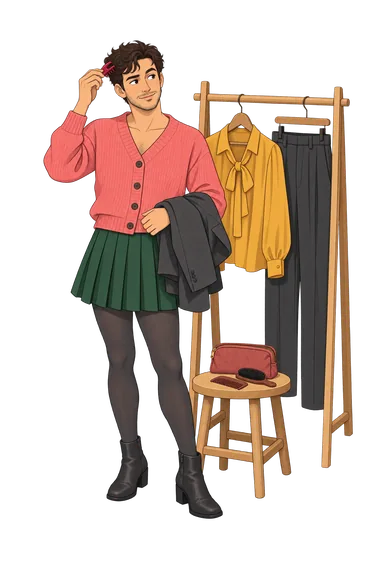
Femboy Quiz: man chooses soft detail beside jackets.
March 25, 2026March 25, 2026Material has been updatedMarch 25, 2026Material has been published
12,855 views
10,681 completion
614 likes
Daniel HallPsychologist · Test reviewer
614 likes
Scale Explorer

How the Scales are Structured

Femme Style PreferenceFSP
Measures your preference for feminine-coded aesthetics in clothing, grooming, and overall presentation.
example score9/40
9/40Mostly neutral/masc-leaningexample score
0 – 13Mostly neutral/masc-leaning
14 – 26Mixed or situational femme
27 – 40Strongly femme-presenting
A score of 9 suggests you generally prefer a more neutral or masculine-leaning look, with only occasional interest in feminine-coded styling.
Gender Expression FlexibilityGEF
Measures how comfortable you are mixing masculine and feminine presentation across different situations and experimenting with your expression.
example score20/30
20/30Situational Blenderexample score
0 – 10Style-Consistent
11 – 20Situational Blender
21 – 30Highly Fluid
A score of 20 suggests you’re fairly comfortable blending masculine and feminine elements when it fits the context, even if you don’t switch styles all the time.
Label & Social ComfortL&SC
Measures comfort with using or being perceived with labels like “femboy” and navigating social situations while presenting more femme.
example score7/20
7/20Guardedexample score
0 – 7Guarded
8 – 14Selective
15 – 20Comfortable
A score of 7 suggests you may feel cautious about claiming the label or presenting femme in social settings, preferring more control over when and with whom you share it.
just completed the test
DATA-BASED USER COHORTS

Who Usually Takes This Test?

Curious gender explorers
41%OF USERS
People who are questioning where they land on the masculine–feminine spectrum and want a low-pressure way to reflect on labels, comfort, and boundaries.
Style experimenters
34%OF USERS
Folks who enjoy trying softer or more feminine looks and want ideas for outfits, presentation tweaks, and safe ways to test the vibe.
Partners and friends
25%OF USERS
People supporting someone who may be exploring a femboy or femme-leaning style and want language for respectful communication and encouragement.
BASED ON AGGREGATED, ANONYMIZED DATA FROM TENS OF THOUSANDS OF FREUDLY USERS.
Benchmarking

See How You Compare

Once you complete the test, your results are compared with real-world data from people in your country.
Below is a preview of how scores are typically distributed across each scale.
Shaded area — where most people score
Dot — the average
You — your score lands on each curve after the test— your score, after the test
Femme Style PreferenceFSP
You?
Average12.3
Typical rangeTypical4.7 – 19.8
Possible0 – 40
Gender Expression FlexibilityGEF
You?
Average16
Typical rangeTypical11.2 – 20.8
Possible0 – 30
Label & Social ComfortL&SC
You?
Average13.6
Typical rangeTypical10.9 – 16.4
Possible0 – 20
Featured On
SAMPLE QUESTIONS

Example Questions From the Test

Answer for how you like to look, move, and be read by other people, not for a label you think you should claim. This quiz asks about feminine and androgynous style, comfort with the word femboy, and the boundaries you want in public and with friends. There are 75 items. If a setting changes your answer, choose what is most often true. Share the result only where it feels safe.
    • Strongly disagree
    • Disagree
    • Not sure
    • Agree
    • Strongly disagree
    • Disagree
    • Not sure
    • Agree
    • Strongly disagree
    • Disagree
    • Not sure
    • Agree
WHAT THE TEST MEASURES

Femboy Quiz - Description and methodology of the test

gender
identity

People who are curious about how their clothing, grooming, and social presentation fit together can use this femboy quiz as a structured starting point for self-reflection. As a femboy test, it focuses on patterns of femme preference, flexibility, and comfort rather than assigning a fixed identity. The result can help you notice which forms of expression feel natural, experimental, context-dependent, or socially sensitive.

What This Assessment Explores

Gender expression involves appearance, setting, and comfort, so this assessment suits people exploring femme presentation or wondering why a style feels right in one context but less comfortable in another. Rather than treating whether you are a femboy as decisive, this profile separates preference, flexibility, and social ease instead of treating identity as one fixed score.

The result has three dimensions:

  • Femme Style Preference (0-40) measures your pull toward feminine-coded clothing, grooming, and presentation: Mostly neutral/masc-leaning (0-13), Mixed or situational femme (14-26), or Strongly femme-presenting (27-40).
  • Gender Expression Flexibility (0-30) measures openness to mixing or changing styles: Style-Consistent (0-10), Situational Blender (11-20), or Highly Fluid (21-30).
  • Label & Social Comfort (0-20) measures ease with labels, disclosure, boundaries, and femme presentation: Guarded (0-7), Selective (8-14), or Comfortable (15-20).

Together, the profile shows how preference, adaptability, and social ease may relate.

Methodology and Scientific Basis

Each item uses four choices: Strongly disagree, Disagree, Not sure, or Agree. Prompts cover grooming, clothing, cute or delicate aesthetics, experimentation across gendered styles, reactions to misreading, public or online presentation, disclosure, and boundaries. As a femboy style quiz, the questionnaire groups responses into three displayed scales; higher values indicate more of the tendency defined by each scale. The format does not show whether items are weighted identically or how many points a response adds.

Conceptually, the dimensions align with CAGES (Spencer, 2007), which examines comfort and conformity in gender expression, and with Wylie et al. (2010), which provides a brief measure of socially assigned gender nonconformity. This questionnaire is conceptually consistent with those works, not an adaptation, reproduction, or validation of either instrument.

Interpret the profile across its own dimensions: stronger style preference does not automatically mean greater fluidity or social comfort. Self-report responses can shift with current safety, relationships, audience, mood, and self-awareness. The questionnaire is not presented as a standardized clinical instrument, so its bands are descriptive prompts for reflection rather than diagnostic cutoffs.

Literature:
  • Spencer, Katherine G. (2007). Development and validation of the Comfort and Conformity of Gender Expression Scale (CAGES). Doctoral dissertation, University of Missouri-Columbia.
  • Wylie, Sarah A., Heather L. Corliss, Vanessa Boulanger, Lisa A. Prokop, and S. Bryn Austin. (2010). Socially assigned gender nonconformity: A brief measure for use in surveillance and investigation of health disparities. Sex Roles, 63(3-4), 264-276. 10.1007/s11199-010-9798-y

Updated:

Popular tests
Comments
Leave a Comment