
Intermittent Explosive Disorder Test
How the Scales are Structured
Who Usually Takes This Test?
See How You Compare
Below is a preview of how scores are typically distributed across each scale.
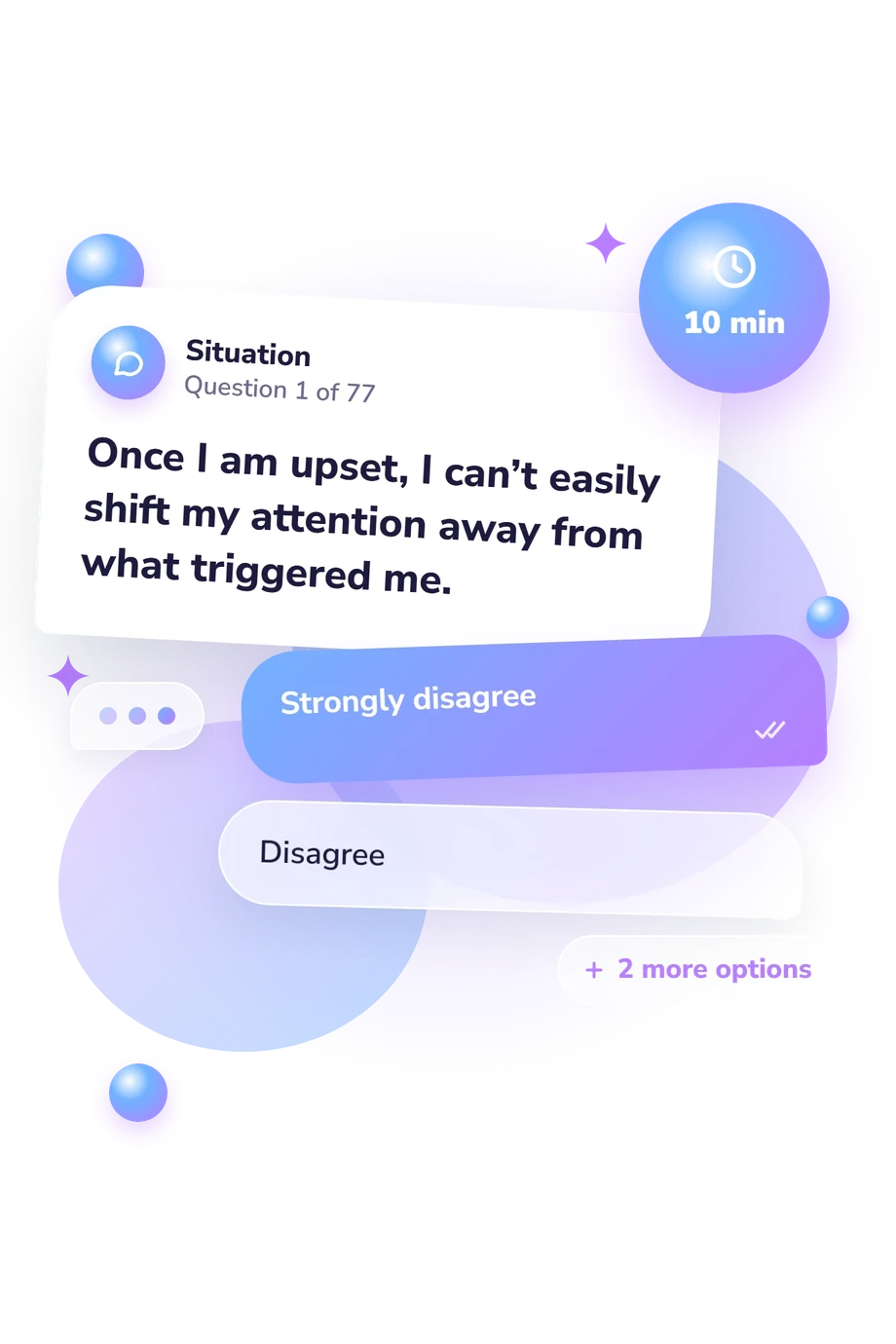
Example Questions From the Test
- Strongly disagree
- Disagree
- Not sure
- Agree
- Never
- Rarely
- Sometimes
- Often
- Strongly disagree
- Disagree
- Not sure
- Agree
Intermittent Explosive Disorder Test - Description and methodology of the test
People who notice recurring explosive reactions, rapid escalation, or damaging consequences may use this anger test to organize what they are experiencing. The anger issues test focuses on patterns that can be difficult to judge during or immediately after an outburst. Its result provides a profile of impulse control, recurrence, and aftermath, helping readers identify which areas deserve closer attention and more deliberate self-reflection.
What This Assessment Explores
This screener examines rapid escalation, difficulty stopping anger, repeated verbal or physical outbursts, and consequences that continue after conflict ends. Items address property damage, conflict with close others, failed coping attempts, regret, and practical disruption. An anger management test can help distinguish ordinary anger from a pattern marked by loss of control and difficult aftermath.
The result separates the pattern into three dimensions:
- Impulse Control Difficulty (0-20) shows stopping or de-escalation difficulty; Lower difficulty 0-6, Moderate difficulty 7-13, Higher difficulty 14-20.
- Life Impact & Aftermath (0-20) reflects relationship, work or school, legal or financial, and emotional consequences; Low impact 0-6, Moderate impact 7-13, High impact 14-20.
- Outburst Frequency (0-20) indicates recurrent verbal or physical episodes; Low frequency 0-6, Moderate frequency 7-13, High frequency 14-20.
Together, the bands show whether the stronger signal concerns regulation, recurrence, or consequences.
Methodology and Scientific Basis
Response formats match each item. Statements use four-point agreement choices; other questions ask about frequency, recent time windows, consequences, or event counts, with options such as Never-Often and yes/no selections. This captures both felt loss of control and observable recurrence.
As an anger quiz, the questionnaire groups responses into the three displayed dimensions and reports one score for each. The bands organize the profile; they are not diagnostic cutoffs or confirmation of IED.
The content is conceptually consistent with IED-SQ (Coccaro et al., 2017), a published DSM-5 screening questionnaire for intermittent explosive disorder, but this online questionnaire is not a direct reproduction and should not be assumed to share its standardization. Coccaro (2012) links IED with impulsive aggression; Kulper et al. (2015) examine aggressive-outburst experience; and Rynar and Coccaro (2018) address psychosocial impairment. These sources support the focus on regulation, recurrence, and aftermath without proving identical validity for this version.
Self-reports can shift with memory, current stress, shame, minimization, or limited awareness of others’ experience. Read the result as a structured snapshot of reported patterns, interpreted within its own bands.
- Coccaro, Emil F., Mitchell E. Berman, and Michael S. McCloskey. (2017). Development of a screening questionnaire for DSM-5 intermittent explosive disorder (IED-SQ). Comprehensive Psychiatry, 74, 21-26. 10.1016/j.comppsych.2016.12.004
- Kulper, Daniel A., Evan M. Kleiman, Michael S. McCloskey, Mitchell E. Berman, and Emil F. Coccaro. (2015). The experience of aggressive outbursts in Intermittent Explosive Disorder. Psychiatry Research, 225(3), 710-715. 10.1016/j.psychres.2014.11.008
- Coccaro, Emil F. (2012). Intermittent explosive disorder as a disorder of impulsive aggression for DSM-5. American Journal of Psychiatry, 169(6), 577-588. 10.1176/appi.ajp.2012.11081259
- Rynar, Lauren, and Emil F. Coccaro. (2018). Psychosocial impairment in DSM-5 intermittent explosive disorder. Psychiatry Research, 264, 91-95. 10.1016/j.psychres.2018.03.077
Updated: