
Which Minion Are You Quiz
How the Scales are Structured
Who Usually Takes This Test?
See How You Compare
Below is a preview of how scores are typically distributed across each scale.
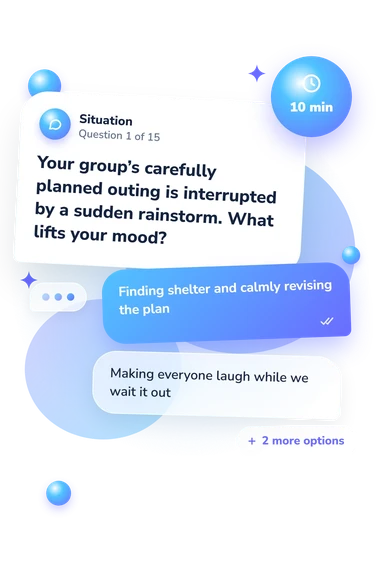
Example Questions From the Test
- Finding shelter and calmly revising the plan
- Making everyone laugh while we wait it out
- Noticing how different and exciting everything looks in the rain
- Checking that everyone is comfortable and included
- A small, unusual detail that makes the place feel magical
- The layout and what everyone needs to know
- The sounds, atmosphere, and possibility of entertainment
- A friendly face who might explore it with me
- I quickly establish a replacement plan so nobody is stuck
- I check how everyone feels before deciding what comes next
- I shrug, adapt, and look for the fun in the new direction
- I become curious about the unexpected possibilities
Which Minion Are You Quiz - Description and methodology of the test
People who enjoy playful character-based reflection can use the Which Minion Are You Quiz to explore whether their choices lean toward curiosity, responsibility, or relaxed self-expression. The result gives a Minion personality profile that can help a visitor notice familiar habits and preferences through a friendly narrative lens. It identifies a leading affinity or a close blend rather than a fixed identity.
What This Assessment Explores
The questionnaire examines responses to changing plans, group needs, reassurance, novelty, humor, music, and self-expression. Its everyday situations and four-option choices turn recognizable decisions into a character-based personality test rather than film trivia.
The result groups those choices into three dimensions:
- Bob (0-15) reflects curiosity, imagination, affection, and delight in discovery; Quiet Spark (0-5), Playful Heart (6-10), and King Bob Energy (11-15) show increasing affinity.
- Kevin (0-15) reflects initiative, loyalty, leadership, and protective responsibility; Independent Contributor (0-5), Reliable Guide (6-10), and Kevin in Command (11-15) show increasing leadership affinity.
- Stuart (0-15) reflects musical expression, relaxed confidence, improvisation, and present-moment enjoyment; Measured Groove (0-5), Easygoing Performer (6-10), and Full Stuart Mode (11-15) show increasing affinity.
Methodology and Evidence Base
Each item presents an everyday situation with four response choices. You select the option closest to your usual reaction across planning, group coordination, support, responsibility, spontaneity, and self-expression. This makes the questionnaire a structured self-report exercise rather than a knowledge test.
Scoring compares three outcome scores: the highest is the strongest affinity, while a score within one point supports a blended profile. The bands are questionnaire-specific categories rather than clinical cutoffs.
The questionnaire uses its own character-affinity model rather than a published psychological instrument or external theory. It organizes playful character profiles into three dimensions, giving the result a narrative frame without claiming a measured clinical trait.
For a visitor, the character affinity profile can prompt reflection on the blend shown. Self-awareness, mood, and the imagined situation can shape the self-report result, while no population norms are provided; the bands therefore describe this questionnaire’s categories rather than a standardized psychological standing.
- Park, Nansook, Christopher Peterson, and Martin E. P. Seligman. (2004). Strengths of character and well-being. Journal of Social and Clinical Psychology, 23(5), 603-619. 10.1521/jscp.23.5.603.50748
- Peterson, Christopher, and Martin E. P. Seligman. (2004). Character Strengths and Virtues: A Handbook and Classification. Oxford University Press and American Psychological Association.
- Illumination Entertainment. (2015). Minions. Official character profiles and film materials.