
Which MBA Is Right for Me Quiz
How the Scales are Structured
Who Usually Takes This Test?
See How You Compare
Below is a preview of how scores are typically distributed across each scale.
Example Questions From the Test
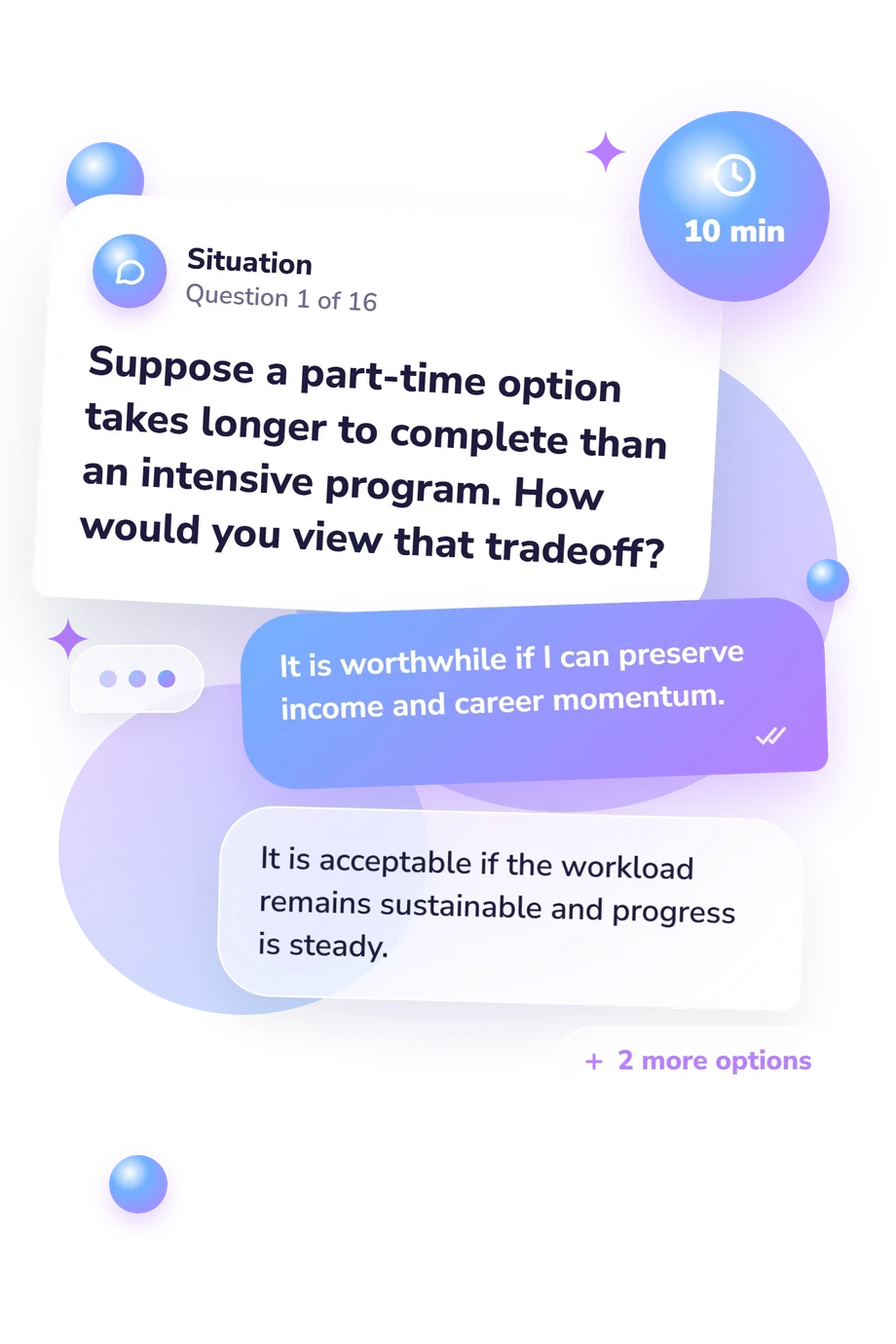
- It is worthwhile if I can preserve income and career momentum.
- It is acceptable if the workload remains sustainable and progress is steady.
- I might accept it, but finishing sooner would usually matter more.
- I would strongly prefer a concentrated program with an earlier completion date.
- I would mainly use school to explore roles beyond my current organization.
- I might draw on the situation for examples, but it would not shape my studies.
- I would test relevant frameworks against the project when appropriate.
- I would want to apply strategic lessons immediately to decisions I help lead.
- Not especially appealing; I want room to explore a different career direction first.
- Somewhat useful, though immediate workplace application is not a priority.
- Appealing because it would help connect theory with ongoing responsibilities.
- Very appealing; immediate application is one of the main benefits I want.
Which MBA Is Right for Me Quiz - Description and methodology of the test
Choosing an MBA format involves balancing career momentum, learning environment, location, schedule, and the kind of peer network you want. The Which MBA Is Right for Me Quiz is designed for prospective students comparing those trade-offs before committing to a program. This MBA quiz points to the formats whose profiles most closely match your present priorities.
What This Assessment Explores
Questions examine work continuity, study intensity, location, campus contact, recruiting, peer context, and responsibility. It compares four formats in a quiz about which MBA program is right for me, showing affinity rather than admission likelihood.
The displayed profiles are:
- Executive MBA (0-12) measures alignment across senior peer learning, immediate application, work responsibilities, schedule, and school eligibility: Limited alignment (0-4), Conditional alignment (5-8), Strong alignment (9-12).
- Full-Time MBA (0-12) measures alignment with immersion, campus recruiting, career development, financing, relocation, and pausing work: Limited alignment (0-4), Conditional alignment (5-8), Strong alignment (9-12).
- Online MBA (0-12) measures alignment with digital collaboration, self-directed study, geographic flexibility, live interaction, support, and accountability: Limited alignment (0-4), Conditional alignment (5-8), Strong alignment (9-12).
- Part-Time MBA (0-12) measures alignment with employment, local study, evening/weekend scheduling, commute, workload, income, and career momentum: Limited alignment (0-4), Conditional alignment (5-8), Strong alignment (9-12).
Methodology and Scientific Basis
This self-report questionnaire presents work and study scenarios with four response options representing different priorities or preferences. Choices contrast preserving employment, accepting relocation, applying learning immediately, using campus resources, and managing independent study. The result displays four format-specific affinity scores; outcomes within one point are interpreted as blended, not a definitive winner. The questionnaire does not state how an answer contributes points.
The questionnaire is conceptually consistent with the cited work, but is not an adaptation of any source. Choi et al. (2019) is the closest match for part-time MBA choice factors. Syed (2007) adds context on executive MBA curriculum and delivery; the GMAC Prospective Students Survey (2022) addresses program-choice priorities. These studies provide contextual evidence for work-study, delivery, and program-choice trade-offs; they do not validate the questionnaire or provide standardization, norms, or admissions cutoffs.
It can serve as a should-I-get-an-MBA quiz only in a limited sense: it clarifies format fit, not the broader value of earning the degree. Self-report results can shift with workload, finances, confidence, or career plans, so compare the profile with school requirements and practical constraints.
- Choi, Pilsik, Michael L. Harris, Kathryn W. Ernstberger, K. Chris Cox, and Carolyn F. Musgrove. “An exploratory study on part-time MBA program choice factors and characteristics of part-time MBA students.” Journal of Education for Business, 94(3), 139-147, 2019. 10.1080/08832323.2018.1491823
- Syed, Sabeen. “Curriculum Variation in MBA Programs: Executive MBA Programs Magnified.” Graduate Management Admission Council, 2007.
- Graduate Management Admission Council. “GMAC Prospective Students Survey - 2022 Summary Report.” Graduate Management Admission Council, 2022.
Updated: