
What YuGiOh Card Are You Quiz
How the Scales are Structured
Who Usually Takes This Test?
See How You Compare
Below is a preview of how scores are typically distributed across each scale.
Example Questions From the Test
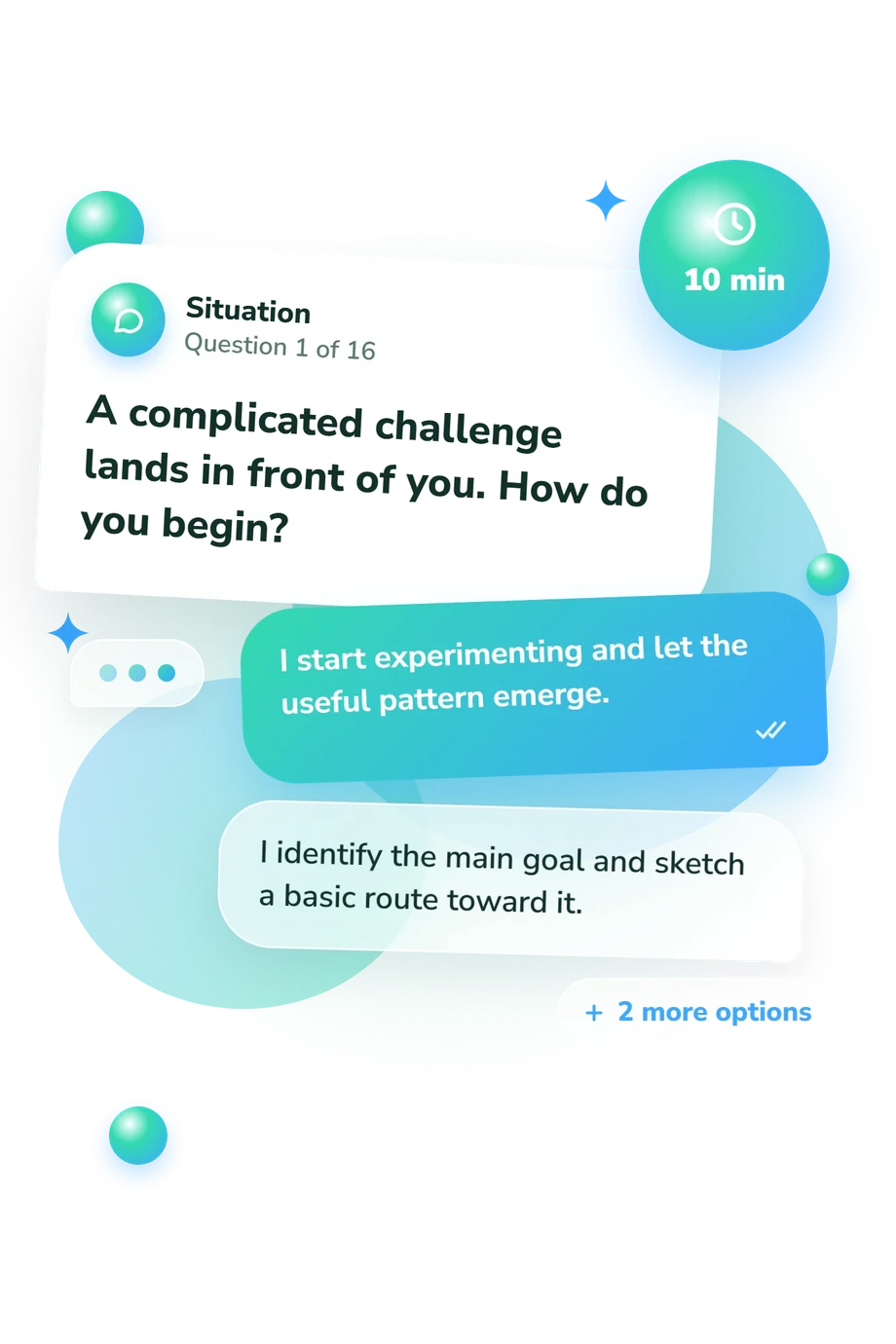
- I start experimenting and let the useful pattern emerge.
- I identify the main goal and sketch a basic route toward it.
- I divide it into stages and choose an order for tackling them.
- I map the stages, dependencies, and likely contingencies before moving.
- I pass and focus on opportunities that fit skills I already trust.
- I gather more information and prepare before deciding.
- I accept if I can draw on guidance or collaborate with experienced people.
- I accept the stretch, expecting the challenge itself to accelerate my growth.
- I learn only the essentials needed for my immediate goal.
- I begin with practical examples and absorb rules as they appear.
- I follow a structured progression from fundamentals to advanced uses.
- I study how the whole system works so I can combine its parts deliberately.
What YuGiOh Card Are You Quiz - Description and methodology of the test
People who enjoy character-based self-reflection can use the What YuGiOh Card Are You Quiz to connect everyday choices with a playful card profile. It is intended for fans who want to examine how they respond to pressure, ambition, planning, support, and growth, whether they are taking a Yu-Gi-Oh personality quiz casually or using the result to notice recurring habits. The outcome offers a symbolic snapshot rather than a fixed identity.
What This Assessment Explores
Four profiles connect choices with styles of challenge and connection. Planning, competition, teamwork, improvisation, encouragement, and persistence shape the interpretation. As a Yu-Gi-Oh card quiz, it gives fans a playful structure for self-reflection.
The result is organized around four card affinities:
- Blue-Eyes White Dragon (0-12) reflects bold independence: Quiet Strength (0-4), Rising Presence (5-8), or Commanding Force (9-12).
- Dark Magician (0-12) reflects composed study and tactics: Different Spellbook (0-4), Tactical Spark (5-8), or Masterful Strategist (9-12).
- Kuriboh (0-12) reflects protective resourcefulness: Steady Observer (0-4), Hidden Helper (5-8), or Unexpected Guardian (9-12).
- Red-Eyes Black Dragon (0-12) reflects resilient growth: New Path (0-4), Growing Flame (5-8), or Boundless Potential (9-12).
A card within one point of the highest can join a blended result, combining styles.
Methodology and Evidence Base
Each prompt presents a situation involving challenge, learning, competition, teamwork, presentation, tension, or support, followed by four possible responses. The respondent selects the option that feels most natural. The questionnaire presents four card-affinity scores. The highest score identifies the closest profile, while any card within one point of the highest may form a blended result.
Park and Henley (2007) provide context for fantasy-character preferences. Soto and John’s BFI-2 and Dweck and Yeager’s (2019) mindset literature offer conceptual background on personality facets and ideas about challenge, persistence, and development; neither is a scoring model or validation study for this questionnaire. This questionnaire is not an adaptation of those published instruments.
As a Yu-Gi-Oh card personality test, it uses four displayed score ranges and result bands as descriptive categories for the fictional styles, not as population norms or clinical thresholds. The labels indicate how strongly a respondent’s choices align with each style, not how they compare with other fans. Because self-report is affected by current context, response bias, and self-awareness, the profile is best read as a flexible snapshot rather than a diagnosis.
- Park, Anna E., and Tracy B. Henley. “Personality and Fantasy Game Character Preferences.” Imagination, Cognition and Personality 27, no. 1 (2007): 37-46. 10.2190/IC.27.1.d
- Soto, Christopher J., and Oliver P. John. “The Next Big Five Inventory (BFI-2): Developing and Assessing a Hierarchical Model With 15 Facets to Enhance Bandwidth, Fidelity, and Predictive Power.” Journal of Personality and Social Psychology 113, no. 1 (2017): 117-143. 10.1037/pspp0000096
- Dweck, Carol S., and David S. Yeager. “Mindsets: A View From Two Eras.” Perspectives on Psychological Science 14, no. 3 (2019): 481-496. 10.1177/1745691618804166
Updated: