
What Snake Am I Quiz
How the Scales are Structured
Who Usually Takes This Test?
See How You Compare
Below is a preview of how scores are typically distributed across each scale.
Example Questions From the Test
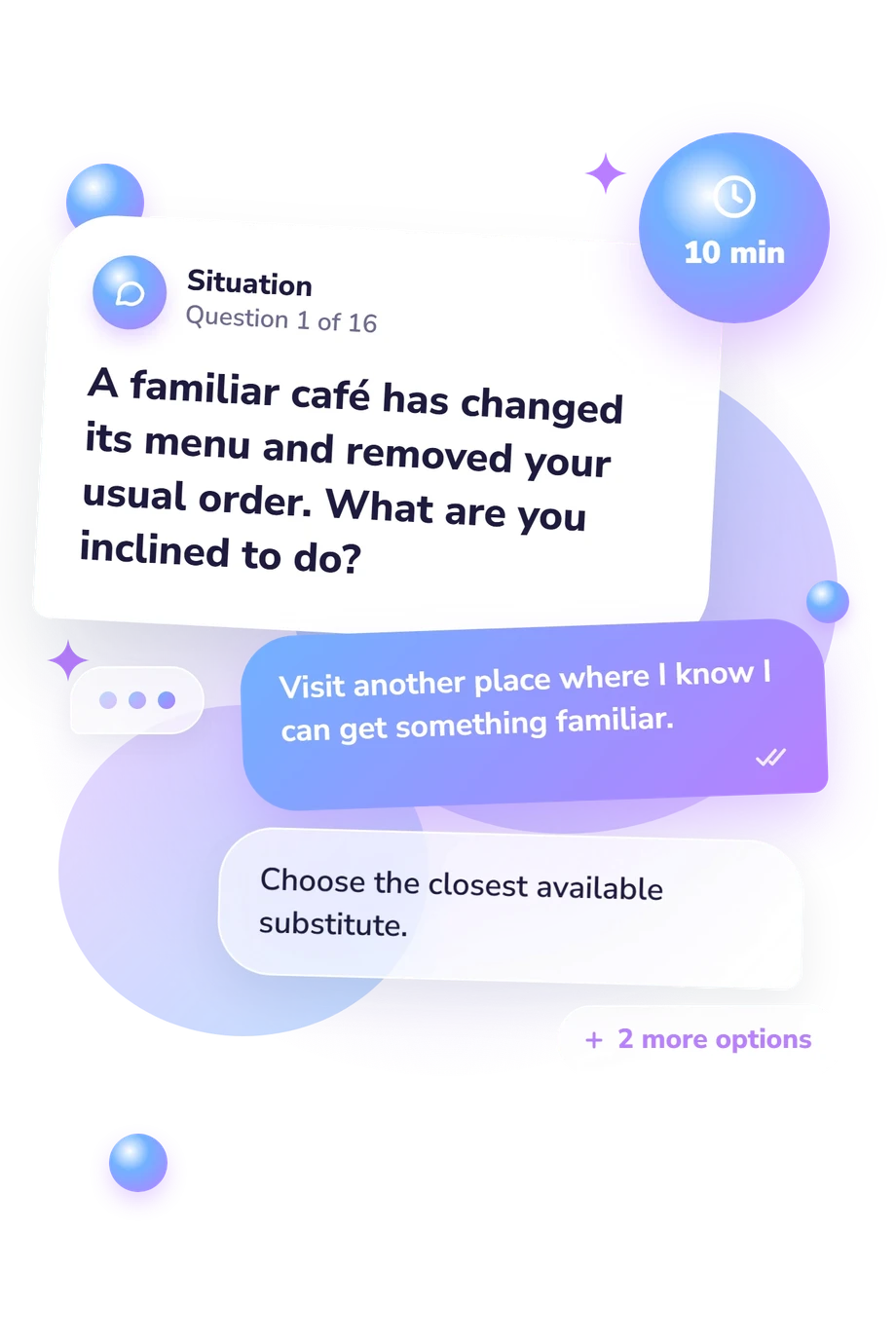
- Visit another place where I know I can get something familiar.
- Choose the closest available substitute.
- Ask about the new options, then select one with familiar elements.
- Use the change as a reason to try something entirely different.
- Change the subject so the atmosphere can reset quickly.
- Say what is on my mind before the moment passes.
- Take a short pause, then return with a clearer perspective.
- Let the tension settle and respond only after I have fully processed it.
- Sample several places or activities with no fixed plan.
- Follow my mood and decide each step as I go.
- Balance one absorbing activity with a few changes of pace.
- Devote a long, uninterrupted stretch to one immersive pursuit.
What Snake Am I Quiz - Description and methodology of the test
Readers who want a clear way to examine everyday patterns can use the What Snake Am I Quiz to see how answers combine into a symbolic profile. It suits anyone curious about a snake personality quiz that gives familiar reactions a symbolic vocabulary without presenting one preference as a fixed identity. The result presents a strongest affinity or blended pattern, giving a concise picture of how responses come together.
What This Assessment Explores
The questions use everyday situations rather than factual knowledge, including unfamiliar settings, disrupted plans, recognition, recovery time, conflict, long projects, and decisions. These situations give the what snake are you quiz a practical focus, rather than reducing the result to one fixed identity.
The four displayed profiles are:
- Cobra Presence (0-12) reflects visible composure and influence: Quiet Current (0-4), Emerging Presence (5-8), and Cobra Presence (9-12).
- Garter Snake Adaptability (0-12) reflects flexible adjustment and curiosity: Familiar Ground (0-4), Flexible Explorer (5-8), and Garter Snake Adaptability (9-12).
- Python Patience (0-12) reflects deliberate pacing and focus: Quick-Moving Style (0-4), Measured Momentum (5-8), and Python Patience (9-12).
- Rattlesnake Boundaries (0-12) reflects early signaling and autonomy: Open Perimeter (0-4), Selective Signal (5-8), and Rattlesnake Boundaries (9-12).
Methodology and Scientific Basis
Each item presents an everyday situation with four responses, and you choose the option closest to your usual reaction. Questions in the what type of snake am I quiz help you explore flexibility, visibility, persistence, and boundaries through choices instead of abstract ratings.
The result displays four profile scores: the highest is the strongest snake affinity, and any profile within one point of it forms a blended result. This allows the outcome to combine symbolic styles rather than name only one.
The profiles are conceptually consistent with work on personality aspects, flexibility, sustained effort, and assertive expression. Relevant conceptual parallels include Big Five Aspect Scales (DeYoung et al., 2007), Kashdan and Rottenberg (2010), Duckworth et al. (2007), and Bakker et al. (1978). The online questionnaire is not a scored administration of those instruments; the cited sources do not validate its results.
Scores have no established clinical cutoffs or population standardization. Compare the leading and near-leading profiles with familiar situations; current stress, self-awareness, and favorable self-presentation can shape self-report, so the result is a context-sensitive reflection rather than a complete personality assessment.
- DeYoung, Colin G., Lena C. Quilty, and Jordan B. Peterson. "Between Facets and Domains: 10 Aspects of the Big Five." Journal of Personality and Social Psychology 93, no. 5 (2007): 880-896. 10.1037/0022-3514.93.5.880
- Bakker, Cornelis B., Marianne K. Bakker-Rabdau, and Saul Breit. "The Measurement of Assertiveness and Aggressiveness." Journal of Personality Assessment 42, no. 3 (1978): 277-284. 10.1207/s15327752jpa4203_9
- Kashdan, Todd B., and Jonathan Rottenberg. "Psychological Flexibility as a Fundamental Aspect of Health." Clinical Psychology Review 30, no. 7 (2010): 865-878. 10.1016/j.cpr.2010.03.001
- Duckworth, Angela L., Christopher Peterson, Michael D. Matthews, and Dennis R. Kelly. "Grit: Perseverance and Passion for Long-Term Goals." Journal of Personality and Social Psychology 92, no. 6 (2007): 1087-1101. 10.1037/0022-3514.92.6.1087
Updated: