
Freudly+971 508685814hello@freudly.ai
Freudly

What Small Pet Should I Get Quiz
What Small Pet Should I Get Quiz - Free Get Test - FreudlyTake a free what small pet should i get quiz to find out which small pet would suit you best. Quick, no sign-up needed. Start now!en
With 20 questions and a completion time of about 10 minutes, the What Small Pet Should I Get Quiz helps you compare your preferences with the needs and routines of five small-pet options. Your result highlights preference alignment, supporting thoughtful self-reflection about space, interaction, care, and long-term commitment.
Questions: 2010 minutes
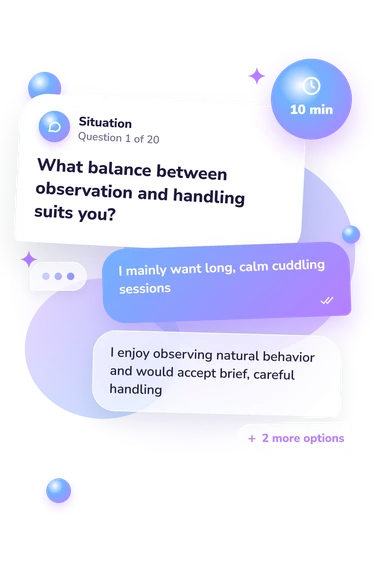
What Small Pet Should: situation and reply bubbles
July 22, 2026July 22, 2026Material has been updatedJuly 22, 2026Material has been published
5,792 views
504 completions
421 likes
Daniel HallPsychologist · Test reviewer
421 likes
Scale Explorer

How the Scales are Structured

Bonded Rabbit PairBRP
Measures how well a bonded rabbit pair matches your space, interaction style, and long-term care commitment preferences.
example score3/12
3/12Different commitment fitexample score
0 – 4Different commitment fit
5 – 8Possible fit
9 – 12Strong affinity
A score of 3 suggests a lower current alignment with bonded rabbit pair needs, such as spacious housing, careful home management, and sustained care intensity.
Gerbil PairGP
Measures your affinity for keeping a social gerbil pair, including comfort with active observation, digging-focused enrichment, and pair-based care.
example score9/12
9/12Strong affinityexample score
0 – 4Different preference
5 – 8Possible fit
9 – 12Strong affinity
A score of 9 suggests a strong affinity for the active, burrowing-centered routine and social needs of a compatible gerbil pair.
Guinea Pig PairGPP
Measures how well a pair of guinea pigs matches your preferred routine, space, and style of interaction with a small pet.
example score7/12
7/12Possible fitexample score
0 – 4Different fit
5 – 8Possible fit
9 – 12Strong affinity
A score of 7 suggests guinea pigs could suit you, but you may need to confirm you can support a compatible pair with adequate enclosure space, hay storage, regular cleaning, and ongoing care.
Rat PairRP
Measures how well your preferences align with the social, interactive, and enrichment-heavy experience of keeping a pair of pet rats.
example score5/12
5/12Possible fitexample score
0 – 4Different interaction style
5 – 8Possible fit
9 – 12Strong affinity
A score of 5 suggests some rat traits may suit you, while the need for pair housing, frequent enrichment, cleaning, and their shorter lifespan may be important considerations.
Syrian HamsterSH
Measures how well your preferences align with the typical care rhythm and interaction style of a Syrian hamster.
example score5/12
5/12Possible fitexample score
0 – 4Different rhythm
5 – 8Possible fit
9 – 12Strong affinity
A score of 5 suggests a possible fit, meaning some Syrian hamster traits may suit you, with a need to consider evening activity, solitary housing, and enclosure requirements.
just completed the test
DATA-BASED USER COHORTS

Who Usually Takes This Test?

First-Time Pet Planners
41%OF USERS
People considering their first small pet who want a quick match based on time, handling preferences, and space.
Apartment and Dorm Residents
34%OF USERS
Renters with limited room and possible noise or lease constraints who are comparing practical day-to-day care needs.
Parents Choosing a Family Pet
25%OF USERS
Adults researching a small companion for their household who want an option that fits kids’ interaction and supervision levels.
BASED ON AGGREGATED, ANONYMIZED DATA FROM TENS OF THOUSANDS OF FREUDLY USERS.
Benchmarking

See How You Compare

Once you complete the test, your results are compared with real-world data from people in your country.
Below is a preview of how scores are typically distributed across each scale.
Shaded area — where most people score
Dot — the average
You — your score lands on each curve after the test— your score, after the test
Bonded Rabbit PairBRP
You?
Average5.8
Typical rangeTypical3.8 – 7.9
Possible0 – 12
Gerbil PairGP
You?
Average4.1
Typical rangeTypical2.6 – 5.7
Possible0 – 12
Guinea Pig PairGPP
You?
Average5.5
Typical rangeTypical3.8 – 7.1
Possible0 – 12
Rat PairRP
You?
Average4.5
Typical rangeTypical2.6 – 6.3
Possible0 – 12
Syrian HamsterSH
You?
Average4.9
Typical rangeTypical3 – 6.9
Possible0 – 12
Featured On
SAMPLE QUESTIONS

Example Questions From the Test

    • Offering long cuddle sessions once the pet is home
    • Mostly watching without expecting much direct interaction
    • Using brief, gentle sessions to build trust over time
    • Gradually working toward regular short handling sessions
    • I strongly prefer a lively social group
    • I would prefer a pair, though one animal could still appeal to me
    • Either arrangement could suit me
    • I like focusing my care and attention on one solitary animal
    • Mostly in the evening, when I am settling in at home
    • Mainly early in the morning before my day begins
    • At varied times; evening interaction would usually work
    • Throughout much of the daytime, especially during family activity
WHAT THE TEST MEASURES

What Small Pet Should I Get Quiz - Description and methodology of the test

People choosing a small companion need to match daily routines, available space, and expectations for contact with an animal. The What Small Pet Should I Get Quiz offers a structured profile for households comparing care styles. For households wondering which small pet they should get, this profile answers the practical question behind a which small pet should I get quiz by organizing priorities around habitat, social needs, activity rhythm, and commitment.

What This Assessment Explores

The result compares five profiles through preferences about handling, observation, housing, activity timing, companionship, cleaning, noise, and long-term care. It treats the result as a pattern of preference fit rather than a universal ranking, making the small pet quiz useful for practical self-reflection. These are the displayed result profiles:

  • Bonded Rabbit Pair (0-12) reflects spacious, trust-led companionship: Different commitment fit 0-4; Possible fit 5-8; Strong affinity 9-12.
  • Gerbil Pair (0-12) reflects deep digging and social-pair observation: Different preference 0-4; Possible fit 5-8; Strong affinity 9-12.
  • Guinea Pig Pair (0-12) reflects vocal, routine-based floor interaction: Different fit 0-4; Possible fit 5-8; Strong affinity 9-12.
  • Rat Pair (0-12) reflects active, intelligent engagement with a pair: Different interaction style 0-4; Possible fit 5-8; Strong affinity 9-12.
  • Syrian Hamster (0-12) reflects solitary, evening-active care: Different rhythm 0-4; Possible fit 5-8; Strong affinity 9-12.

Methodology and Evidence Base

Items pair preferences with four response choices covering handling, observation, pair housing, habitat size, activity timing, cleaning, lifespan, noise, and care planning. This format measures preference alignment, not factual knowledge.

Responses combine into five profiles with descriptive bands. Because point values are unstated, the score is a pattern, not a formula to reverse-engineer. The comparison also answers the practical question behind a should I get a hamster or a guinea pig quiz by weighing activity rhythm, housing, social needs, and care demands.

Normando and Gelli (2011) examine owner satisfaction and behavioral complaints in rabbit and rodent keeping. This questionnaire is conceptually consistent with that work, not adapted from it. Carroll et al. (2025) and Fenton et al. (2025) address small-mammal housing and welfare, emphasizing enclosure design, companionship, diet, enrichment, and veterinary access.

As a self-report questionnaire, the displayed bands are descriptive preference categories, and current circumstances, expectations, and self-awareness can influence the result; species-specific welfare guidance remains necessary before choosing an animal.

Literature:
  • Normando, Simona, and Donatella Gelli. “Behavioral complaints and owners’ satisfaction in rabbits, mustelids, and rodents kept as pets.” Journal of Veterinary Behavior 6, no. 6 (2011): 337-342. 10.1016/j.jveb.2011.01.005
  • Carroll, Grace, Kerry Taylor, Claire Stallard, and Alison Wills. “Small mammal owners’ experiences of housing challenges and animal welfare: A COM-B and word frequency analysis.” Animal Welfare 34 (2025): e59. 10.1017/awf.2025.10034
  • Fenton, Lauren, Livia Benato, Elisabetta Mancinelli, and Nicola J. Rooney. “What are the most prevalent welfare issues for pet small mammals?” Animals 15, no. 10 (2025): 1423. 10.3390/ani15101423
Popular tests
Comments
Leave a Comment