
What Lane Should I Play LoL Quiz
How the Scales are Structured
Who Usually Takes This Test?
See How You Compare
Below is a preview of how scores are typically distributed across each scale.
Example Questions From the Test
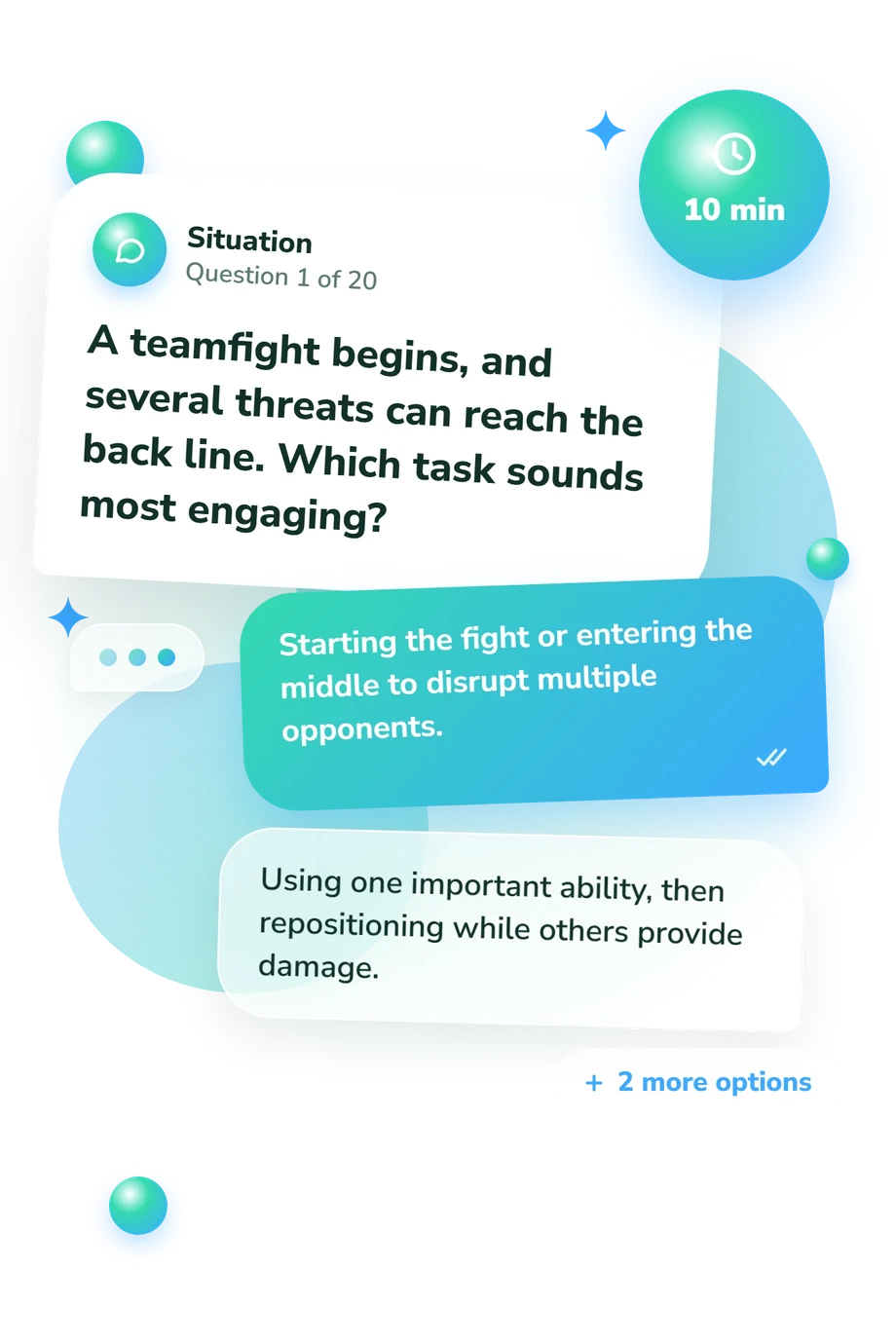
- Starting the fight or entering the middle to disrupt multiple opponents.
- Using one important ability, then repositioning while others provide damage.
- Waiting for key threats to commit before attacking from a safer angle.
- Continuously adjusting range and targets to deliver as much sustained damage as possible.
- I would rather trade some personal resources for earlier movement or utility.
- I can commit to farming when the matchup makes it comfortable.
- I like seeing careful resource collection turn into reliable power.
- Building toward a high-output damage role is one of my favorite match arcs.
- I would rather share a lane or move around the map frequently.
- I can handle the isolation when I know the matchup well.
- I usually enjoy having my own lane before joining larger fights.
- That independent contest is one of the main experiences I want.
What Lane Should I Play LoL Quiz - Description and methodology of the test
For players choosing a first role or reconsidering an old one, the useful question is which responsibilities feel sustainable across a match. The What Lane Should I Play LoL Quiz compares preferences for pressure, resources, teamwork, and map responsibility. The result from this LoL role quiz presents those preferences as a comparison of contributions rather than a ranking of ability.
What This Assessment Explores
The scenarios focus on responsibilities that make positions feel rewarding: farming for later power, surviving isolated pressure, changing routes, coordinating with a partner, controlling information, and producing reliable damage. The What Lane Should I Play Quiz lets players use its scores to see which role preferences are strongest; the result describes role preference rather than mechanical skill.
The five role affinities are:
- ADC (0-12) shows how strongly sustained damage, spacing, and resource scaling fit your playstyle.
- Jungle (0-12) shows how pathing, cross-map choices, and objective responsibility appeal.
- Mid Lane (0-12) shows how much central access, wave timing, and flexible movement suit you.
- Support (0-12) shows whether coordination, vision, protection, and play creation match your preferences.
- Top Lane (0-12) shows whether independence, dueling, and side-lane decisions feel rewarding.
Across the scales, Limited pull covers 0-4, Situational fit covers 5-8, and Strong affinity covers 9-12.
Methodology and Scientific Basis
Each prompt describes a match situation with four choices. The alternatives contrast protecting a partner, holding a side lane, adapting a route, securing an objective, or delivering sustained damage, making the task comparative self-report, not a knowledge test.
Each displayed role-affinity score has a band showing how closely that role profile matches a preference. The questionnaire does not state how many points each answer contributes, and no norm-based standardization is specified. Read these profiles as directional signals, not measures of rank, accuracy, or teamwork quality.
The evidence base is conceptually consistent with Šajinović and Bodroža (2024), who examined traits associated with League of Legends positions. Wang et al. (2019) add context on how personality relates to play in online team games, while Eaton et al. (2018) links role familiarity with team performance. These studies support role preference's relevance but do not validate this questionnaire.
Because this LoL lane quiz uses in-game scenarios, prior play experience helps you judge its role comparisons. Try the strongest profile, observe whether its decisions remain satisfying, and compare roles. Mood, champion familiarity, and self-awareness can shape answers.
- Šajinović, Nemanja, and Bojana Bodroža. (2024). Psychological traits of League of Legends players who prefer different positions and roles in the game. Primenjena Psihologija, 17(4), 551-576. 10.19090/pp.v17i4.2535
- Wang, Zhao, Anna Sapienza, Aron Culotta, and Emilio Ferrara. (2019). Personality and Behavior in Role-based Online Games. In 2019 IEEE Conference on Games (CoG), 1-8. IEEE. 10.1109/CIG.2019.8848027
- Eaton, Joshua A., David J. Mendonça, and Matthew-Donald D. Sangster. (2018). Attack, Damage and Carry: Role Familiarity and Team Performance in League of Legends. Proceedings of the Human Factors and Ergonomics Society Annual Meeting, 62(1), 130-134. 10.1177/1541931218621030
Updated: