
What Egyptian Goddess Are You Quiz
How the Scales are Structured
Who Usually Takes This Test?
See How You Compare
Below is a preview of how scores are typically distributed across each scale.
Example Questions From the Test
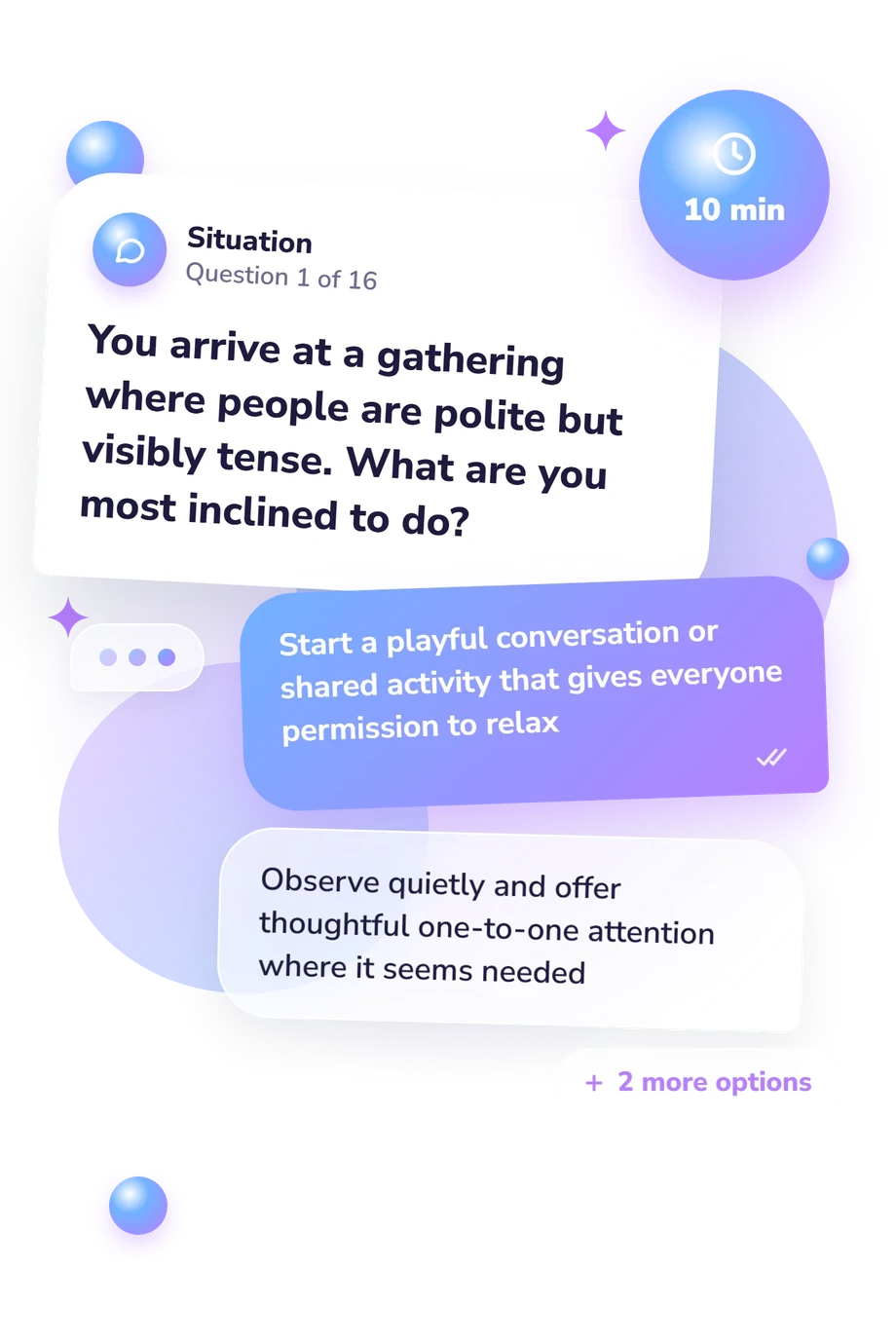
- Start a playful conversation or shared activity that gives everyone permission to relax
- Observe quietly and offer thoughtful one-to-one attention where it seems needed
- Address the source of tension directly so it does not control the room
- Help establish a fair plan or clear expectations for the gathering
- Invite them into enjoyable activities that help life feel lighter again
- Help them make sense of what happened and patiently assemble a practical recovery plan
- Encourage them to confront the obstacle directly and reclaim their confidence
- Offer steady company while letting them decide exactly what support they want
- Turning isolation into welcome and shared enjoyment
- Turning confusion into a balanced and truthful pattern
- Turning damage into renewed wholeness through devoted effort
- Turning fear or rage into disciplined power that protects what matters
What Egyptian Goddess Are You Quiz - Description and methodology of the test
People who enjoy mythic symbolism and want a structured way to reflect on their values can use the What Egyptian Goddess Are You Quiz as a guided self-assessment. This Egyptian goddess quiz connects choices about relationships, fairness, repair, celebration, and protection with four symbolic goddess affinities. The result shows which pattern-celebration, restoration, balance, or protective action-most resembles your responses, including a reserved, independent, flexible, or measured orientation.
What This Assessment Explores
Egyptian deities offer symbolic patterns, not fixed personality types. Situations cover tension, unfairness, setbacks, celebration, beauty, anger, and protection. This Egyptian goddess personality quiz explores values and relational habits; results show reserved, independent, flexible, or measured affinities.
The dimensions are:
- Hathor Affinity (0-12) measures welcome, beauty, creativity, celebration, and joy: Reserved Current 0-4, Warm Creator 5-8, Radiant Celebrant 9-12.
- Isis Affinity (0-12) measures care, ingenuity, loyalty, restoration, and wholeness: Independent Path 0-4, Resourceful Supporter 5-8, Restorative Guardian 9-12.
- Ma’at Affinity (0-12) measures honesty, accountability, fairness, proportion, and balanced judgment: Flexible Compass 0-4, Principled Balancer 5-8, Keeper of Balance 9-12.
- Sekhmet Affinity (0-12) measures protective courage, intensity, boundaries, decisive action, and purposeful transformation; bands are Measured Force 0-4, Protective Fire 5-8, and Fierce Guardian 9-12.
Methodology and Evidence Base
Each of the 16 questions presents a situation and four response options. The choices represent different approaches to welcome, restoration, fairness, or protection, so you select the response that feels most natural rather than a factually correct answer. Choosing among the four situational options gives this Egyptian goddess personality test a symbolic profile: responses translate into affinity scores for the four goddesses.
Historical descriptions by Wahlberg (2002) and Wilkinson (2003) provide cultural context for the deities’ roles, while Faulkner and Goelet (2008) and Furutani (2024) add textual perspectives on order, restoration, and divine power. The questionnaire is conceptually consistent with these works, which offer cultural context rather than validation, norms, or reliability evidence for this online questionnaire.
Results display a score for each affinity and identify the highest score as the strongest match; scores within one point of another outcome form a blended result. As a self-report tool, the outcome can be influenced by current mood, self-awareness, response style, and situational context, so read it as a reflection prompt rather than a clinical conclusion.
- Wahlberg, Nina May. Goddess Cults in Egypt Between 1070 BC and 332 BC. PhD thesis, University of Birmingham, 2002.
- Wilkinson, Richard H. The Complete Gods and Goddesses of Ancient Egypt. Thames & Hudson, 2003.
- Faulkner, Raymond O., and Ogden Goelet, translators. The Egyptian Book of the Dead: The Book of Going Forth by Day: Being the Papyrus of Ani (Royal Scribe of the Divine Offerings). Edited by Eva von Dassow. Chronicle Books, 2008.
- Furutani, Jordan. "An Excellent Scribe and Servant of the Great Goddess: The Textual Development and Interpretation of Coffin Text 533." Zeitschrift für Ägyptische Sprache und Altertumskunde 151, no. 2 (2024): 221-231. 10.1515/zaes-2023-0014
Updated: