
What Color Should I Paint My Room Quiz
How the Scales are Structured
Who Usually Takes This Test?
See How You Compare
Below is a preview of how scores are typically distributed across each scale.
Example Questions From the Test
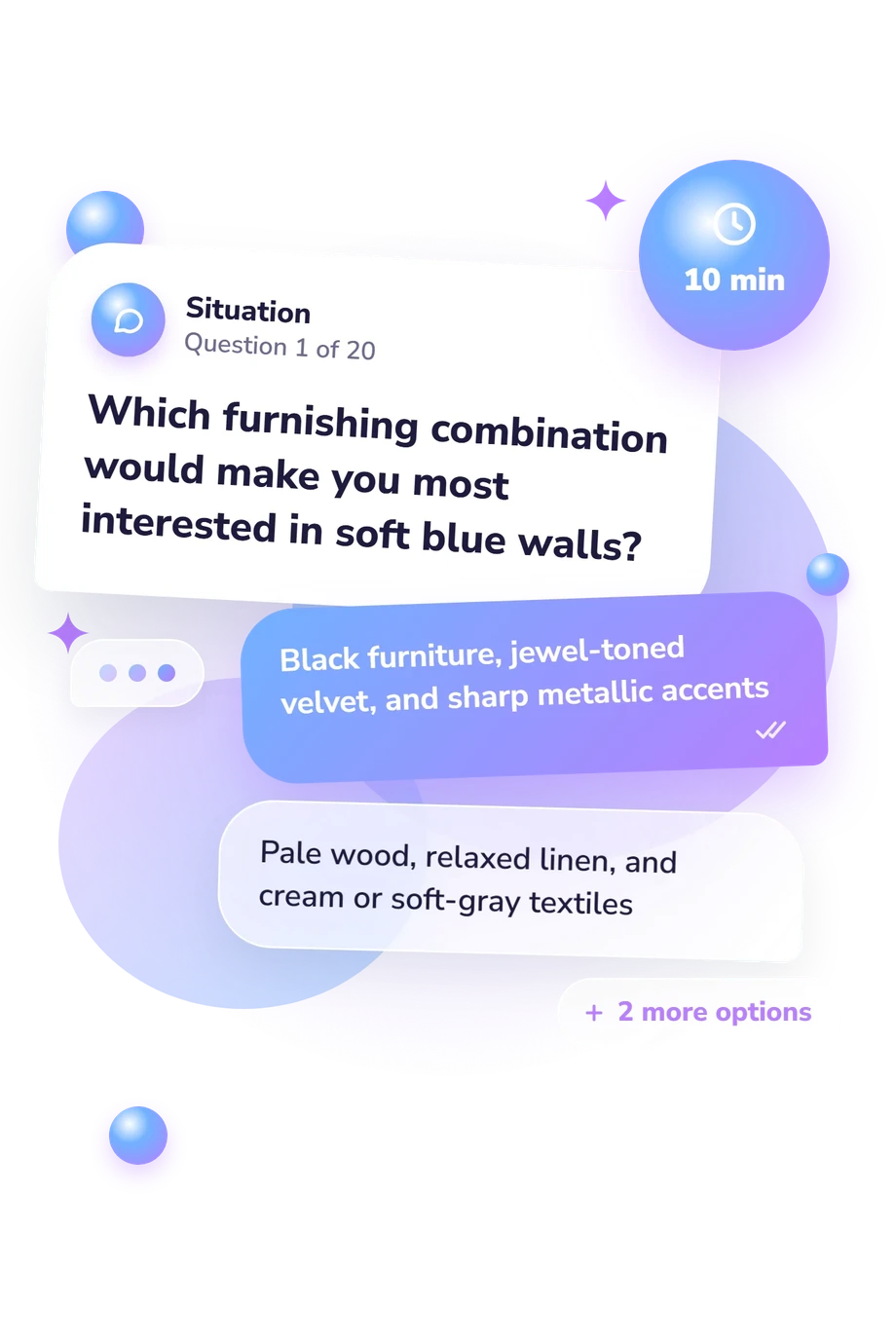
- Black furniture, jewel-toned velvet, and sharp metallic accents
- Pale wood, relaxed linen, and cream or soft-gray textiles
- Rust, clay, and strongly warm-toned upholstery
- A mix of light neutrals with a few cool-toned accessories
- As an intentional atmosphere I would be happy to develop
- As interesting, though I might limit it to selected walls
- As too enclosed; I would choose a much lighter color
- As workable only if the final shade were a softer medium gray
- Almost none; I want the walls to register mainly as neutral
- A gentle wash that is unmistakably blue but not highly saturated
- A bold color statement that immediately commands attention
- A moderate cool note that becomes more noticeable in daylight
What Color Should I Paint My Room Quiz - Description and methodology of the test
Before buying paint, people may want to organize preferences about atmosphere, daylight, materials, and visual drama. The What Color Should I Paint My Room Quiz is intended for that reflection, helping readers compare how different room-color directions fit their existing space. The result of this paint color quiz helps organize which samples to compare without dictating the final choice.
What This Assessment Explores
Five affinities reflect reactions to darkness, warmth, coolness, nature, undertones, contrast, and furnishings. Higher scores identify directions; scores within one point suggest a blend.
Results include:
- Charcoal (0-12) signals dark, cocooning walls: Accent-Level Fit (0-4), Dramatic Contender (5-8), Strong Affinity (9-12).
- Sage Green (0-12) signals earthy calm: Occasional Accent (0-4), Natural Contender (5-8), Strong Affinity (9-12).
- Soft Blue (0-12) signals cool spaciousness: Limited Match (0-4), Promising Option (5-8), Strong Affinity (9-12).
- Terracotta (0-12) signals earthy warmth: Small-Dose Appeal (0-4), Warm Possibility (5-8), Strong Affinity (9-12).
- Warm White (0-12) signals airy flexibility: Accent Only (0-4), Flexible Contender (5-8), Strong Affinity (9-12).
The result from this what color should i paint my walls quiz still needs checking against daylight and fixed finishes.
Methodology and Evidence
Each prompt presents a room situation with four response choices about lighting, furnishings, materials, color, mood, and tolerance for a strong backdrop. The what color should i paint my living room quiz uses the same format to tie a recommendation to atmosphere and furnishings.
The result gives one score per affinity; the highest is the strongest, while scores within one point indicate a blend. Since the answer-to-point conversion is not stated, the ranges should not be reverse-engineered into a scoring formula.
Yildirim et al. (2011) examine relationships between interior-color preferences and living-room atmosphere. Costa et al. (2018) link residence-hall color with psychological functioning, while Elliot and Maier (2014) provide broader color-psychology theory. Together, these studies provide conceptual context for preferences related to room atmosphere and color response.
The displayed bands are internal descriptive labels that organize the result rather than published population norms. For this what color should i paint my bedroom quiz, honest self-report and current mood may affect answers; compare large samples at different times of day because daylight, flooring, and furnishings affect how the selected color looks.
- Yildirim, K., Hidayetoglu, M. L., & Capanoglu, A. (2011). Effects of interior colors on mood and preference: Comparisons of two living rooms. Perceptual and Motor Skills, 112(2), 509-524. 10.2466/24.27.PMS.112.2.509-524
- Costa, M., Frumento, S., Nese, M., & Predieri, I. (2018). Interior Color and Psychological Functioning in a University Residence Hall. Frontiers in Psychology, 9, 1580. 10.3389/fpsyg.2018.01580
- Elliot, A. J., & Maier, M. A. (2014). Color psychology: Effects of perceiving color on psychological functioning in humans. Annual Review of Psychology, 65(1), 95-120. 10.1146/annurev-psych-010213-115035
Updated: