
What Candy Am I Quiz
How the Scales are Structured
Who Usually Takes This Test?
See How You Compare
Below is a preview of how scores are typically distributed across each scale.
Example Questions From the Test
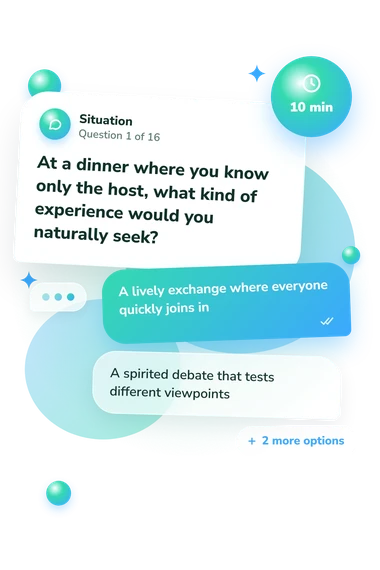
- A lively exchange where everyone quickly joins in
- A spirited debate that tests different viewpoints
- One absorbing conversation that goes beyond small talk
- A relaxed seat near someone who makes the room feel familiar
- Whether it will make them laugh immediately
- Whether it feels warm, useful, and reassuring
- Whether it offers an exciting surprise
- Whether its details quietly reflect what I know about them
- I order a dependable favorite that I already enjoy
- I try it if the table turns it into a shared adventure
- I want to test it and experience the full impact myself
- I first ask what makes the combination interesting
What Candy Am I Quiz - Description and methodology of the test
For readers who want a playful way to reflect on preferences and social style, the What Candy Am I Quiz connects everyday choices with a symbolic candy profile. It helps show whether comfort, depth, sociability, or bold challenge is most prominent in a person’s responses. As a what candy are you quiz, it offers an accessible prompt for self-reflection rather than a fixed identity.
What This Assessment Explores
Everyday choices about company, home atmosphere, disagreement, novelty, routine, and support reveal four symbolic dimensions. In a what kind of candy am i quiz, the result is a playful profile of tendencies rather than a permanent personality category. These dimensions show whether a respondent favors comfort, stimulation, connection, or challenge.
The displayed scales describe the following result directions:
- Caramel (0-12) reflects warmth, patience, reliability, and comforting connection: Light Affinity (0-4), Mixed Affinity (5-8), or Strong Affinity (9-12).
- Dark Chocolate (0-12) reflects reflection, discernment, subtlety, and depth: Light Affinity (0-4), Mixed Affinity (5-8), or Strong Affinity (9-12).
- Gummy Bears (0-12) represents playfulness, sociability, flexibility, and colorful optimism: Light Affinity (0-4), Mixed Affinity (5-8), or Strong Affinity (9-12).
- Sour Candy (0-12) captures boldness, candor, novelty, and high-energy challenge: Light Affinity (0-4), Mixed Affinity (5-8), or Strong Affinity (9-12).
Methodology and Evidence Base
Each situation offers four forced-choice responses contrasting comfort, reflection, playfulness, and bold challenge. The format turns reactions to company, conflict, change, novelty, and routine into comparable signals rather than open-ended stories. As a what type of candy are you quiz, it compares the four displayed totals: the highest score identifies the strongest candy affinity, while scores within one point of that highest score create a blended result.
Meier et al. (2024) is the closest subject-specific reference, linking agreeableness with sweet-taste preference across cultures. Spence (2022) adds a broader personality-and-context account of food behavior, while Pliner and Melo (1997) help contextualize arousal, sensation seeking, and reactions to unfamiliar or intense experiences. This questionnaire is conceptually consistent with these findings, not an adaptation or validation of any one study.
Read as a what kind of candy are you quiz, the outcome is a current self-report profile. The cited studies do not standardize this exact questionnaire, and mood, context, self-awareness, and response style can affect answers; a blended result may reflect genuinely mixed preferences.
- Meier, Brian P., Michael Schaefer, Li-Jun Ji, and Carlota Batres. (2024). Cross-cultural evidence for an association between agreeableness and sweet taste preferences. Journal of Research in Personality, 113, 104547. 10.1016/j.jrp.2024.104547
- Spence, Charles. (2022). What is the link between personality and food behavior? Current Research in Food Science, 5, 19-27. 10.1016/j.crfs.2021.12.001
- Pliner, Paul, and N. Melo. (1997). Food neophobia in humans: effects of manipulated arousal and individual differences in sensation seeking. Physiology & Behavior, 61(2), 331-335. 10.1016/S0031-9384(96)00406-4