
Weed Addiction Quiz
How the Scales are Structured
Who Usually Takes This Test?
See How You Compare
Below is a preview of how scores are typically distributed across each scale.
Example Questions From the Test
- Cannabinoid hyperemesis syndrome
- Cannabis intoxication
- Cannabis withdrawal
- Cannabis use disorder
- Runny nose, watery eyes, and marked muscle aches
- Irritability, sleep difficulty, and decreased appetite
- Slowed breathing, pinpoint pupils, and loss of consciousness
- High fever, a widespread rash, and swollen joints
- Changing brands while keeping use infrequent
- Using an edible instead of inhaled cannabis on one occasion
- Beginning at a younger age and using frequently
- Using only after dinner rather than before dinner
Weed Addiction Quiz - Description and methodology of the test
For readers trying to understand cannabis-related risks in their own lives or while supporting someone close to them, the weed addiction quiz offers a focused knowledge check. It clarifies warning signs, safer responses, treatment concepts, and urgent situations. Read as an am i addicted to weed quiz, it organizes a personal concern around accurate concepts rather than producing a quick label.
What This Assessment Explores
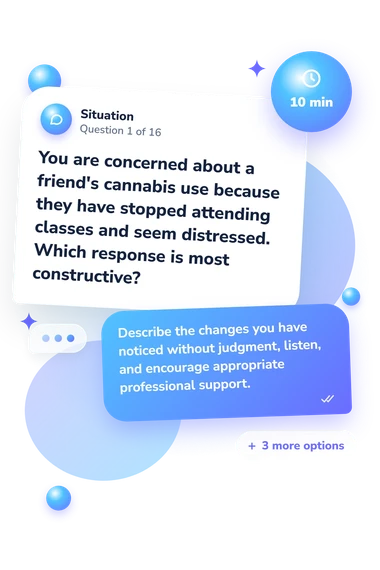
The questionnaire tests recognition of problematic cannabis-use concepts. Scenarios cover impaired control, consequences, tolerance, withdrawal, hazardous combinations, supportive communication, and behavior change. It suits readers building understanding or preparing for a careful conversation.
This addicted to weed quiz produces a knowledge profile, not a personal risk judgment. The displayed result is Weed Addiction Knowledge (0-16): Foundations to build (0-6), Developing knowledge (7-12), or Strong knowledge (13-16). The educational result groups material into these themes:
- Impaired control covers unsuccessful efforts to cut down and returning to use sooner than intended.
- Dependence concepts distinguish physical adaptation, withdrawal, and broader cannabis-related problems.
- Safety awareness covers impairment, substance combinations, urgent symptoms, and immediate help.
- Support and change planning address communication, triggers, coping, and setbacks.
Methodology and Scientific Basis
Each item presents a scenario or knowledge question with four response options. The respondent selects the statement that best fits impaired control, tolerance, withdrawal, safer driving, support, or treatment; responses are combined into an educational knowledge score. As a marijuana addiction quiz, it tests recognition of concepts rather than symptoms.
The framework is conceptually consistent with DSM-5 criteria (Hasin et al., 2013), which organizes cannabis use disorder around impaired control, consequences, hazardous use, tolerance, withdrawal, and related features. This questionnaire is not an adaptation of that publication. Connor et al. (2022) supports the withdrawal examples, and Litt et al. (2008) supports coping skills and contingency management as behavior-change approaches.
Reading the result as an am i addicted to marijuana quiz answer would overstate what it can show: this unvalidated educational measure has no validated norms or diagnostic cutoff, performance may vary with prior education, reading, attention, and interpretation of the scenarios, and personal symptoms, severe reactions, or immediate danger require broader qualified assessment.
- Hasin, Deborah S., O’Brien, Charles P., Auriacombe, Marc, Borges, Guilherme, Bucholz, Kathleen, Budney, Alan, Compton, Wilson M., Crowley, Thomas, Ling, Walter, Petry, Nancy M., Schuckit, Marc A., and Grant, Bridget F. (2013). DSM-5 criteria for substance use disorders: recommendations and rationale. American Journal of Psychiatry, 170(8), 834-851. 10.1176/appi.ajp.2013.12060782
- Connor, Jason P., Stjepanović, Daniel, Budney, Alan J., Le Foll, Bernard, and Hall, Wayne D. (2022). Clinical management of cannabis withdrawal. Addiction, 117(7), 2075-2095. 10.1111/add.15743
- Litt, Mark D., Kadden, Ronald M., Kabela-Cormier, Elise, and Petry, Nancy M. (2008). Coping skills training and contingency management treatments for marijuana dependence: exploring mechanisms of behavior change. Addiction, 103(4), 638-648. 10.1111/j.1360-0443.2008.02137.x