
Tsunami Quiz
How the Scales are Structured
Who Usually Takes This Test?
See How You Compare
Below is a preview of how scores are typically distributed across each scale.
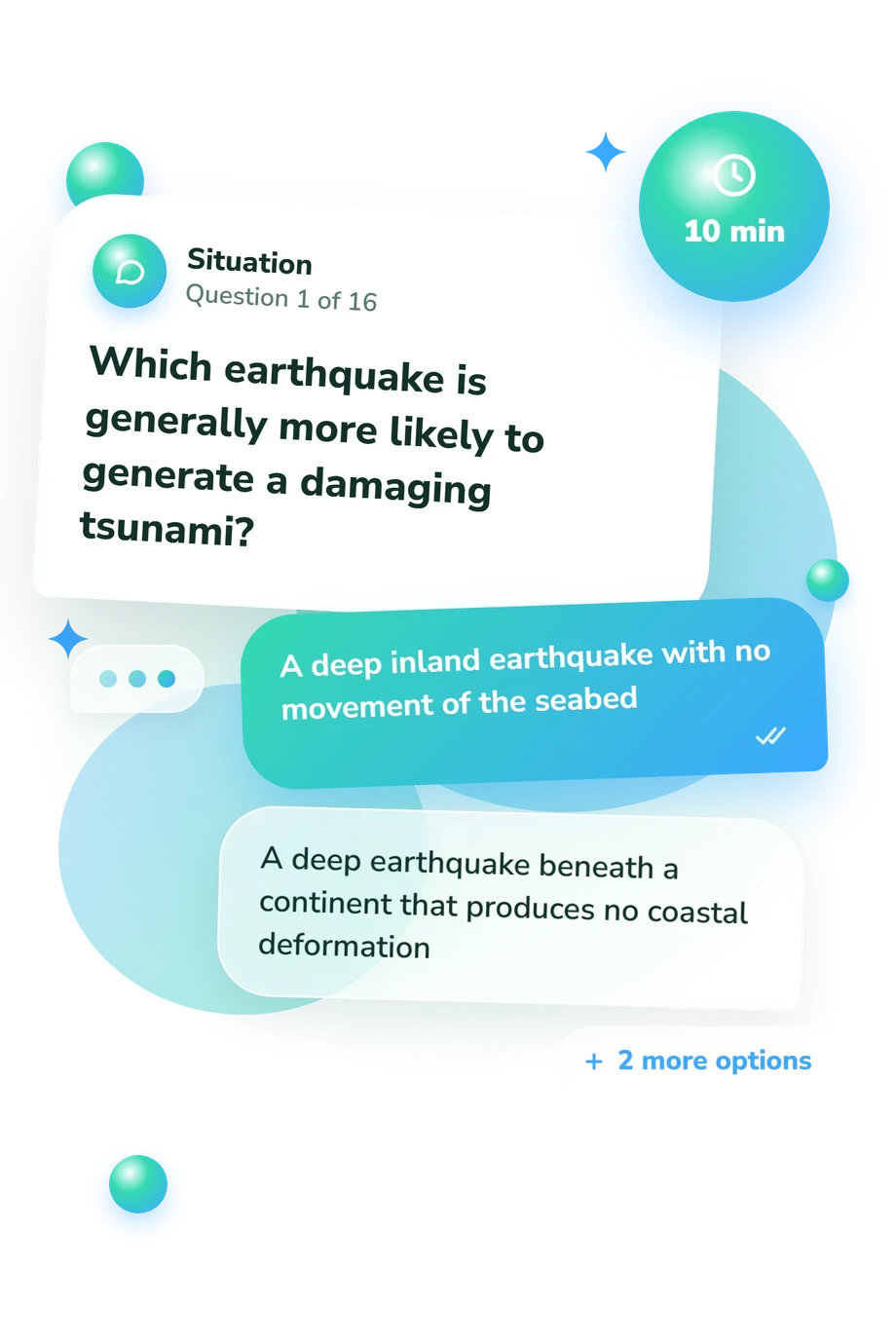
Example Questions From the Test
- Small pressure changes produced as a tsunami passes overhead
- The precise magnitude of every earthquake on nearby land
- Changes in wind direction that generate coastal surf
- The salt content of water entering a harbor
- Ignore it because only felt earthquakes can produce local danger
- Visit the beach to look for a receding shoreline before leaving
- Follow the evacuation instruction even though you felt no shaking
- Wait until water enters nearby streets before moving uphill
- The depth of the water
- The air temperature above the ocean
- The daily tidal stage at the nearest beach
- The direction of the prevailing wind
Tsunami Quiz - Description and methodology of the test
People reviewing coastal hazards, emergency education, or personal preparedness can use the tsunami quiz to connect scientific facts with safer decisions. It focuses on what a reader should recognize before or during a warning, rather than estimating personal exposure. The format also uses tsunami questions and answers in quiz form to identify concepts that deserve closer study and to build a more organized understanding of protective action.
What This Assessment Explores
The content examines tsunami literacy from physical cause to protective response. It asks whether a reader can connect undersea earthquakes or landslides with water displacement, recognize natural and official warnings, understand wave behavior, and choose actions that reduce exposure.
For a reader using this tsunami knowledge test, the result maps learning priorities rather than personal risk. It groups the subject into three practical areas:
- Tsunami science shows whether the result reflects understanding of generation, water depth, wave speed, and near-shore behavior.
- Warnings and evacuation show whether the reader can respond to coastal withdrawal, prolonged shaking, official alerts, marked routes, and vertical structures.
- Continuing hazards show whether the result recognizes later waves, strong currents, unstable buildings, unsafe water, utility risks, and the need to wait for an all-clear.
Together, these themes identify knowledge that can support faster decisions during emergencies.
Methodology and Scientific Basis
Each item presents a four-option multiple-choice question, either testing a scientific relationship or asking for the safest response in a scenario. Selecting the best answer measures recognition and applied judgment rather than self-rated confidence.
Answers are summarized on the Tsunami Knowledge scale, which runs from 0-16. The displayed bands are Foundations to Build (0-6), Developing Knowledge (7-12), and Strong Knowledge (13-16). These bands describe educational understanding represented by the score; they do not forecast an event or certify emergency competence.
As a tsunami preparedness quiz, the questionnaire is conceptually consistent with Lindell et al. (2023) on warning information and preparedness intentions, but it is not an adaptation of that survey. Satake (2014) supplies scientific context for tsunami sources, wave behavior, warning, and risk reduction. González et al. (2005) supports the treatment of deep-ocean pressure-sensor detection.
These publications support the content domain, not validation of this online questionnaire. No population norms, reliability estimates, or standardization are stated, so the result is a knowledge snapshot shaped by recall and current context. During an actual warning, natural signs and local-authority instructions take priority.
- Lindell, Michael K., Meen Chel Jung, Carla S. Prater, and Donald H. House. 2023. "US Pacific Coast Communities’ Past Preparedness and Preparedness Intentions for Cascadia Subduction Zone Tsunamis." International Journal of Disaster Risk Reduction, 84, 103466. 10.1016/j.ijdrr.2022.103466
- Satake, Kenji. 2014. "Advances in earthquake and tsunami sciences and disaster risk reduction since the 2004 Indian Ocean tsunami." Geoscience Letters, 1, 15. 10.1186/s40562-014-0015-7
- González, Frank I., Eddie N. Bernard, Christian Meinig, Marie C. Eble, Harold O. Mofjeld, and Scott Stalin. 2005. "The NTHMP Tsunameter Network." Natural Hazards, 35(1), 25-39. 10.1007/s11069-004-2402-4
Updated: