
To Kill a Mockingbird Chapter 1 Quiz
How the Scales are Structured
Who Usually Takes This Test?
See How You Compare
Below is a preview of how scores are typically distributed across each scale.
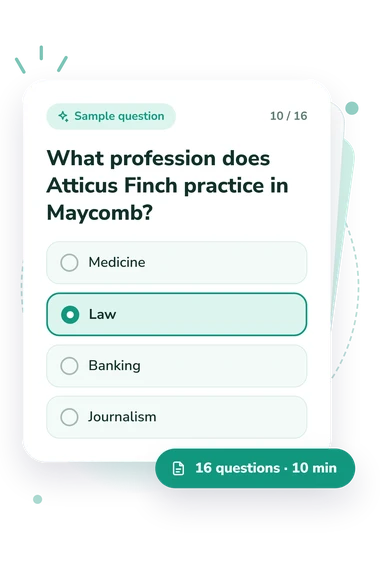
Example Questions From the Test
- He became Maycomb’s first sheriff and built the courthouse
- He opened the law office that Atticus later inherited
- He moved the family from Alabama to Meridian, Mississippi
- He established Finch’s Landing after settling in Alabama
- Run up and touch the house
- Knock on the front door and ask for Arthur
- Leave a written invitation on the porch
- Look through a window after dark
- Jem breaking his arm at the elbow
- Scout’s first day at school
- Dill leaving Maycomb after the summer
- Atticus accepting a difficult court case
To Kill a Mockingbird Chapter 1 Quiz - Description and methodology of the test
Readers preparing for a class conversation, written response, or quick check after reading can use this To Kill a Mockingbird Chapter 1 Quiz at a useful stopping point. It suits students, independent readers, and anyone returning to the opening chapter before discussion or review. The focused format works as a chapter 1 reading quiz when time is limited.
What This Assessment Explores
Questions test connected understanding rather than isolated recall. They link Jem’s injury with Scout’s narration, place the Finch family in its history, describe Maycomb’s conditions, and follow the children’s interest in Arthur Radley.
The result shows whether review is needed for facts, relationships, or early narrative signals. Because Chapter 1 is Part 1 of To Kill a Mockingbird, the quiz keeps review anchored here.
The main areas are:
- Narrative structure shows how the reader follows Scout and the framing of Jem’s injury.
- Family and setting show understanding of Finch history, Maycomb, Atticus, Calpurnia, and the children.
- Radley interpretation shows whether rumor, observed events, and the final sequence are kept distinct.
The displayed scale is To Kill a Mockingbird Chapter 1 Knowledge (0-16): Foundation to Revisit, 0-6; Developing Command, 7-12; Strong Command, 13-16. It describes the result’s level of chapter command.
Methodology and Scientific Basis
This is a text-referenced multiple-choice questionnaire. Each item presents a question with four answer choices, asking the reader to identify the most accurate fact, sequence, relationship, or interpretation from Chapter 1. Several items require connecting details rather than spotting a single name.
The scoring output is a single knowledge result organized into the three displayed bands. It describes command of this chapter, not broader reading ability or literary aptitude. The score therefore works best as a guide to targeted rereading and discussion of Chapter 1.
Harper Lee's novel is the direct textual source for the events, descriptions, characters, and narrative framing tested here. The question set follows the chapter's opening frame around Jem's injury, Finch family history, Maycomb, the Radleys, and the children's actions. It is a chapter-content questionnaire rather than an adaptation of a published literary assessment.
Someone using this To Kill a Mockingbird comprehension test should answer from memory and the chapter’s wording. Rereading, attention, and personal interpretation can change results; as a chapter-specific knowledge score, the result should not be generalized to overall reading ability.
- Lee, Harper. To Kill a Mockingbird. Philadelphia: J. B. Lippincott Company, 1960.
- Armstrong, Jean. To Kill a Mockingbird by Harper Lee. Macmillan Education UK, 1987. 10.1007/978-1-349-08255-1.
- Noble, Don, editor. Critical Insights: To Kill a Mockingbird. “To Kill a Mockingbird: Successes and Myths,” by Nancy Grisham Anderson, pp. 21-37. Salem Press, 2009.
Updated: