
Then vs. Than Quiz
How the Scales are Structured
Who Usually Takes This Test?
See How You Compare
Below is a preview of how scores are typically distributed across each scale.
Example Questions From the Test
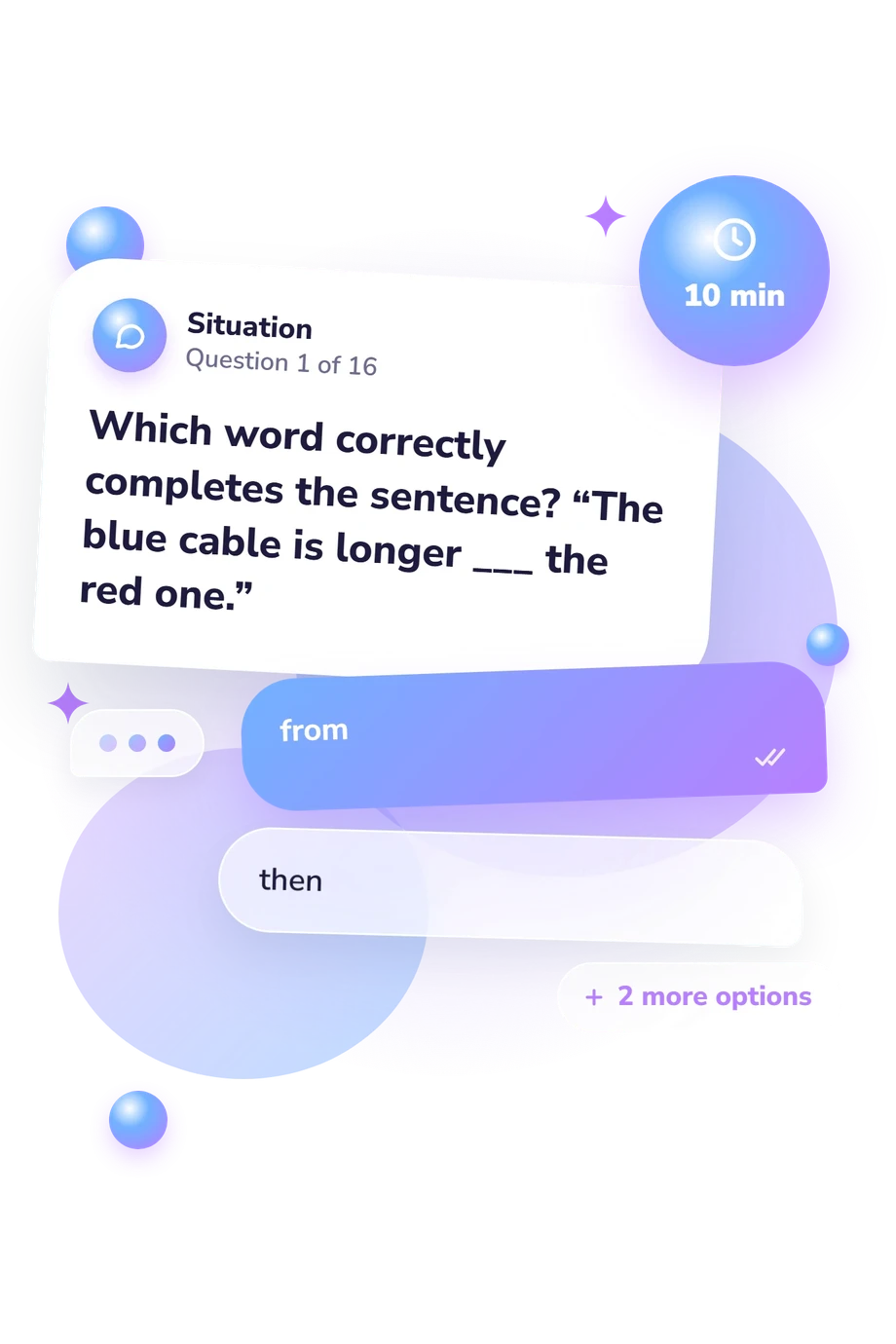
- from
- then
- as
- than
- June begins earlier than July.
- Other than screws, all the supplies were included.
- We measured the shelf, then ordered the brackets.
- The shelf is wider than the desk.
- It introduces the second part of a comparison.
- It places two events in chronological order.
- It identifies a result caused by a condition.
- It refers to a particular time in the past.
Then vs. Than Quiz - Description and methodology of the test
Students, editors, and careful writers can use the Difference Between Then and Than Quiz to judge whether their sentence-level choices are secure in the covered contexts. Its questions focus on practical decisions rather than abstract terminology, making this than vs then quiz useful for anyone who wants to strengthen proofreading, editing, or everyday written communication. Results show whether further practice may help.
What This Assessment Measures
At its core, this assessment checks whether you can choose the word that fits a comparison, sequence, consequence, or established phrase. Each question links the answer to the relationship expressed in a complete sentence, so this then and than quiz tests meaning in context rather than spelling in isolation.
The question themes cover four practical language functions:
- Comparison language shows whether you use than when measuring one person, thing, or amount against another.
- Sequence language shows whether then marks what happens next or identifies a past role.
- Consequence language shows whether then signals the result of a condition or instruction.
- Established phrases show whether you distinguish other than and rather than from incorrect substitutions.
The displayed scale, Then vs. Than Knowledge (0-16), reports Foundation Needed (0-6), Developing Knowledge (7-12), or Strong Knowledge (13-16). These bands indicate how consistently the respondent handles the tested contexts.
Methodology and Evidence Base
Each item presents a sentence or brief language problem with answer choices. The respondent selects the option that completes the meaning or identifies correct use across comparisons, sequences, consequences, and phrases. Accuracy depends on context, not simply recognizing two spellings.
Scoring produces one knowledge total, and the displayed bands are descriptive labels for this questionnaire rather than population norms. The total can indicate whether to review basic then-and-than distinctions or less familiar sentence patterns.
The content is consistent with English Grammar Today (Carter et al., 2016) and the descriptive framework associated with Huddleston and Pullum (2002). These sources support than in comparisons and then in temporal, sequential, and consequential uses; they are reference points for content, not evidence that this quiz adapts either book.
Because choices depend on sentence context, guessing, familiarity with expressions, and current learning context can affect the result; reviewing missed items helps connect errors with the rules they test.
- Ronald Carter, Michael McCarthy, Geraldine Mark, and Anne O'Keeffe. English Grammar Today: An A-Z of Spoken and Written Grammar. Cambridge University Press, 2016.
- Rodney Huddleston and Geoffrey K. Pullum. The Cambridge Grammar of the English Language. Cambridge University Press, 2002. 10.1017/9781316423530
Updated: