
The Wife of Bath's Tale Quiz
How the Scales are Structured
Who Usually Takes This Test?
See How You Compare
Below is a preview of how scores are typically distributed across each scale.
Example Questions From the Test
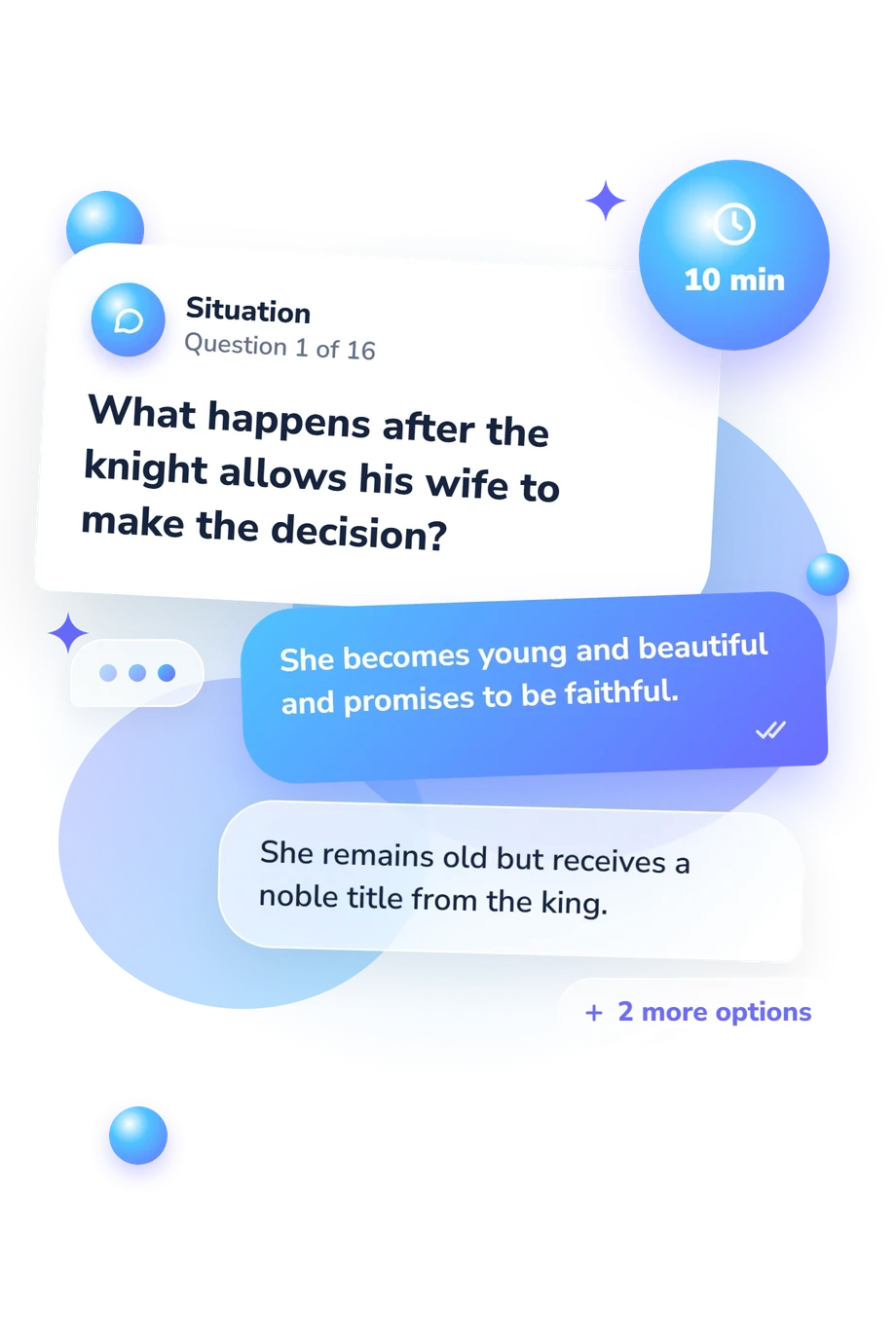
- She becomes young and beautiful and promises to be faithful.
- She remains old but receives a noble title from the king.
- She leaves him and returns to the women of Arthur’s court.
- She reveals that the entire quest was a dream.
- Poverty proves that a person has rejected all worldly duties.
- Poverty makes noble ancestry unnecessary in marriage.
- Poverty ensures that a person will live without suffering.
- Poverty can encourage humility and reveal genuine friends.
- Formal recognition by a monarch
- Ancient family ancestry
- Possession of land and wealth
- Virtuous actions and character
The Wife of Bath's Tale Quiz - Description and methodology of the test
For readers revisiting Chaucer’s narrative, The Canterbury Tales The Wife of Bath's Tale Quiz offers a knowledge check before they decide which parts of the tale deserve another reading. It suits students, book-club members, and anyone wanting to see which details or interpretations their responses treated as supported by the tale. As a Canterbury Tales literature quiz, it emphasizes informed recall and thematic comprehension rather than speed or literary ranking.
What This Assessment Explores
The assessment treats the tale as a knowledge check, asking whether you can connect events with the old woman’s arguments about gentility, poverty, age, beauty, marriage, and authority. The Wife of Bath's Tale Quiz emphasizes how the ending develops the knight’s question rather than name recall.
The questions group into four areas:
- Plot and sequence show whether you follow the crime, quest, bargain, and transformation.
- Moral worth reveals how the tale challenges status, wealth, ancestry, age, and appearance.
- Gender and sovereignty examine the meaning of women’s authority in marriage.
- Rhetoric and social critique connect competing answers with legal danger and the ending.
These are thematic groupings of the questions, all reflected in the single displayed knowledge result: The Wife of Bath’s Tale Knowledge (0-16), with Foundation to Build (0-6), Developing Knowledge (7-12), and Strong Knowledge (13-16). The bands move from partial command, through a grasp needing refinement, to command of events, arguments, satire, and sovereignty.
Methodology and Evidence Base
Together, the Wife of Bath's Tale questions produce one bounded knowledge score: the questionnaire reports a single total score, and no per-option weights, deductions, or separate subscale formula are stated, so the result should be interpreted only at the broad displayed level rather than reverse-engineered into a more precise rule.
The conceptual anchor is Wife of Bath’s Tale (Chaucer, c. 1387-1400), especially the movement from sexual violence and legal peril to bargaining, sovereignty, and arguments about true gentility. Helena Znojemská’s 2022 study frames the loathly-lady pattern and negotiations of gender; Suzanne Edwards’s 2011 analysis addresses rape rhetoric and gender politics; and Brown and Egge’s 1976 discussion offers a focused comparison of the tale’s literary function. The questionnaire is conceptually consistent with this scholarship, which supplies literary context rather than norms, validation, or a scoring manual for this questionnaire.
Interpret the result as evidence of how well you recognized the tested details and themes at the time of answering. Prior reading, memory, and the wording of alternatives can affect performance, while one online score cannot capture every defensible literary interpretation.
- Chaucer, Geoffrey. "The Wife of Bath’s Tale." In The Riverside Chaucer, 3rd ed., edited by Larry D. Benson, Oxford University Press, 1988.
- Znojemská, Helena. "Loathly Ladies’ Lessons: Negotiating Structures of Gender in ‘The Tale of Florent’, ‘The Wife of Bath’s Tale’ and ‘The Wedding of Sir Gawain and Dame Ragnelle’." AUC Philologica, 2022, no. 2, pp. 21-37. 10.14712/24646830.2022.35
- Edwards, Suzanne. "The Rhetoric of Rape and the Politics of Gender in the Wife of Bath’s Tale and the 1382 Statute of Rapes." Exemplaria, vol. 23, no. 1, 2011, pp. 3-26. 10.1179/104125711X12864610741666
- Brown, Carole K., and Marion F. Egge. "The Friar’s Tale and the Wife of Bath’s Tale." PMLA, vol. 91, no. 2, 1976, pp. 291-292. 10.2307/461515
Updated: