
Strip Quiz
How the Scales are Structured
Who Usually Takes This Test?
See How You Compare
Below is a preview of how scores are typically distributed across each scale.
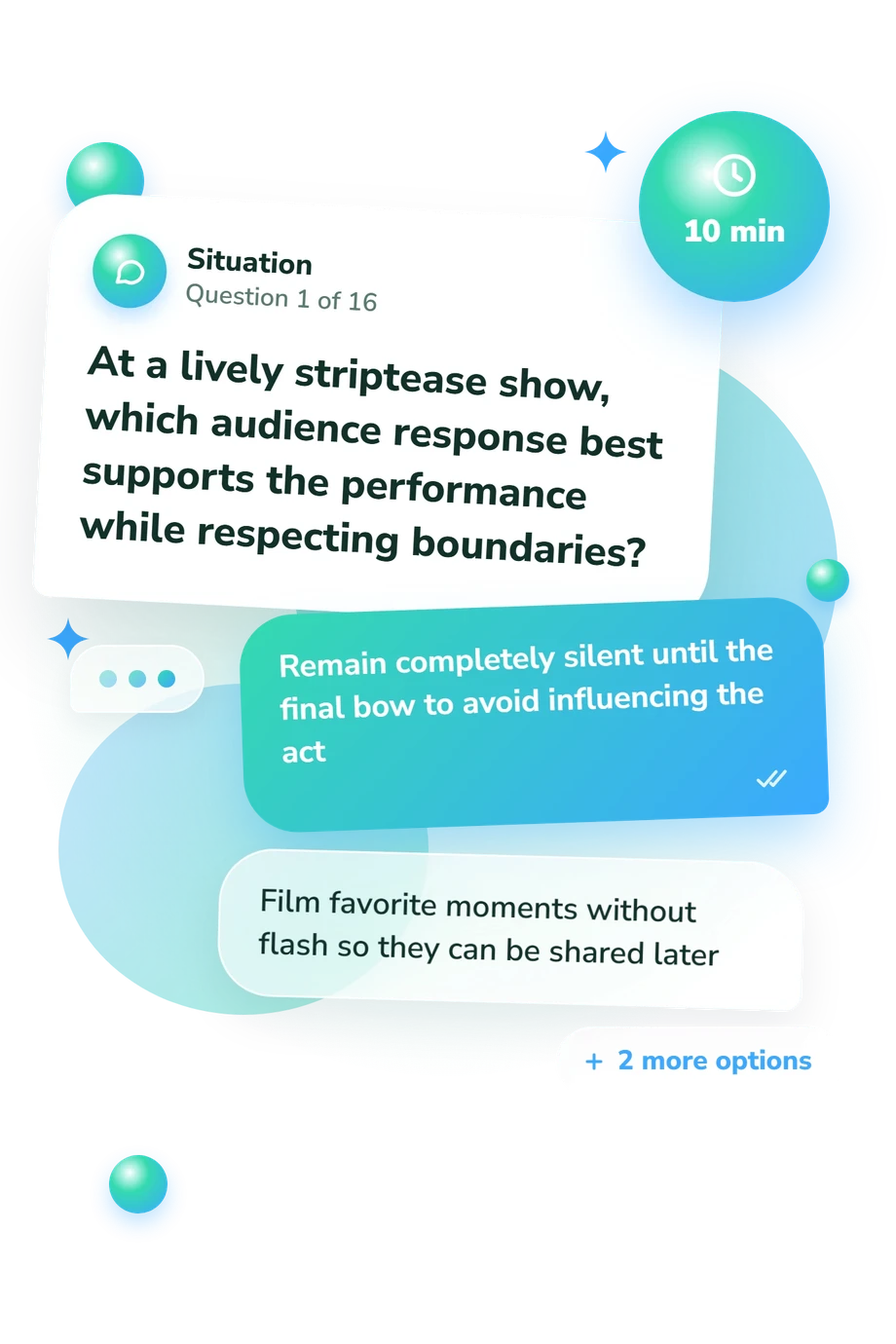
Example Questions From the Test
- Hand money directly to a performer during any part of the act
- Check the venue's policy and use only its approved tipping method
- Assume the ticket price means tipping is never appropriate
- Place money on the stage as soon as a costume piece comes off
- Adhesive grips placed under dance shoes
- Decorative coverings worn over the nipples
- Fabric panels used to repair torn stockings
- Weights sewn into the edge of a feather fan
- Closures hidden so completely that they cannot be reached onstage
- Extra stitching that permanently attaches the jacket to the shirt
- A heavier lining that slows down the removal
- Rehearsed quick-release fasteners such as snaps or hooks
Strip Quiz - Description and methodology of the test
Designed for readers who want to understand performance culture rather than test their ability to perform it, this strip quiz turns familiar scenes, terms, and etiquette choices into a focused knowledge check. It suits newcomers, offering a striptease knowledge quiz that connects historical vocabulary with practical conduct. The result places overall knowledge in a descriptive level: Foundation, Developing, or Strong.
What This Assessment Explores
The assessment measures knowledge of striptease and cabaret as staged forms, linking cultural history with respectful audience choices. It suits newcomers and audiences who want clearer performance vocabulary.
Topics include history, costume mechanics, pacing, visual devices, participation, tipping, photography, and boundaries. The questions connect how an act is built with how spectators should respond. The questions test cabaret and striptease terminology alongside audience awareness.
These groups organize it:
- Cabaret history and terminology show how well you recognize traditions, places, and forms such as neo-burlesque.
- Stagecraft and visual language show whether you understand reveals, quick-release features, fan work, and movement.
- Consent and etiquette indicate whether you identify respectful conduct around participation, recording, touching, tipping, and photography.
Strip Knowledge ranges from 0-16: Foundation (0-6), Developing (7-12), Strong (13-16). It measures knowledge, not performance or personal experience.
Methodology and Scientific Basis
Each item uses four-option multiple choice with one best answer. Some prompts test factual recognition-such as pasties, neo-burlesque, or the Moulin Rouge-while others present situations involving tipping, photography, participation, or costume handling. The questionnaire reports the knowledge result in a descriptive band; it concerns knowledge rather than skill or personal experience.
Its short, game-like format makes this an interactive striptease quiz, combining cultural knowledge with scenario judgment. Its evidence base is conceptual, not a reproduction of a published scale. Dodds (2013) is the closest source for its treatment of neo-burlesque striptease, embodiment, costume, movement, and performer-audience relations. Haley (2021) supports attention to negotiated participation and boundaries; O’Brien and Perkoski (2019) and Werner (2020) add cultural and interpretive context. The questionnaire is conceptually consistent with these works, not an adaptation of them.
The bands are descriptive levels for this question set, not established norms, and no reliability evidence is reported. A missed item may reflect terminology, history, stagecraft, or etiquette. Results can vary with prior exposure and cultural knowledge, giving a focused snapshot rather than a complete measure of understanding.
- Dodds, Sherril. "Embodied Transformations in Neo-Burlesque Striptease." Dance Research Journal, vol. 45, no. 3, 2013, pp. 75-90. 10.1017/S0149767713000016
- Haley, Claudia Jazz. The Politics of Neo-Burlesque: An Investigation into the Performer-Audience Relationship. Doctoral thesis, Sheffield Hallam University, 2021.
- O’Brien, Erin, and Bob Perkoski. Rust Belt Burlesque: The Softer Side of a Heavy Metal Town. Ohio University Press, 2019.
- Werner, Maggie M. Stripped: Reading the Erotic Body. Penn State University Press, 2020. 10.5325/jj.22247064
Updated: