
St. Mungo's Hospital Quiz
How the Scales are Structured
Who Usually Takes This Test?
See How You Compare
Below is a preview of how scores are typically distributed across each scale.
Example Questions From the Test
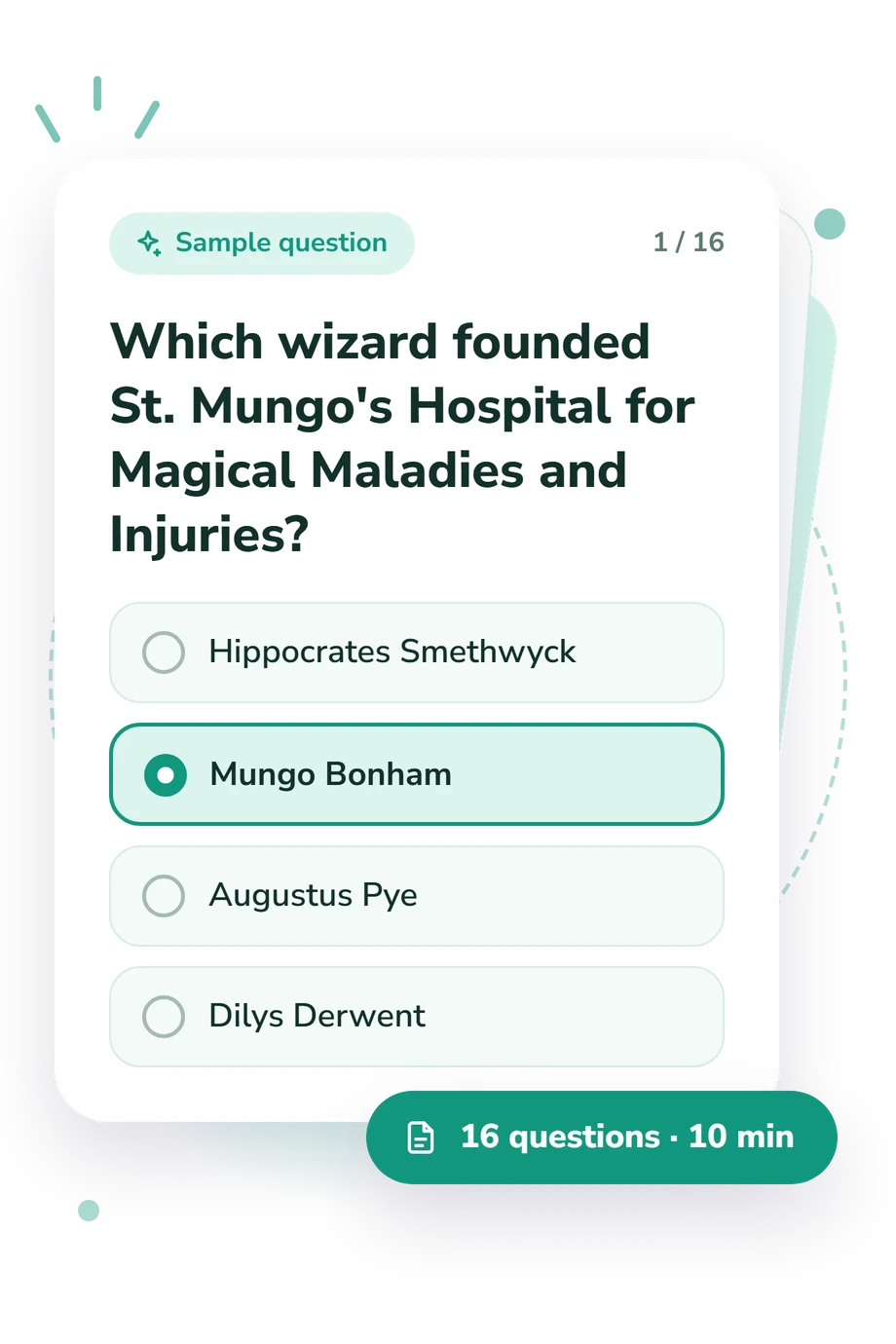
- Hippocrates Smethwyck
- Mungo Bonham
- Augustus Pye
- Dilys Derwent
- Spell Damage on the fourth floor
- Magical Bugs on the second floor
- Potion and Plant Poisoning on the third floor
- Creature-Induced Injuries on the first floor
- Creature-Induced Injuries on the first floor
- Spell Damage on the fourth floor
- Potion and Plant Poisoning on the third floor
- Artefact Accidents on the ground floor
St. Mungo's Hospital Quiz - Description and methodology of the test
For readers revisiting the hospital’s lore, the St Mungo's Hospital Quiz checks how securely they remember its people, departments, entrances, wards, and book-canon events. It suits anyone who wants a focused St Mungo's trivia quiz rather than a broad character profile. The result places overall St. Mungo’s knowledge into a broad result band, giving a clear picture of recall for this setting.
What This Assessment Explores
The questions cover St. Mungo’s founder, concealed entrance, floor plan, departments, wards, patients, and key events. Some require matching an injury or magical problem with the correct destination; others test recognition of people and scenes from the novels.
As a Harry Potter hospital quiz, it checks canon recall rather than general wizarding knowledge. Higher results indicate firmer memory of the hospital’s layout, staff, patients, and events; lower results indicate less secure overall knowledge of the hospital’s lore.
The result uses one scale, St. Mungo's Hospital Knowledge (0-16), with these bands:
- First Visit (0-6) indicates that you recognize important details but may confuse departments, people, or events.
- Capable Visitor (7-12) shows solid knowledge that lets you navigate much of the hospital’s lore.
- St. Mungo's Specialist (13-16) reflects excellent command of the layout, patients, staff, and book-canon events.
Methodology and Scientific Basis
Methodologically, each item presents four answer choices and asks for one selection. The prompts combine direct recall with applied matching: a reader may identify a founder or patient, locate the hidden entrance, or connect an injury, potion, jinx, or plant with the relevant department. This is structured canon recall, not a psychological scale.
Scoring is interpreted through the result level shown. As a St Mungo's knowledge test, the result describes performance on these fictional facts at the time of completion; it does not establish a clinical threshold or a broader measure of intelligence.
The content is conceptually consistent with Rowling (2003), Rowling’s 2005 Mungo Bonham material, and Rowling (2007), which supply the relevant book-canon facts. Helfenbein and Brown (2008) add literary context for the series’ institutional themes, but do not validate this questionnaire or its scoring. This questionnaire is an online canon-recall tool with descriptive result bands, not a standardized instrument with established norms or validation.
Performance can vary with recent rereading, familiarity with book canon, and uncertainty when memories come from the films instead, so the result works best as a focused snapshot of St. Mungo’s recall.
- Rowling, J. K. Harry Potter and the Order of the Phoenix. London: Bloomsbury, 2003.
- Rowling, J. K. “Wizard of the Month: Mungo Bonham.” J.K. Rowling’s Official Site, March 2005.
- Rowling, J. K. Harry Potter and the Deathly Hallows. London: Bloomsbury, 2007.
- Helfenbein, Robert J., and Sydney K. Brown. “Conjuring Curriculum, Conjuring Control: A Reading of Resistance in Harry Potter and the Order of the Phoenix.” Curriculum Inquiry 38, no. 4 (2008): 499-513. 10.1111/j.1467-873X.2008.00431.x
Updated: