
Skin Type Quiz
How the Scales are Structured
Who Usually Takes This Test?
See How You Compare
Below is a preview of how scores are typically distributed across each scale.
Example Questions From the Test
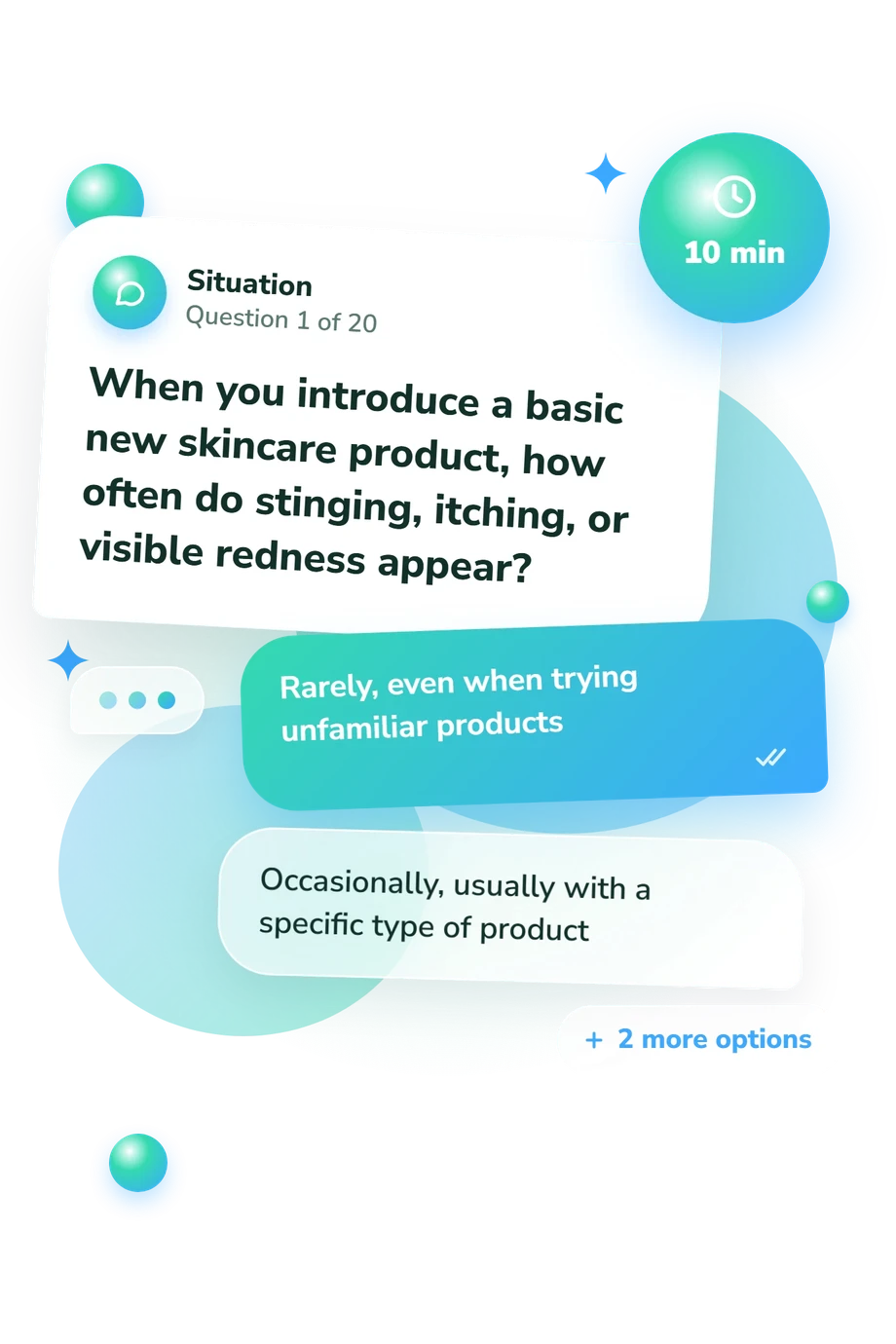
- Rarely, even when trying unfamiliar products
- Occasionally, usually with a specific type of product
- Often enough that I introduce products cautiously
- Very often, including with products marketed as gentle
- Little or no visible oil from any area
- A faint trace, mainly around the nose
- Clear oil from several areas
- Substantial oil from nearly every area tested
- Usually none; more product might feel heavy
- A small amount would sometimes improve comfort
- I often want to reapply it to several areas
- I regularly need more to relieve marked tightness or roughness
Skin Type Quiz - Description and methodology of the test
For anyone trying to understand recurring facial patterns, the skin type quiz organizes observations about shine, tightness, comfort, facial zones, and reactions to products or weather. It can also help someone asking what kind of skin do I have choose a realistic starting point for routine decisions. The result is most useful to people who want a structured profile of current tendencies rather than a permanent label.
What This Assessment Explores
Questions cover shine, tightness, flaking, facial-zone contrast, cleansing comfort, and product or weather reactions. For a reader asking what is my skin type, the profile shows whether one tendency leads or several remain close.
The five displayed affinities are:
- Balanced Skin Affinity (0-12) shows even comfort: Weak affinity 0-4; Mixed affinity 5-8; Strong affinity 9-12.
- Combination Skin Affinity (0-12) shows T-zone and cheek contrast: Weak affinity 0-4; Mixed affinity 5-8; Strong affinity 9-12.
- Dry Skin Affinity (0-12) shows tightness or flaking: Weak affinity 0-4; Mixed affinity 5-8; Strong affinity 9-12.
- Oily Skin Affinity (0-12) shows recurring shine: Weak affinity 0-4; Mixed affinity 5-8; Strong affinity 9-12.
- Sensitive or Reactive Skin Affinity (0-12) shows stinging or redness: Weak affinity 0-4; Mixed affinity 5-8; Strong affinity 9-12.
This gives the question what skin type do I have a current, pattern-based answer.
Methodology and Scientific Basis
Each item offers four ordered responses describing increasing frequency or intensity. Prompts cover oil, dryness after cleansing, zone differences, product tolerance, and reactions to weather or routine changes.
Scoring creates five separate affinity scores. The highest is strongest, while scores within one point indicate a blend; no answer-by-answer point formula is stated. Interpretation therefore rests on relative patterns.
Conceptually, the method aligns with the Baumann Skin Type Indicator (Baumann, 2008), which organizes skin description around oiliness and sensitivity. Baumann's 2016 validation study addresses questionnaire classification across ethnicities and locations, and the 2014 study examines self-report measurement of facial oiliness. This questionnaire is conceptually consistent with those works, not an adaptation of them, so their validation does not standardize its wording or scoring.
For someone reviewing what skin type do I have after a new product or seasonal shift, context and honest recall matter. Rather than fixing my skin type as a permanent label, the result is a self-reflection aid rather than a diagnosis; persistent pain, rash, cracking, or marked reactions warrant professional assessment.
- Leslie Baumann. Understanding and treating various skin types: the Baumann Skin Type Indicator. Dermatologic Clinics. 2008;26(3):359-373, vi. 10.1016/j.det.2008.03.007
- Leslie Baumann. Validation of a Questionnaire to Diagnose the Baumann Skin Type in All Ethnicities and in Various Geographic Locations. Journal of Cosmetics, Dermatological Sciences and Applications. 2016;6:34-40. 10.4236/jcdsa.2016.61005
- Leslie Baumann, Randall D. Penfield, Jennifer L. Clarke, Deysi K. Duque. A Validated Questionnaire for Quantifying Skin Oiliness. Journal of Cosmetics, Dermatological Sciences and Applications. 2014;4(2):78-84. 10.4236/jcdsa.2014.42012
Updated: