
Should I Convert to Catholicism Quiz
How the Scales are Structured
Who Usually Takes This Test?
See How You Compare
Below is a preview of how scores are typically distributed across each scale.
Example Questions From the Test
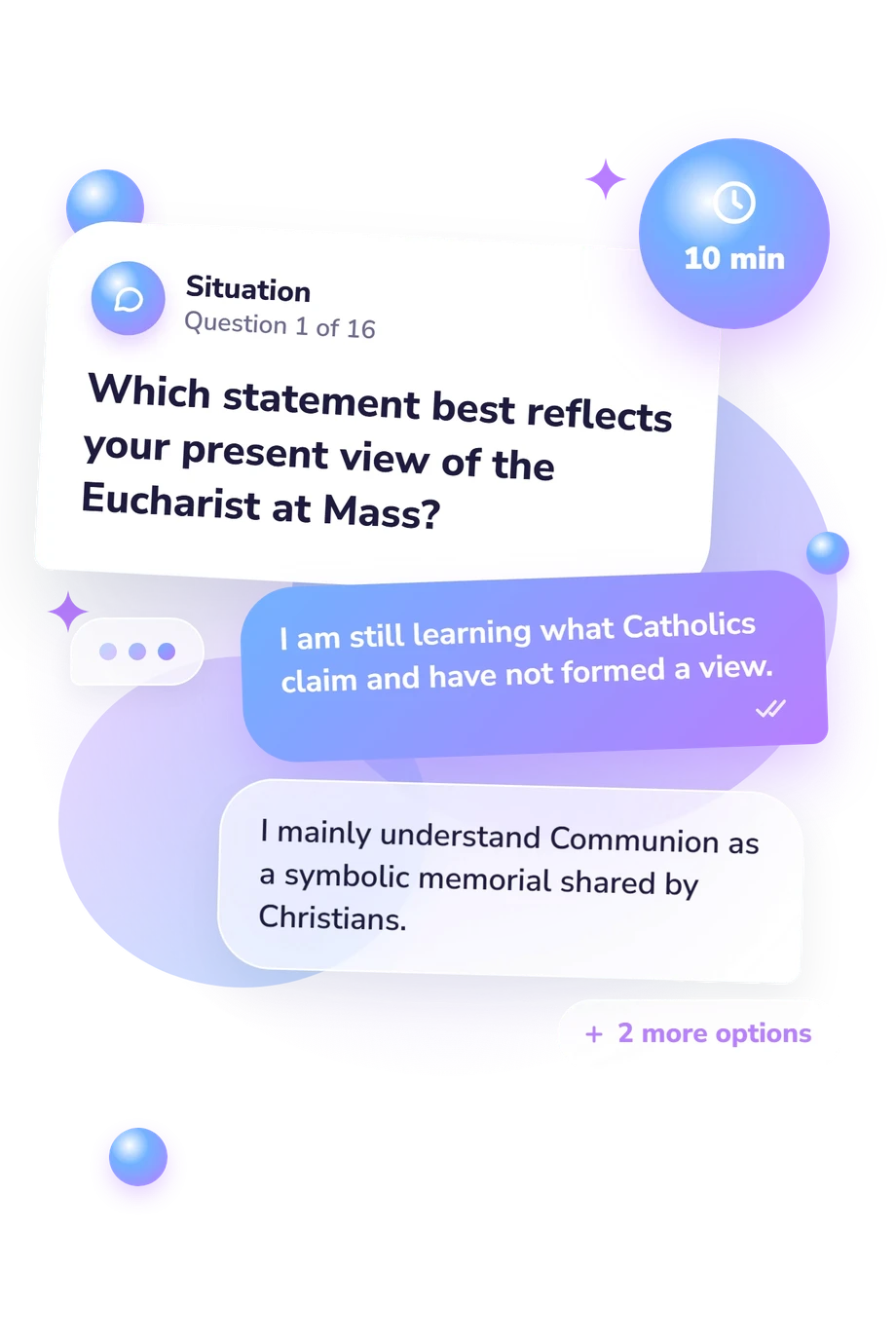
- I am still learning what Catholics claim and have not formed a view.
- I mainly understand Communion as a symbolic memorial shared by Christians.
- I am seriously considering the Catholic teaching on Christ's real presence.
- I believe, or am close to believing, the Catholic teaching on Christ's real presence.
- I would rather volunteer through a nonreligious group and keep service separate from worship.
- I might join occasionally if the schedule and project suited me.
- I would value serving regularly with people whose faith also motivates the work.
- I would see shared service as a key part of becoming rooted in parish life.
- It is interesting background but carries little weight in my religious decisions.
- It gives Catholicism cultural depth, though continuity alone does not attract me strongly.
- It offers a meaningful sense of connection with Christians across generations.
- Belonging to a living historical tradition is one of my strongest reasons for considering Catholicism.
Should I Convert to Catholicism Quiz - Description and methodology of the test
People considering conversion can use this assessment to examine spiritual attraction and Catholic teaching, treating relationship pressure as context for independent choice. The Should I Convert to Catholicism Quiz turns those concerns into a structured profile, not a yes-or-no verdict. It suits a decision that feels emotionally important but intellectually unfinished. Its result shows the relative prominence of four tendencies; this am i catholic quiz supports discernment without deciding it.
What This Assessment Measures
This assessment examines interest through truth claims, teaching authority, worship, parish belonging, historical continuity, shared identity, communal service, and deliberate choice. For someone weighing Catholic and Christian identity, this am i catholic or christian quiz shows attraction and uncertainty rather than a verdict.
The four displayed dimensions are:
- Community-and-Tradition Seeker (0-12) measures attraction to parish belonging, historical continuity, shared identity, and communal service; bands: Independently Oriented (0-4), Connection Seeking (5-8), and Community-and-Tradition Led (9-12).
- Conviction-Led Candidate (0-12) measures attraction to Catholic truth claims and teaching authority; bands: Open but Unconvinced (0-4), Meaningful Alignment (5-8), and Conviction-Led (9-12).
- Deliberate Questioner (0-12) measures preference for patient study, independent choice, and time; bands: Decision-Focused (0-4), Actively Discerning (5-8), and Inquiry-First (9-12).
- Sacramental Spiritual Seeker (0-12) measures attraction to worship, prayer, sacraments, and liturgical rhythm; bands: Observing the Practice (0-4), Spiritually Drawn (5-8), and Sacramentally Oriented (9-12).
Methodology and Scientific Basis
Each item presents four choices about a belief, practice, situation, or decision. A thematic self-report approach summarizes responses into profiles rather than one conversion score, and the exact contribution of each choice should not be inferred. For a reader comparing Catholic and Protestant commitments, this am i catholic or protestant quiz organizes the displayed tendencies without assigning an identity.
The questionnaire’s themes are conceptually consistent with Longhurst’s study of contemporary people considering entry into Catholicism and Yamane’s account of becoming Catholic as a process involving belief, practice, community, and identity. It is not an adaptation of either work.
Interpret the result as a map for reflection. In this christian or catholic quiz, the displayed profile can show whether doctrine, sacramental life, belonging, or careful inquiry deserves attention next. The displayed bands are descriptive profiles of present response patterns. Because this is an online self-report, scores may shift with relationships, mood, pressure, and familiarity with Catholic ideas. Use them to identify what merits further study and make a deliberate, unpressured decision.
- Longhurst, Susan. “Who Joins the Catholic Church and Why?” A Case Study of Contemporary Britons Seeking to Become Catholic in the Archdiocese of Southwark. In Christianity in Britain Since 1914, edited by David Goodhew and Mark Smith, pp. 285-310. Palgrave Macmillan, 2024. 10.1007/978-3-031-71311-8_13
- Yamane, David A. Becoming Catholic: Finding Rome in the American Religious Landscape. Oxford University Press, 2014. 10.1093/acprof:oso/9780199964987.001.0001
- Tevington, Patricia, and Gregory A. Smith. 47% of U.S. Adults Have a Personal or Family Connection to Catholicism. Pew Research Center, June 16, 2025.
Updated: