
Sentence Structure Quiz
How the Scales are Structured
Who Usually Takes This Test?
See How You Compare
Below is a preview of how scores are typically distributed across each scale.
Example Questions From the Test
- The rain stopped; because the children wanted to return outside.
- The rain; stopped before the children returned to the playground.
- When the rain stopped; the children returned to the playground.
- The rain stopped; the children returned to the playground.
- Because the roads were icy, the school opened late.
- The roads were icy; however, the school opened late.
- The roads were icy, and the school opened late.
- The school opened late, but the roads were icy.
- The laptop arrived, and I opened the box.
- The new laptop arrived today.
- The laptop that I ordered arrived today.
- The laptop arrived with its charger and case.
Sentence Structure Quiz - Description and methodology of the test
Students, writers, and English learners can use this sentence structure quiz to examine how they recognize and assemble clauses in context. It is especially useful when you want to distinguish a gap in sentence analysis from a punctuation mistake. An English sentence-structure quiz can point to skills worth practising, but its result remains a focused snapshot rather than a complete measure of writing.
What This Assessment Explores
The assessment examines how clauses combine and how punctuation signals their relationships. Items classify sentence types, distinguish independent, dependent, and relative clauses, select conjunctions, and repair fragments or comma splices. It suits readers seeking feedback for editing or deliberate sentence building. An identifying quiz for sentence structure checks recognition rather than extended writing.
The question themes cover four abilities:
- Clause recognition shows whether you can separate complete thoughts from dependent structures.
- Sentence classification indicates how clause patterns map to common sentence types.
- Conjunction choices show whether you can express contrast, cause, time, or coordination.
- Punctuation and revision reveal whether you can join or separate clauses correctly.
Sentence Structure Knowledge summarizes performance across these areas. Scores from 0-16 are shown as Foundations to Review (0-6), Developing Command (7-12), or Strong Command (13-16). These bands describe sentence-structure knowledge, not overall writing ability.
Methodology and Evidence Base
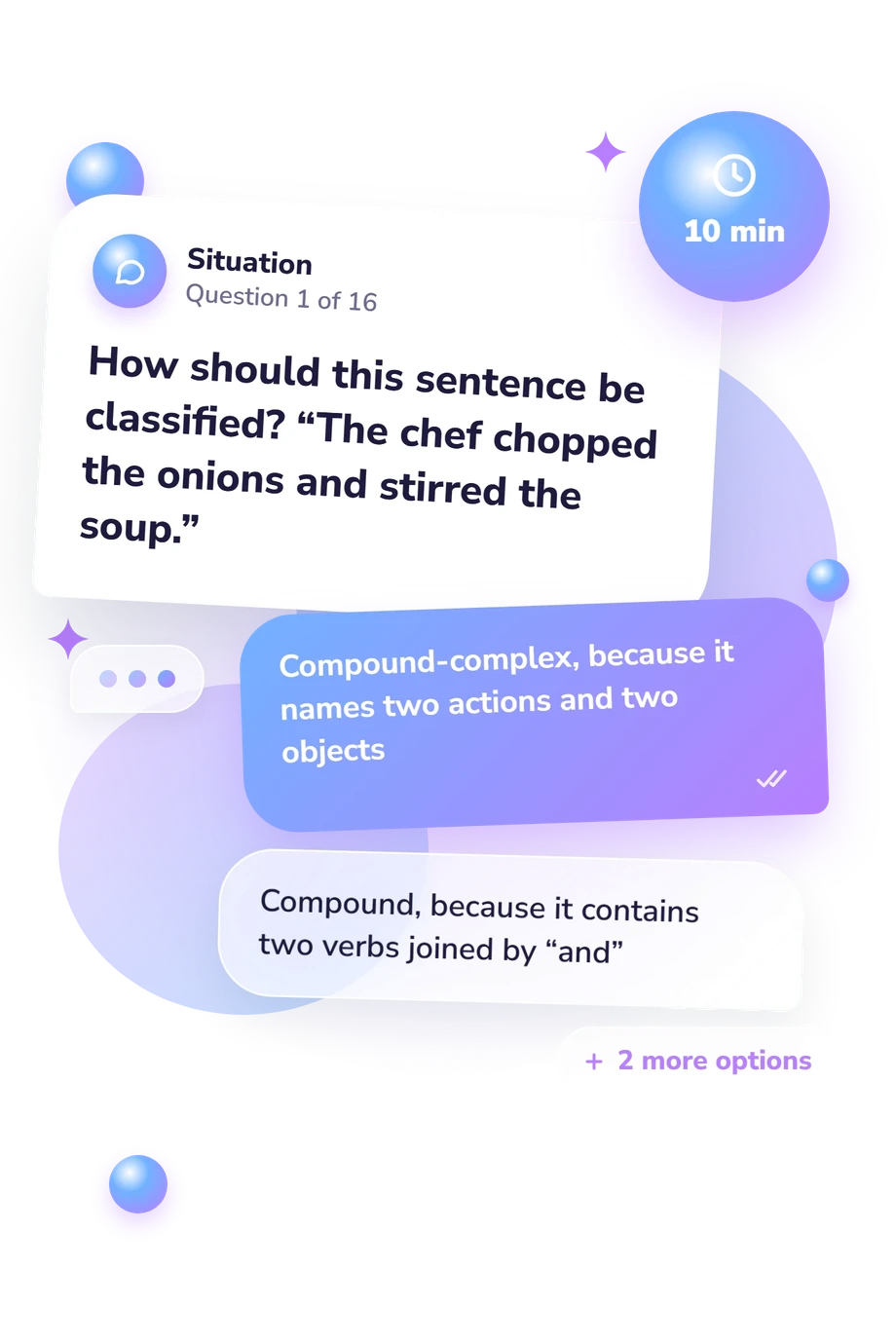
Each item uses four-option multiple-choice. Questions ask you to classify sentences or count clauses, choose conjunctions and punctuation, identify complete sentences, or select a revision that meets a grammatical requirement. This format tests recognition and application in short contexts rather than extended composition.
Conceptually, the questionnaire is consistent with the Sentence Structure Knowledge Test (Bouirane, 2018), but it is not presented as an adaptation or validated edition of that instrument. Dhadhodara and Joshi (2020) relate grammatical and sentence-structure knowledge to reading comprehension; this does not make an individual score predictive. Currie and Chiramanee (2010) show that multiple-choice item format can influence measurement of language-structure knowledge.
A sentence-structure practice quiz like this is an educational profile of familiar skills. The result summarizes selected responses as one educational score and may be affected by attention, test-taking strategy, prior instruction, and item wording. Its bands are educational summaries, not standardized norms, and it does not capture originality, fluency, organization, or longer-passage quality. Use the result to choose what to review, then check those skills in your own writing.
- Ahlam Bouirane. (2018). Evaluating the efficiency of a pattern integration approach in grammar teaching: Towards a revisited grammar teaching paradigm. International Journal of Research Studies in Language Learning, 7(1), 91-100. 10.5861/ijrsll.2017.1684
- Nitinkumar Dhadhodara, & Bharat Joshi. (2020). The Relationship of Grammatical Knowledge and Sentence Structure Knowledge with Cloze Test Based Reading Comprehension. Voices of Teachers and Teacher Educators, 9(2), 22-28.
- Michael Currie, & Thanyapa Chiramanee. (2010). The effect of the multiple-choice item format on the measurement of knowledge of language structure. Language Testing, 27(4), 471-491. 10.1177/0265532209356790
Updated: