
Royal Family Quiz
How the Scales are Structured
Who Usually Takes This Test?
See How You Compare
Below is a preview of how scores are typically distributed across each scale.
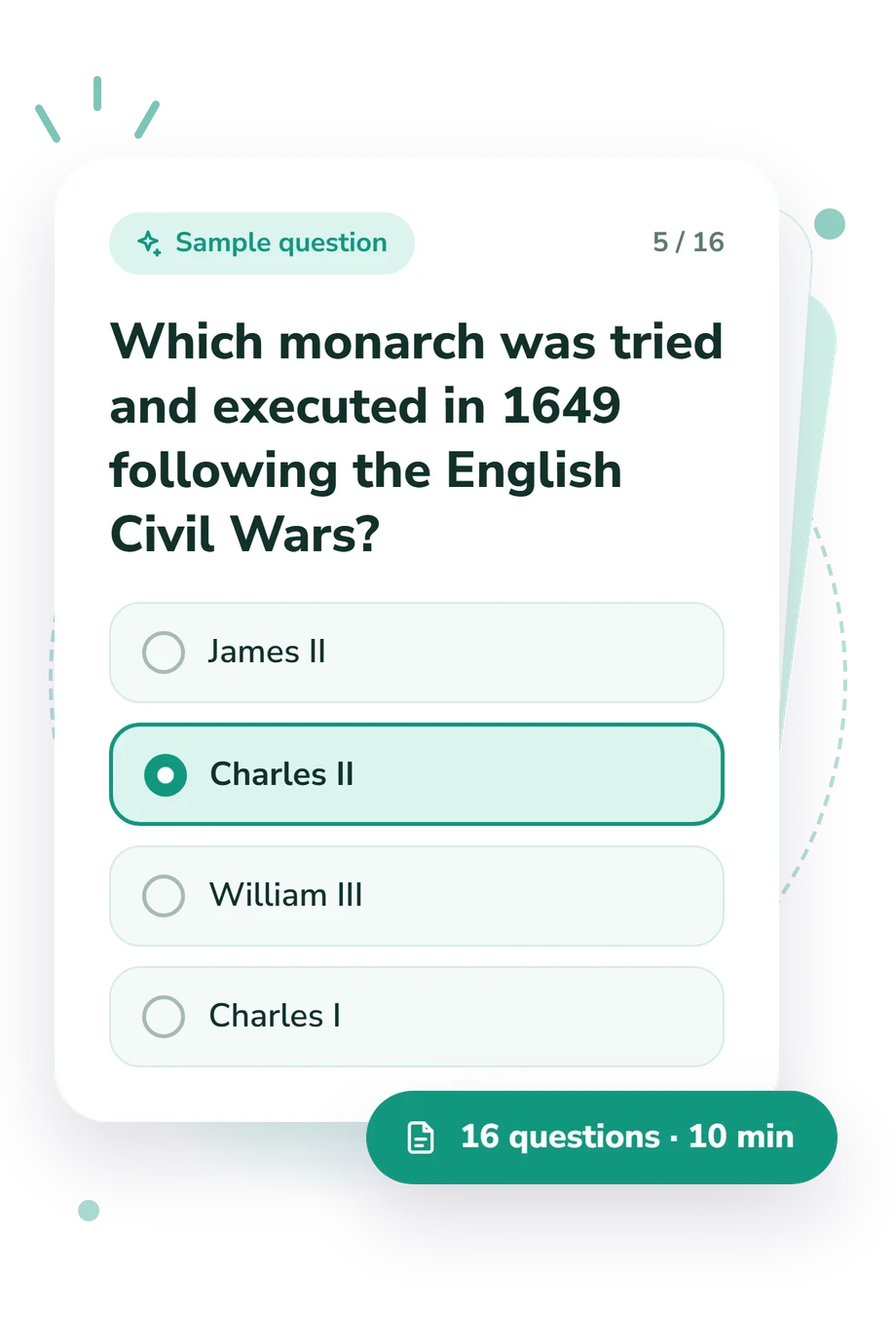
Example Questions From the Test
- George V
- Edward VIII
- George VI
- Edward VII
- Elizabeth I
- Mary I
- Anne
- Mary II
- Windsor
- Hanover
- Mountbatten
- Stuart
Royal Family Quiz - Description and methodology of the test
Anyone curious about Britain’s monarchy can use this assessment to check how confidently they connect rulers, dynasties, laws, and turning points. Taking the royal family quiz gives a focused picture of historical knowledge rather than a personality profile. This short royal quiz suits learners, history enthusiasts, and readers who want a structured way to recognize familiar periods and choose topics for further study.
What This Assessment Measures
The assessment examines historical knowledge through recognition and connection. It asks you to identify monarchs, place reigns in time, distinguish royal houses, and understand how constitutional milestones shaped Crown-Parliament relations. This royal trivia quiz asks respondents to match people, events, and institutions with their historical contexts.
The main groups are:
- Monarchs and reigns show whether you connect rulers with dates and defining decisions.
- Dynasties, succession, and major events show whether you follow competing houses, accessions, wars, and unions.
- Constitutional history measures your understanding of royal limits, parliamentary power, and Protestant succession.
Your result appears on the British Royal Family Knowledge scale, which measures how accurately you connect monarchs, events, royal houses, and constitutional developments across British history. Scores run 0-16: Foundations to build (0-6), Developing knowledge (7-12), and Strong knowledge (13-16). These bands describe performance on this content.
Methodology and Evidence Base
Each item presents a historical prompt with four answer choices. One point is awarded for each correct response, and the total is interpreted through the displayed result categories. Different factual errors in quiz answers about Britain’s royal family share one score; this cannot identify what caused a knowledge gap.
The content is conceptually consistent with Cannon and Griffiths (1998) on monarchs, dynasties, and institutional change. Bogdanor (1997) supplies constitutional context for the Crown, government, and parliamentary confidence; the Bill of Rights 1689 and Act of Settlement 1701 support specific items on royal limits and succession. The questionnaire is not an adaptation of these publications but uses them as reference points for the historical content assessed.
Because familiarity with British history shapes performance, questions in this quiz about the royal family depend on factual recall, wording, and prior education, so guessing can affect results. The displayed bands are descriptive categories for this questionnaire, not population norms. A strong score indicates accurate performance on these items, not complete coverage of British royal history; use the result to identify subjects for further study.
- Cannon, John, and Ralph Alan Griffiths. The Oxford Illustrated History of the British Monarchy. Revised edition. Oxford University Press, 1998.
- Bogdanor, Vernon. The Monarchy and the Constitution. Oxford University Press, 1997. 10.1093/0198293348.001.0001.
- Parliament of England. An Act Declaring the Rights and Liberties of the Subject, and Settling the Succession of the Crown (Bill of Rights 1689). Parliamentary Archives, 1689.
- Parliament of England. An Act for the Further Limitation of the Crown, and Better Securing the Rights and Liberties of the Subject (Act of Settlement). Parliamentary Archives, 1701.
Updated: