
Movie Picture Quiz
How the Scales are Structured
Who Usually Takes This Test?
See How You Compare
Below is a preview of how scores are typically distributed across each scale.
Example Questions From the Test
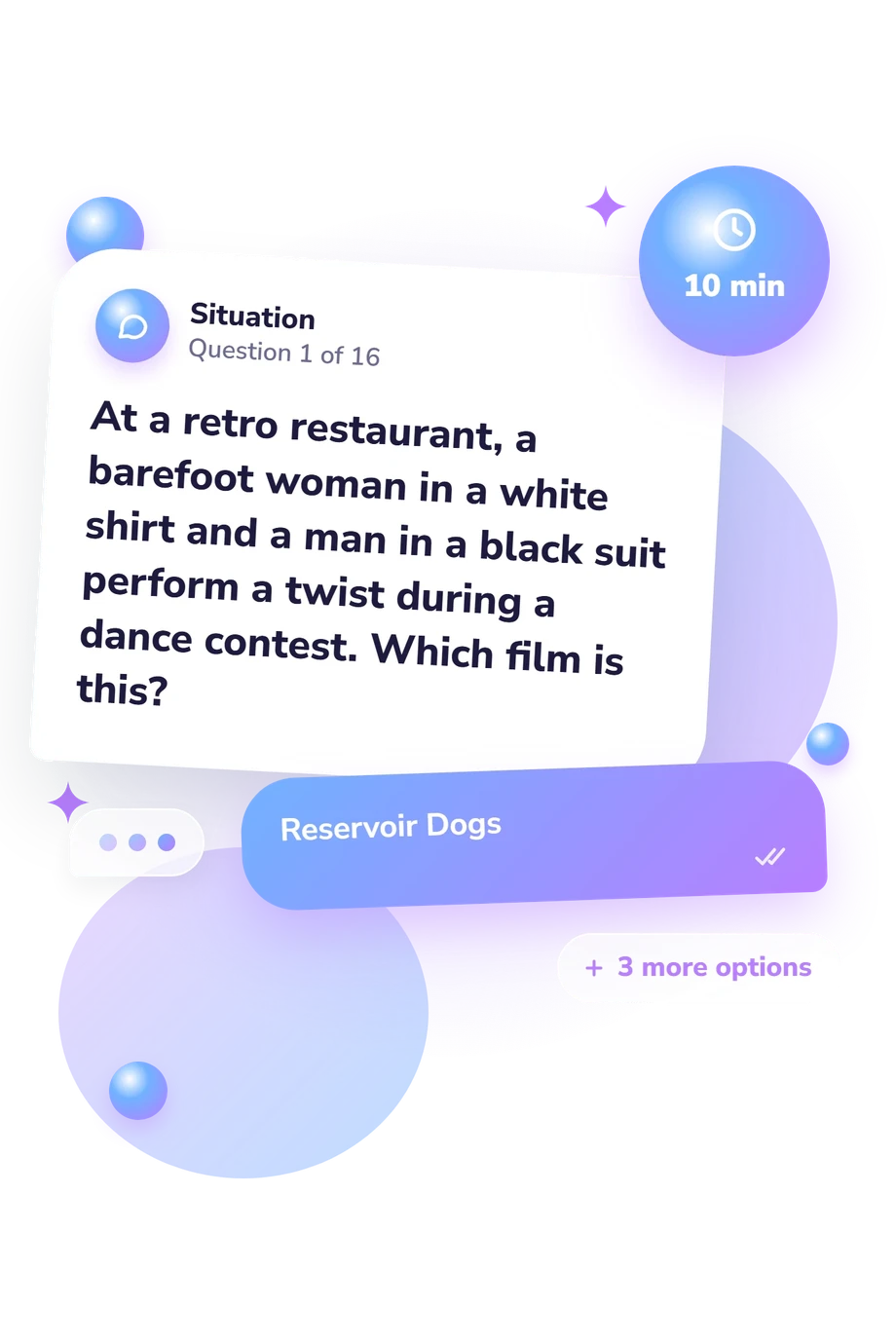
- Reservoir Dogs
- Saturday Night Fever
- Grease
- Pulp Fiction
- The Others
- Poltergeist
- The Shining
- The Omen
- E.T. the Extra-Terrestrial
- Flight of the Navigator
- The NeverEnding Story
- Explorers
Movie Picture Quiz - Description and methodology of the test
Whether you enjoy classic Hollywood, animation, science fiction, or modern blockbusters, the movie picture quiz offers a focused way to test visual film memory. Its picture-led format lets viewers take a guess-the-film quiz by picture, making the task accessible to people who recognize scenes, props, or compositions and want to measure how accurately they connect visual scenes with film titles. The result gives a concise snapshot of cinema-image knowledge.
What This Assessment Explores
Visual recognition is the central ability here: can you connect a distinctive frame to its film from visual scene clues and multiple-choice titles? The items draw on settings, costumes, compositions, creatures, vehicles, and memorable moments across genres and decades. It suits viewers who want to see how visual memory supports title recognition.
The main thematic groups are:
- Classic drama and suspense test recognition of settings, performances, and visual motifs.
- Fantasy and animation measure recall of distinctive worlds and character situations.
- Science-fiction, action, and adventure test memory for spectacle, vehicles, and familiar compositions.
Movie Picture Knowledge runs from 0-16, with one point for each correctly identified film. Scene Spotter Starter covers 0-6, Developing Frame Reader 7-12, and Screen-Scene Expert 13-16. These bands describe performance on this particular set of movie quiz images, not total film expertise.
Methodology and Evidence Base
Each question pairs a visual film moment with four answer choices, making it a guess-the-movie-picture quiz with answers. Choosing the matching title adds one point.
The approach is closest to visual scene and story-understanding research. MovieCLIP treats movie scenes as recognizable visual units, while MovieQA demonstrates how question-and-answer formats can test understanding of film content. Film Art contributes vocabulary for framing, editing, mise-en-scène, and other features that make images memorable. The questionnaire is conceptually consistent with these sources, which do not establish validation, standardization, or population norms for this quiz.
The scoring is transparent but narrow. The score reports how many titles you identified in this selection, not a population norm. Film familiarity, cultural exposure, image quality, genre preference, and chance can affect performance, so each band is best read as a snapshot of visual film recognition rather than a fixed ability.
- Digbalay Bose, Rajat Hebbar, Krishna Somandepalli, Haoyang Zhang, Yin Cui, Kree Cole-McLaughlin, Huisheng Wang, and Shrikanth Narayanan. (2023). MovieCLIP: Visual Scene Recognition in Movies. Proceedings of the IEEE/CVF Winter Conference on Applications of Computer Vision (WACV), 2082-2091. 10.1109/WACV56688.2023.00212
- Makarand Tapaswi, Yukun Zhu, Rainer Stiefelhagen, Antonio Torralba, Raquel Urtasun, and Sanja Fidler. (2016). MovieQA: Understanding Stories in Movies through Question-Answering. Proceedings of the IEEE Conference on Computer Vision and Pattern Recognition (CVPR), 4631-4640. 10.1109/CVPR.2016.501
- David Bordwell, Kristin Thompson, and Jeff Smith. (2020). Film Art: An Introduction, 12th edition. New York: McGraw-Hill Education. ISBN 9781260056082
Updated: