
Close Up Picture Quiz
How the Scales are Structured
Who Usually Takes This Test?
See How You Compare
Below is a preview of how scores are typically distributed across each scale.
Example Questions From the Test
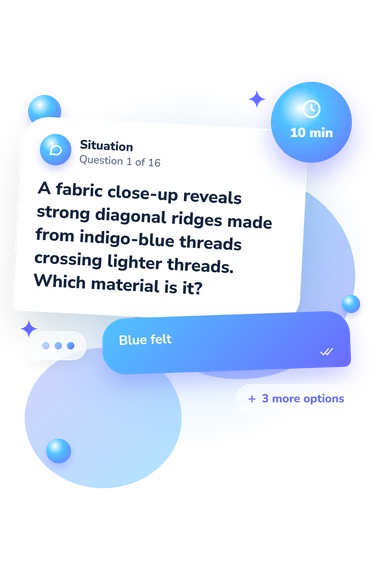
- Blue felt
- Denim
- Satin
- Fleece
- A wax crayon
- A charcoal stick
- A wooden graphite pencil
- A metal stylus
- An onion
- A leek
- A potato
- A cabbage
Close Up Picture Quiz - Description and methodology of the test
Curious readers who want to reflect on how they approach visual identification may find this test useful: its close up picture quiz with answers format gives each clue several alternatives to consider. Close up photos quiz the eye here, giving the questionnaire a focused way to notice whether attention, elimination, or familiarity shapes a response. It is intended for anyone seeking an accessible self-reflection exercise.
What This Assessment Explores
The questions focus on recognition from partial visual evidence. Textures, repeated structures, surface markings, material signatures, and distinctive edges help separate plausible answers. The test is a what is it close up picture quiz built around a close-up identification task, linking each clue with an object, natural surface, or visual technology.
The resulting profile reflects how well you extract identity from limited detail. Its close up picture quiz format suits curious adults, students, hobbyists, and anyone who enjoys observation without specialist training.
The displayed scale is Close-Up Picture Knowledge, scored from 0-16. It groups results as follows:
- Emerging Observer (0-6) indicates that distinctive clues were recognized, while many cropped-view details remained difficult.
- Developing Detective (7-12) shows that textures, structures, and patterns connect with familiar objects, while finer distinctions remain developing.
- Close-Up Expert (13-16) reflects consistent identification from small-scale visual evidence and related clues.
Methodology and Evidence Base
Each item presents a cropped or magnified clue with four answer choices. The forced-choice response requires you to select the option that best matches the observed texture, geometry, layering, or object part. Performance is summarized as one overall score, not separate trait scores.
Close up pictures of everyday objects quiz your eye alongside clues from natural surfaces and visual technology, testing material appearance, component arrangement, biological structure, and manufacturing patterns. The single score reflects the number of correct identifications across the questionnaire.
Recognition-by-components theory, described by Biederman (1987), provides a compatible framework in which parts and their arrangements support object identification. Pattern completion discussed by Tang and colleagues (2018) fits tasks that require incomplete visual information to be resolved. Sharan, Rosenholtz, and Adelson (2014) is the closest source for categorizing materials from visual cues; this quiz is consistent with that work, not an adaptation or validation of it.
Familiarity with pictured objects, momentary attention, and ambiguous or unfamiliar clues can affect performance; interpret the result as a snapshot of correct identifications in this task.
- Sharan, Lavanya, Ruth Rosenholtz, and Edward H. Adelson. 2014. "Accuracy and speed of material categorization in real-world images." Journal of Vision 14(9): 12, 1-24. 10.1167/14.9.12
- Tang, Hanlin, Martin Schrimpf, William Lotter, Charlotte Moerman, Ana Paredes, Josue Ortega Caro, Walter Hardesty, David Cox, and Gabriel Kreiman. 2018. "Recurrent computations for visual pattern completion." Proceedings of the National Academy of Sciences 115(35): 8835-8840. 10.1073/pnas.1719397115
- Biederman, Irving. 1987. "Recognition-by-components: a theory of human image understanding." Psychological Review 94(2): 115-147. 10.1037/0033-295X.94.2.115
Updated: